Full Front Lever: How to Learn It
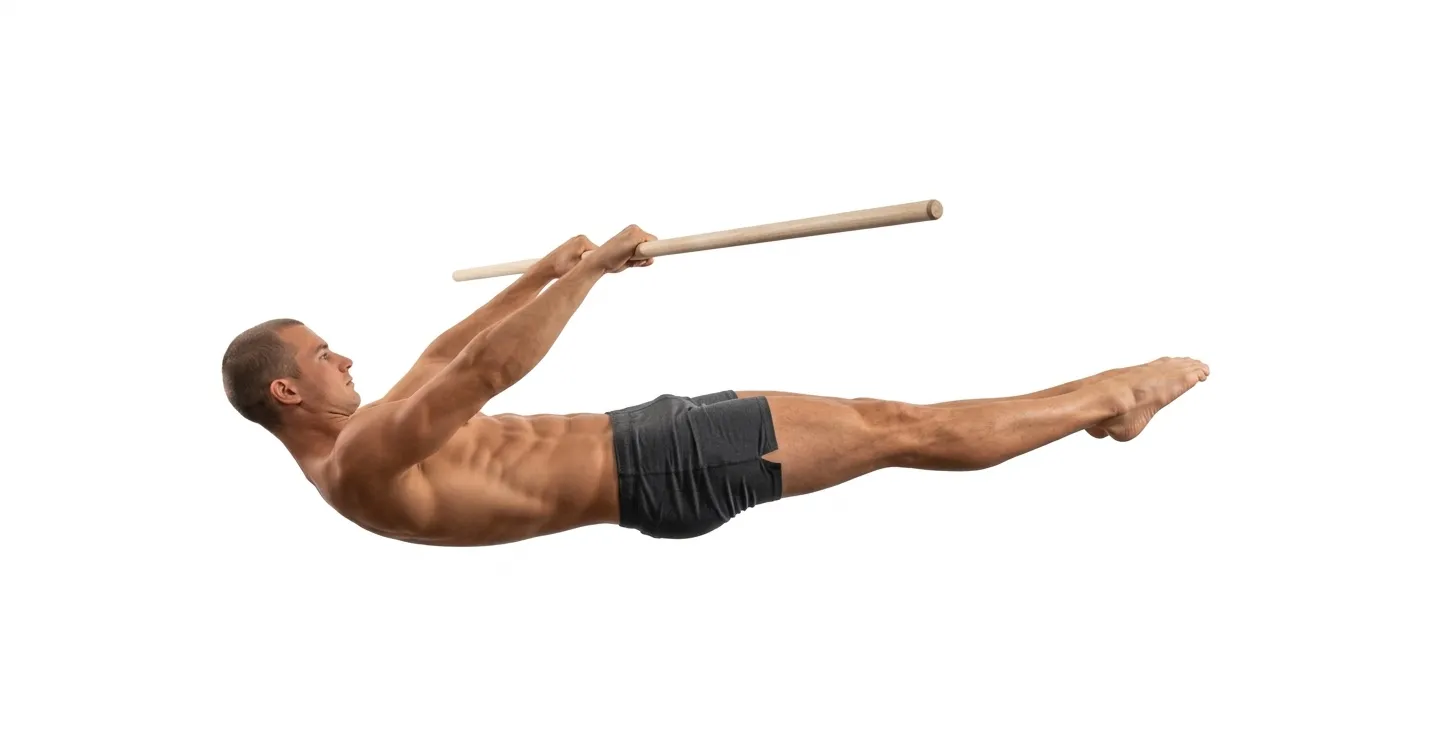
The full front lever is a horizontal pulling isometric that demands near-total lat recruitment, rigid full-body tension, and precise scapular control — simultaneously. Reaching it signals that you have built pulling strength most gym athletes never develop, and it unlocks a family of straight-arm dynamics that sit at the top of the Overcoming Gravity progression system.
What Is the Full Front Lever?
In the full front lever, you hang from a bar or rings with your arms straight overhead and hold your body perfectly horizontal — a rigid, straight line from pointed toes through hips, spine, and shoulders. There is no pike, no tuck, no sagging at the hips: the entire body floats parallel to the floor, suspended entirely by straight-arm lat force.
It belongs to the Front Lever branch of the Overcoming Gravity system, a vertical pulling progression that builds straight-arm horizontal pulling strength from the tuck hold all the way to circle front levers. In gymnastics, the full front lever carries an A-level rating in the Code of Points — the entry point for competitive difficulty. The primary movers are the latissimus dorsi, teres major, and pectoralis major, with the entire posterior chain and core bracing isometrically to keep the body line rigid.
Prerequisites
Before training the full front lever, you need to demonstrate: Half Layout Front Lever for 3 sets × 30 seconds.
The half layout — legs together with a slight pike at the hips — is the direct mechanical precursor to the full position. The pike reduces the lever arm just enough to make 30-second holds achievable, and those holds prove you have built the lat strength and full-body tension patterning needed to then eliminate the remaining pike. Skipping this step and jumping to full attempts produces sagging, which does not build front lever strength — it just builds a sagging front lever.
Additionally, Steven Low's Overcoming Gravity recommends completing back lever training before seriously pursuing the front lever. The back lever develops posterior shoulder tissue tolerance and overall connective tissue resilience in the shoulder girdle that carries directly into straight-arm pulling. Treating front lever as an isolated goal without that connective tissue base is a recipe for biceps tendon or shoulder irritation.
The Progression Chain
The tuck-to-full sequence is fundamentally a lever arm extension problem. From tuck front lever (knees at chest, short lever), each step extends the body further from the bar — advanced tuck, straddle, half layout, full — multiplying the torque the lats must resist at the shoulder. By the time you hold the full position, you are managing the maximum lever arm your body can produce. The next step, the front lever pull to inverted hang, keeps that lever arm and adds concentric movement: the lats must now not only sustain horizontal position but accelerate the body upward with straight arms, demanding a significantly higher peak force output.
Sets, Reps, and Training Frequency
Progression standard: 3 sets × 30 seconds hold
Front lever is a strength exercise — not skill work. It belongs in the strength section of your routine and should be trained 2–4 times per week, with 3–5 minutes of rest between sets. At this level, rest time is not optional: straight-arm isometrics tax the connective tissue heavily and sub-maximal rest produces junk volume, not adaptation.
Build toward 30-second holds by accumulating total time at the full position. A practical structure: attempt the full hold for as long as form holds, drop immediately when the body line breaks, rest fully, repeat. Three sets totaling 30–45 seconds of quality hold time per session is enough stimulus; grinding through broken-form holds does not count. Quality beats duration every time.
For time efficiency, Overcoming Gravity recommends pairing front lever with planche work in alternating sets — both are straight-arm isometrics, the rest for one doubles as active rest from the other, cutting total session time roughly in half without compromising performance.
Warm up with a progression 2–3 levels below your current work — tuck or advanced tuck holds for 10–15 seconds. This primes the scapular depressors and shoulder complex without pre-fatiguing them for the main sets. Dragon flags also serve as an effective warm-up and supplementary exercise if you have residual torso weakness affecting the hold.
Coaching Cues
- Straight line head to toes — Any deviation — a dropped hip, a slight pike — reduces the training stimulus and masks weakness. Before every attempt, create full-body tension: squeeze glutes, brace core, point toes, lock ankles together. Enter the hold already rigid rather than trying to tighten up once you're horizontal.
- Maximum lat engagement — The operative feel is pressing the bar toward your feet rather than pulling your body up. This lat-loading cue keeps the scapulae depressed and retracted (they end in a depressed-and-neutral position due to the required force output) and prevents the hips from sagging below the shoulder line. If you feel the position mainly in your biceps, the lats are not firing correctly.
- Point toes, tight body — Pointed toes are not aesthetic — they cue glute engagement and lock the kinetic chain from ankle to hip. Pressing the ankles together prevents any hip rotation from propagating into a body twist. Any looseness at the lower end will manifest as a visible twist or drop within seconds.
Common Mistakes
- Rounding the back and shoulders to compensate. The single most common flaw. Rounding gives a mechanical advantage that allows a longer hold, but it trains a rounded front lever, not a straight one. Use a camera or training partner to verify your line before counting any hold toward your target time.
- Holding past form failure. A 5-second clean hold builds more strength than a 20-second sagging hold. The moment body line breaks, the set is over. Counting time in a failed position is one of the main reasons athletes plateau in front lever for months without progress.
- Skipping full scapular engagement at entry. Entering the hold from a passive hang without actively depressing and retracting the scapulae first causes the shoulders to immediately roll forward under load. Pull the scapulas down and together before you lift into position.
- Insufficient full-body tension before the hold. Many athletes get into the horizontal position and then try to tighten up. By the time tension propagates through the chain, the hips have already dropped. Set every brace point — glutes, core, lats, pointed toes — before the hold begins, not after.
- Progressing too fast through the earlier positions. Athletes who rush from straddle to full without genuine 30-second straddle or half-layout holds routinely find themselves stuck at the full position for months. Each step in the chain must be genuinely mastered; the holds are not arbitrary checkboxes but connective tissue conditioning milestones.
Prehab and Longevity
The front lever is a high-stress straight-arm exercise. As Steven Low notes in Overcoming Gravity, straight-arm work — front lever, back lever, planche — puts exceptional demand on the connective tissues of the shoulders, elbows, and wrists. Muscles adapt faster than tendons and ligaments; the primary failure mode is that athletes gain the raw strength to hold the position before the connective tissue can safely sustain it at volume.
The most effective prehab intervention is rings-turned-out (RTO) support holds: hang in a support position on rings, palms forward, and hold for 30–60 seconds. This places the biceps tendons and shoulder internal rotators under controlled isometric load in a position directly relevant to front lever mechanics. Add 1–3 sets at the start of every pulling session. Progress by rotating the palms to face further forward over time.
For the shoulder specifically, front lever responds well to supplementary posterior shoulder and rotator cuff work — external rotation exercises and scapular pulls (hanging shrugs where you depress the scapulae without bending the elbows). These strengthen the posterior shoulder musculature that is undersized in most athletes and that the full front lever directly taxes.
If you experience elbow irritation during front lever training, switching from a fixed bar to gymnastic rings allows free rotation at the wrist and elbow, which often resolves training-provoked tendinopathy by removing the fixed motion pattern that aggravates the joint. Reduce volume before increasing it again; do not train through acute pain.
BodyTree tracks your progression through all 228 calisthenics skills — from your first push-up to a full planche. Automatically generated programs, video proof, and a community of serious practitioners.
Get BodyTree — Free on iOS & Android