Full Back Lever: How to Learn It
The full back lever is the benchmark horizontal pulling isometric that separates serious calisthenics athletes from everyone else. Achieving a clean, locked-out back lever proves you have built the posterior shoulder strength — lats, teres major, rear delts — that most ring training skips entirely, and it lays the structural groundwork for the iron cross and advanced ring pulling work that follows.
What Is the Full Back Lever?
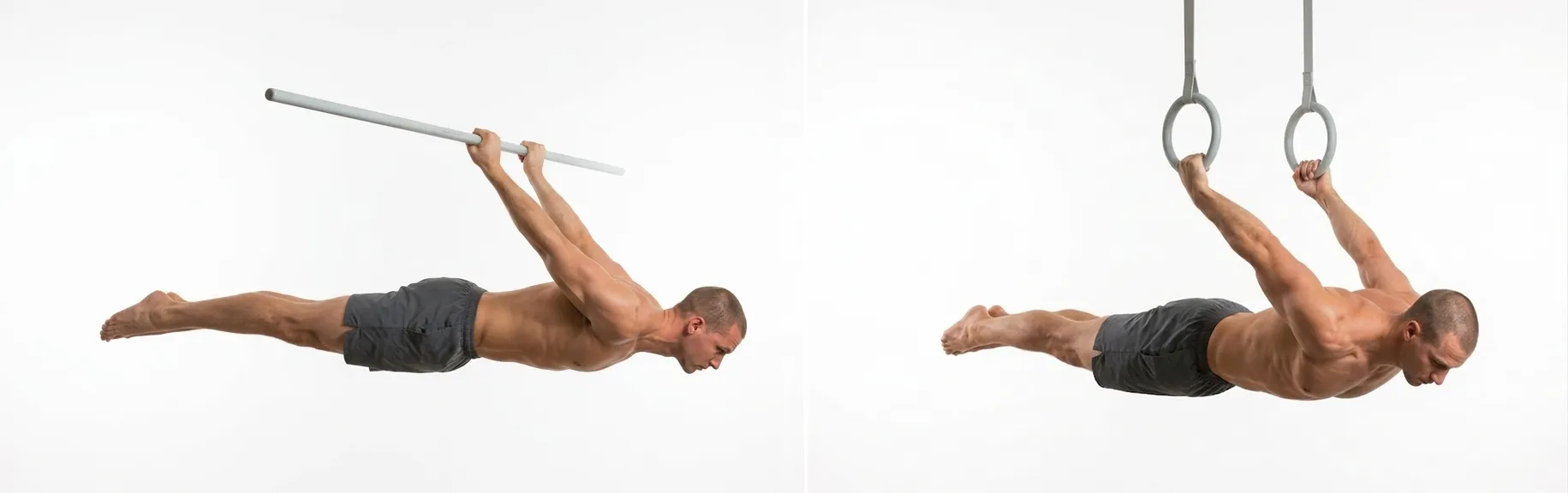
The back lever is a rings isometric hold in which the athlete hangs face-down, body completely horizontal, arms locked straight overhead, hands gripping the rings behind the body. The shoulder joint is driven into extreme shoulder extension — the opposite end of the range of motion from a front lever. In the Overcoming Gravity system, the full back lever sits at Level 7 of the Back Lever branch, which progressively develops shoulder extension range and posterior shoulder strength from German hang through to the dynamic handstand lower.
Unlike handstands or L-sits, the back lever is strength work, not skill work. There is no balance component — the entire demand is muscular and connective tissue strength in a fully extended shoulder position. Steven Low is explicit in Overcoming Gravity: "The planche, front lever, and back lever are incorporated into a routine in order to develop the strength to effectively perform the movements. The proper place for these exercises is in the strength portion of your routine."
Prerequisites
Before training the full back lever, you need to demonstrate: Half Layout Back Lever held for 3 sets × 30 seconds.
The half layout — legs together but with a slight pike — reduces the lever arm just enough to keep the hold manageable while exposing the shoulder and elbow to the full structural demand of the position. Skipping it and jumping directly to a full layout is the single most common reason athletes develop elbow pain in back lever training: the connective tissue hasn't had time to accumulate the density it needs to handle a fully extended position under load.
The Progression Chain
Moving from half layout to full layout closes the slight knee bend and pike, pushing the center of mass further from the rings and increasing the rotational demand on the shoulder extensors dramatically. The leverage change is significant even though the position looks small from the outside. Once the 3×30s full back lever is achieved, the next step is the Back Lever Pullout — a dynamic straight-arm pull from the back lever position up through to an inverted hang, which converts the isometric base into pulling strength.
Sets, Reps, and Training Frequency
Progression standard: 3 sets × 30 second hold
Back lever responds well to accumulation-based isometric programming. Start with the longest hold duration you can currently achieve in good position — often 8–15 seconds early on — and build toward 30 seconds using linear hold progression: add one second to each set each session. When all three sets reach 30 seconds, you advance to the next progression.
An alternative method that works exceptionally well for the back lever is Grease the Groove (GTG). Because the back lever does not fatigue the system as deeply as the planche, you can perform sub-maximal holds (roughly 50–60% of max hold duration) spread across 4–6 sessions per day, 5–6 days per week. This accumulates practice volume without the systemic fatigue that derails isometric gains. Steven Low notes in Overcoming Gravity that GTG works especially well for back lever and front lever among all the ring isometrics — and specifically does not recommend it for the planche due to the relative strength demands there.
For standard programming, 2–3 sessions per week is the appropriate frequency, with at least 48 hours between back lever sessions to allow connective tissue recovery. Rest 2–3 minutes between hold sets. Total weekly hold volume of 4–6 minutes in the full or half layout positions is a reasonable target at the intermediate level.
Because back lever is a straight-arm skill, it belongs in the same training session as other straight-arm work (front lever, planche progressions) on a straight-arm/bent-arm split. Grouping straight-arm exercises allows dedicated recovery days for the elbows, shoulders, and wrists — which carry the primary load in all three isometrics.
Coaching Cues
- Straight line from head to toes — Any break at the hips (a pike or tuck) reduces the lever arm and makes the position easier, but it also means you're not training the full back lever. Hold a hollow body tension from ankles to crown throughout.
- Point toes, squeeze glutes — Plantarflexed feet and active glute contraction drive posterior chain tension through the entire kinetic chain. This is what prevents a passive "sagging" position and converts the hold into full-body muscular work.
- Even pressure on both rings — The rings should bear equal load. If you are rotating to one side, one shoulder is compensating for weakness in the other. Address asymmetries during tuck and straddle progressions, not at the full layout stage.
Common Mistakes
- Hips dropping below horizontal. The most universal form error. The body should be parallel to the floor — if the hips sag, the lever arm shortens and the hold becomes a bent-position hack, not a true back lever. Film yourself from the side.
- Bending the elbows. Any elbow bend immediately shifts load away from shoulder extensors and onto biceps in an extremely vulnerable position. The back lever is a straight-arm exercise. If elbows bend under load, you are not ready for this progression yet.
- Skipping the tuck and straddle progressions. Rushing from skin the cat to advanced tuck to full layout in a few weeks is how biceps tendon issues start. Each intermediate hold (tuck, advanced tuck, straddle, half layout) exists to progressively load the shoulder extension structures. Treat each as its own training goal, not a warmup to skip.
- Neglecting German hangs in warm-up. The German hang and skin the cat are not just prerequisites on the chart — they are ongoing shoulder mobility maintenance tools. Three to five German hangs held for 10–15 seconds each session will keep the shoulder extension range available and reduce injury risk across the entire training career.
- Training back lever in isolation. Back lever belongs in a balanced pulling routine alongside front lever and rowing work. The posterior shoulder musculature developed in back lever directly supports front lever and iron cross training, and the anterior/posterior balance prevents overuse pathology.
Prehab and Longevity
The back lever is one of the highest-stress positions for the biceps tendon at the elbow and the anterior shoulder capsule. In back lever, the biceps is being eccentrically loaded in a supinated, shoulder-extended position — precisely the loading pattern associated with proximal and distal biceps tendinopathy. The key preventive measure is never loading the full layout position before the connective tissue is ready.
Two prehab practices make a material difference. First, include German hangs (3–5 holds of 10–15 seconds) in every warm-up as dynamic shoulder extension mobility work. Do not hold them long enough to cause fatigue — the goal is to take the joint through the range it will work in, not to strain it. Second, perform biceps curls (3×10, light to moderate load) at the end of training sessions as isolation work to build tendon capacity directly. This is standard practice in OG-based programming and is not cosmetic — it directly addresses the musculotendinous structure that bears the highest stress in the hold.
If you feel a dull ache or pinching sensation in the front of the elbow or deep in the shoulder during or after back lever sessions, back off to the previous progression (half layout or straddle) and add 2–3 weeks of additional volume there before returning. Connective tissue adaptations lag behind muscular strength gains by 4–8 weeks — the connective tissue is always the limiting factor in straight-arm ring work, never the muscle.
BodyTree tracks your progression through all 251 calisthenics skills — from your first German hang to a handstand lower into back lever. Automatically generated programs, video proof, and a community of serious practitioners.
Get BodyTree — Free on iOS & Android