Full Planche: How to Learn It
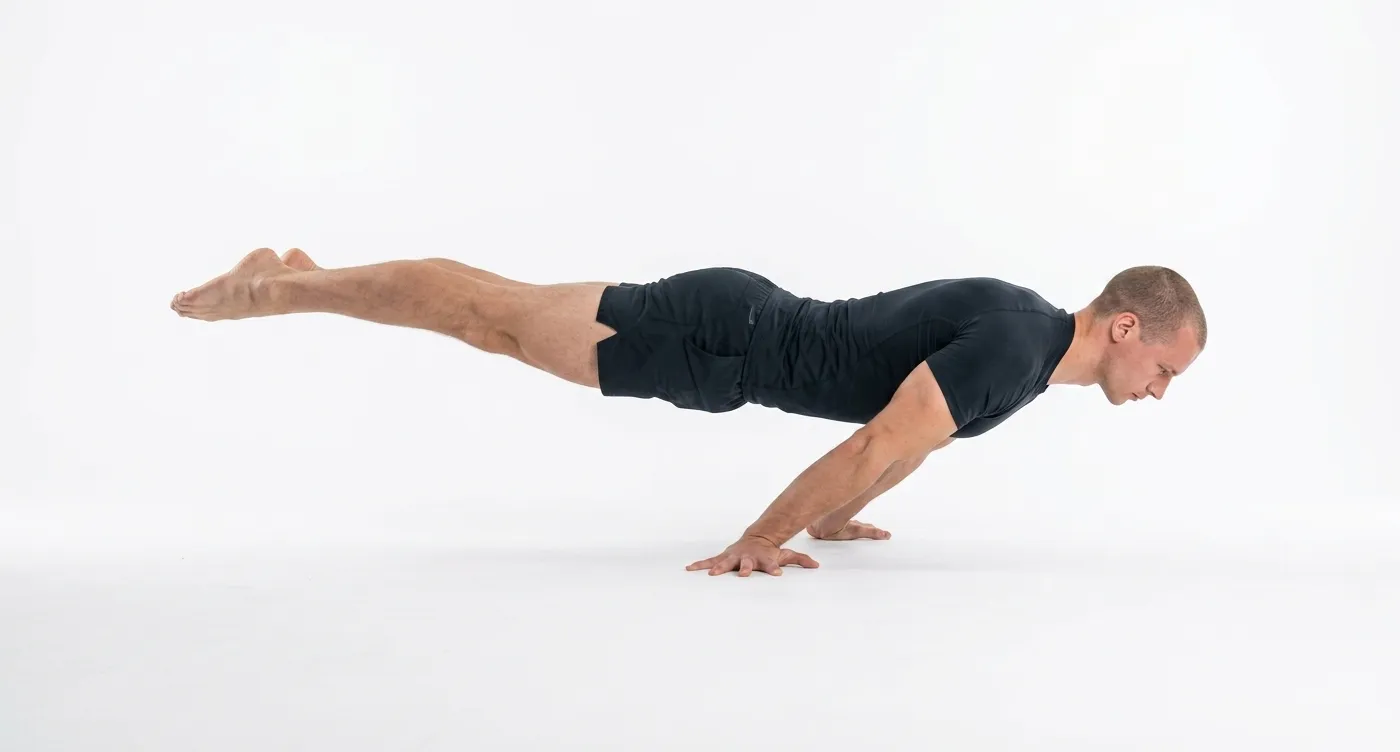
The full planche is the defining test of straight-arm pushing strength in calisthenics. Achieving it means holding your entire body completely horizontal, parallel to the ground, supported only by your hands — no bend in the elbows, no pike in the hips, no exception. It signals a level of anterior deltoid and scapular strength that, as Overcoming Gravity notes, can correlate with the ability to bench press twice bodyweight without ever having touched a barbell.
What Is the Full Planche?
The full planche is a static isometric hold in which the body forms a perfectly straight horizontal line from heels to head, arms locked out, hands flat on the floor with the shoulders leaning well forward of the wrists. It sits at Level 11 in the Overcoming Gravity progression system and is the capstone of the Planche (Floor) branch — the highest-difficulty pure planche hold before the skill transitions into dynamic planche-press movements.
The physics are unforgiving. As Overcoming Gravity 2nd Edition explains, the planche works on the principle that Torque = Force × Distance. Extending the legs from tuck to straddle to full straight body progressively shifts the body's center of mass further from the shoulder joint, multiplying the torque demand on the anterior deltoid. At full extension, that torque is near its maximum for a floor-based isometric — which is exactly why elite gymnasts consistently regard it as a major intermediate milestone, even by gymnastics standards.
Prerequisites
Before training the full planche, you need to demonstrate: Half Layout Planche for 3 sets of 30-second holds.
The half layout bridges the straddle and full positions by bringing the legs together while maintaining a slight hip pike. That subtle difference — legs together versus straddled — dramatically increases the effective lever arm on the shoulder because you can no longer use the spread of the legs to shorten the moment arm. Mastering 3×30s in the half layout proves you have the scapular and anterior deltoid endurance to sustain the shoulder position under a near-full lever load before you commit to a completely flat body line.
The Progression Chain
Each step in the planche chain represents a meaningful shift in leverage. The half layout is roughly 85–90% of the full planche's demand — the body is nearly parallel but the slight hip pike provides a small mechanical advantage that disappears entirely in the full position. Reaching the full planche with 3×30s then unlocks the first dynamic planche skill: the straight-arm straddle planche press to handstand, which transforms the static strength into an explosive pressing movement. At that point the training objective changes from pure isometric endurance to coordinated straight-arm pressing power.
Sets, Reps, and Training Frequency
Progression standard: 3 sets × 30-second hold
At the full planche level, most athletes cannot approach 30 seconds unassisted at first — initial holds are often 3–8 seconds. The Overcoming Gravity advanced programming recommends structuring planche training three times per week using short, high-quality isometric efforts:
- Primary work: 4–5 sets of 6–10 second holds at maximum effort. These build the specific strength for the position itself. Rest 3–5 minutes between sets — planche is a near-maximal effort and full recovery is mandatory.
- Secondary work (same session): 3–5 sets of pseudo planche pushups (PPPUs) with a 1–2 second hold at the top, cycled through a descending rep scheme across the week (e.g., 15 reps Monday, 10 Wednesday, 5 Friday). This targets concurrent strength and hypertrophy in the anterior deltoid and pectoral muscles that the pure isometric cannot build on its own.
- Supplemental work: 3 sets of 25 serratus anterior isolation (scapular pushups, supine dumbbell front raises) and low-trap work. These stabilize the scapula during protraction and are the most common weak link in stalled planche trainees.
Band-assisted planche training is highly effective at this stage. A resistance band looped from a pull-up bar supporting the hips allows much longer time-under-tension — 15–20 seconds per set — which builds the specific endurance the full planche demands without requiring full-strength holds every rep. Use bands on secondary training days to extend total weekly planche volume without excessive joint fatigue.
Total weekly planche volume should land in the 8–12 working sets range. Exceeding this — especially at Level 11 — creates accumulated fatigue that stalls progress more reliably than under-training does.
Coaching Cues
- Perfectly straight body line — Any pike at the hips or arch in the lower back creates a false planche; the torso, hips, and legs must form a single rigid plank. Practice hollow-body drills on the floor to drill the exact spinal position before attempting it under load.
- Maximum forward lean — The shoulders must be significantly forward of the wrists. This lean is not optional and is not adjustable by effort — it is a direct consequence of your body's lever geometry. If the lean feels extreme, that is correct; if it feels comfortable and upright, your hips are dropping.
- Point toes, squeeze everything — The full planche has no slack in it. Every body segment contributes: pointed toes elongate the lever and remove slack from the posterior chain, glute squeeze controls hip extension and prevents arch, core bracing transfers force cleanly from shoulders to legs. Relaxing any link causes the hold to collapse.
Common Mistakes
- Confusing lean with effort. Beginners try to "lean harder" to get their body up, but the shoulder lean angle is determined by your body lever, not by willpower. The correct forward lean appears automatically when the shoulders are sufficiently protracted. If you are leaning forward and your hips still drop, the shoulder protraction — not the lean angle — is the missing piece.
- Depressing instead of protracting the scapulae. Shoulder depression (pulling the shoulders down and back) and protraction (rounding them forward) are opposite actions that cannot occur simultaneously. The planche requires maximum protraction — pushing the hands away from you through the floor — not the retracted/depressed position you might use in a ring support hold. Mixing these up is the single most common technical error and will prevent the position from ever being achieved regardless of strength level.
- Neglecting posterior shoulder work. The anterior deltoid gets all the attention in planche training, but Overcoming Gravity is explicit: you must build posterior shoulder strength concurrently. Front lever, back lever, and rowing progressions develop the muscle mass and stability in the rear deltoid and rotator cuff that balance the extreme anterior load of the planche. Neglecting pulls while over-emphasising planche-specific work is a reliable path to shoulder injury.
- Skipping wrist conditioning. Every planche session loads the wrists in a dorsiflexed, weight-bearing position for extended durations. Starting each session with 5–10 minutes of wrist prep — circles, passive extensions, compression holds — is not optional at this level. Wrist problems that develop here will not resolve with rest alone; they require structured conditioning.
- Extending hold duration past form failure. When the hips drop or the elbows bend, the set is over. Extending duration by sagging into a broken position neither builds the correct motor pattern nor produces useful strength stimulus — it only accumulates connective tissue stress. End the set cleanly and rest fully before the next effort.
Prehab and Longevity
The full planche concentrates three simultaneous stressors at the shoulder: the anterior deltoid works at near-maximum length (a mechanically disadvantaged position), the serratus anterior must sustain maximum protraction isometrically, and the wrists bear full bodyweight in a compromised dorsiflexed angle. This is why planche athletes have historically high rates of wrist and shoulder overuse injuries when programming is too aggressive.
Wrists: Perform dedicated wrist conditioning before every planche session without exception — circles in both directions, passive dorsiflexion stretches, fist push-ups to strengthen the extensors. If full dorsiflexion causes pain, train on parallettes or a planche board immediately; do not push through wrist pain at this level, as it compounds rapidly.
Serratus anterior and lower trapezius: These two muscles form the "push" side of the scapular triangle. Scapular push-ups (getting into push-up position and allowing the scapulae to fall together, then pushing the hands away until the upper back rounds fully) directly train the serratus in the protracted position the planche demands. The Y- and T-movements (prone, arms raised) hit the lower trapezius, which prevents the scapula from winging under the sustained protraction load. Three sets of 25 reps of each, added as supplemental work after planche sessions, will do more to protect your shoulders long-term than any amount of stretching.
External rotators: Heavy planche volume without corresponding external rotation work leads to internal rotation dominance — a well-documented injury precursor. Band pull-aparts and the P-movement (W-position external rotation) performed for 2–3 sets of 15 daily provide the counterbalance. These take 5 minutes and meaningfully extend training longevity at the advanced level.
BodyTree tracks your progression through all 251 calisthenics skills — from your first push-up to a full planche. Automatically generated programs, video proof, and a community of serious practitioners.
Get BodyTree — Free on iOS & Android