German Hang: How to Learn It
If you have never trained calisthenics and the words "shoulder extension" mean nothing to you, you are in exactly the right place. The German hang is one of the most useful moves a beginner can own, and you do not need a gym, years of training, or any special flexibility to start. You need a bar or a set of rings you can reach, a little patience, and a willingness to let your shoulders open up a few degrees at a time. This is a hold, not a feat of strength. Your only job is to hang, breathe, and let your body settle into a slightly deeper range each session. Done gently and consistently, it builds the exact shoulder mobility and connective-tissue resilience that every pulling skill later depends on. If the full position feels like a lot today, you will start with a band under your feet taking most of the load, and that is not a lesser version, it is your version for now.
What Is the German Hang?
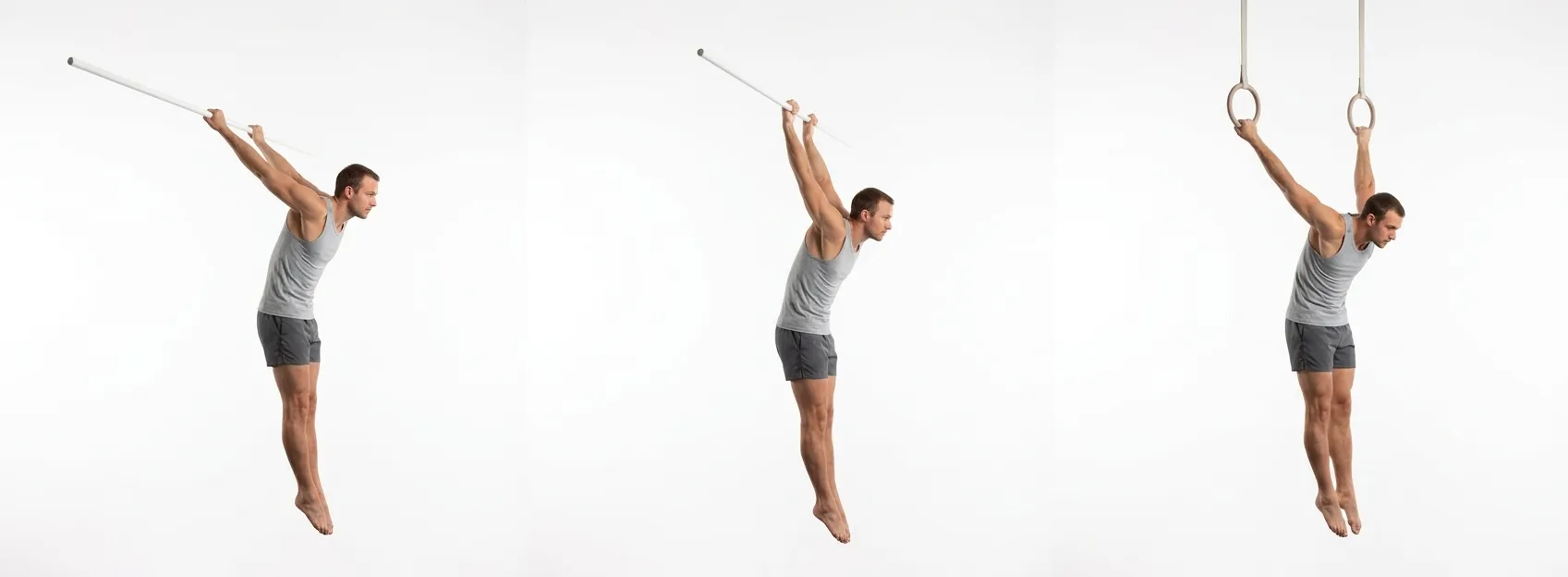
The German hang is a hanging shoulder stretch. You take hold of a bar or rings, rotate backward through the space between your arms, and let your shoulders extend behind your body while your arms stay straight. From the side it looks like you are hanging upside-down-ish with your chest facing away and your shoulders opened up behind you. Because you hold the position rather than move through it, it is an isometric exercise: the muscles work while their length barely changes.
What makes it so valuable for a beginner is what it trains. The German hang takes your shoulders to the comfortable edge of their extension range, which stretches the chest, the lats, and the front of the shoulder girdle all at once. Trusted calisthenics references describe it as a staple general-mobility drill for the shoulders precisely because it opens so much at once. That same open, loaded position is what your body needs to safely reach skills like the back lever and skin the cat down the road. You are not just stretching, you are teaching your connective tissue to be strong at a longer length.
Prerequisites: Where a Beginner Actually Starts
You do not need to earn the German hang with months of other training first. The honest prerequisite is simply being able to hang from a bar and support your own weight for a few seconds, plus the confidence to rotate backward slowly. If you can do a short dead hang without your grip failing immediately, you have enough to begin the banded version today.
The true beginner's starting point is the banded German hang. You loop a thick resistance band over the bar and rest your feet or shins in it so the band carries much of your weight. This lets you settle into the shoulder position with far less load, so you can feel the stretch instead of fighting to hold yourself up. Set rings or a bar low enough that your feet can touch the ground if you need to bail. Ease in, hold five to ten seconds at first, and step out. There is no shame in living in the banded version for weeks. That is the plan, not a detour.
The Progression Chain
The German hang sits early in the back-lever branch, and the path in and out of it is short and clear:
- Banded German Hang (the step before): a band under your feet supports your weight while you learn the shoulder position. Clear this when you can hold a calm, straight-armed position for 3 sets of 30 seconds with the band.
- German Hang (you are here): the same position without the band, carrying your full weight through straight arms. The goal is 3 relaxed sets of 30 seconds.
- Skin the Cat (what comes next): now you add movement, rotating from a hang down into the German hang position and back up again under control. This is where mobility becomes strength through range.
To move on from the banded version, you should own it first: a comfortable 3 by 30 seconds where you are breathing steadily rather than bracing. Do not rush across a chain rung because you can scrape one shaky rep. Owning each step is what keeps your shoulders happy.
Sets, Reps, and Frequency
Because this is a mobility-focused hold, more is not better. The research on stretching is clear that very long static holds right before a workout can dull your strength for the session, so keep individual holds short and purposeful. A good working target is 3 sets of 30 seconds, but early on you will build there from much shorter holds of five to ten seconds.
Frequency can be generous because the intensity is low. Two to four short sessions a week works well, and the German hang also fits neatly into a warm-up: a few brief holds before pulling work help open the shoulders. Rest a minute or so between holds. If you are older, coming back from a layoff, or just stiff, give yourself more warm-up time and shorter early holds. Progress by adding a few seconds or trading a little band tension for a little more of your own weight, never by forcing a deeper stretch.
Coaching Cues
- Keep your arms straight. The German hang is a straight-arm position. Locking the elbows lets the stretch land on the shoulders where you want it, not on a bent, working bicep.
- Lower slowly. Ease into the position rather than dropping into it. Control on the way in is what keeps the stretch safe.
- Use a supinated (palms-back) grip and let the shoulders extend behind you. Feel the opening across your chest and the front of your shoulders.
- Breathe and relax. Deep, steady breaths let the tissue settle. Holding your breath and clenching fights the very release you are after.
- Keep it short. A few brief holds beat one long grind. Quality of position matters more than time under the bar.
Common Mistakes
- Going too deep too soon. The most common beginner error is chasing maximum range on day one. Shoulder extension improves in small increments over weeks. Stay at the comfortable edge, not past it.
- Skipping the band. Trying the full-weight version before your shoulders are ready loads them at a length they cannot yet control. Start banded and earn the full hang.
- Bending the arms. A sneaky elbow bend turns the stretch into a weak pull and hides tightness instead of addressing it.
- Holding forever. Long static holds can leave you feeling loose but weak. Keep holds short, especially before strength work.
- Holding your breath. Bracing hard and going rigid stops the tissue from relaxing into the position. Breathe out and let go a little.
Prehab and Longevity
The German hang loads your shoulders and biceps in a stretched, lengthened position, which is exactly why it is worth respecting. Connective tissue such as tendons and ligaments adapts more slowly than muscle, so it needs gradual, consistent exposure rather than sudden big jumps. This is the whole logic of starting banded and adding load in small doses: you are giving those slower-adapting tissues time to catch up. Rushed loading at long ranges is a classic way to nag an anterior shoulder or a biceps tendon.
Warm up before you hang. A minute or two of shoulder circles and some easy support holds prepares the joint. Never bounce at the bottom of the stretch. If you feel a sharp or pinching sensation rather than a broad, tolerable stretch, back off, add band tension, and shorten the hold. Treated patiently, the German hang is one of the best long-term investments you can make in resilient, mobile shoulders, and it keeps your future pulling training out of the injury ditch.
Related Guides
Frequently Asked Questions
Is the German hang safe for a complete beginner?
Yes, when you start with a band under your feet and keep the holds short. The banded version removes most of the load so you can learn the shoulder position gently. Ease in, hold five to ten seconds, and stop well before any sharp sensation.
How long should I hold a German hang?
Start with five to ten seconds and build toward 3 sets of 30 seconds. Because it is a mobility stretch, longer is not better. Very long static holds right before strength work can temporarily reduce your strength, so keep them short and purposeful.
Do I need rings, or will a pull-up bar work?
Either works. Rings let you set the height low so your feet can reach the ground, which many beginners find reassuring. A fixed bar is fine too. Whatever you use, make sure you can bail safely if your grip tires.
What comes after the German hang?
Skin the cat, which adds controlled movement by rotating from a hang down into the German hang position and back up. From there the path continues toward the tuck back lever and eventually the full back lever.
BodyTree tracks your progression through all 251 calisthenics skills — automatically generated programs, video proof, and a community of serious practitioners.
Get BodyTree — Free on iOS & Android