
Ring Support Hold: How to Learn It
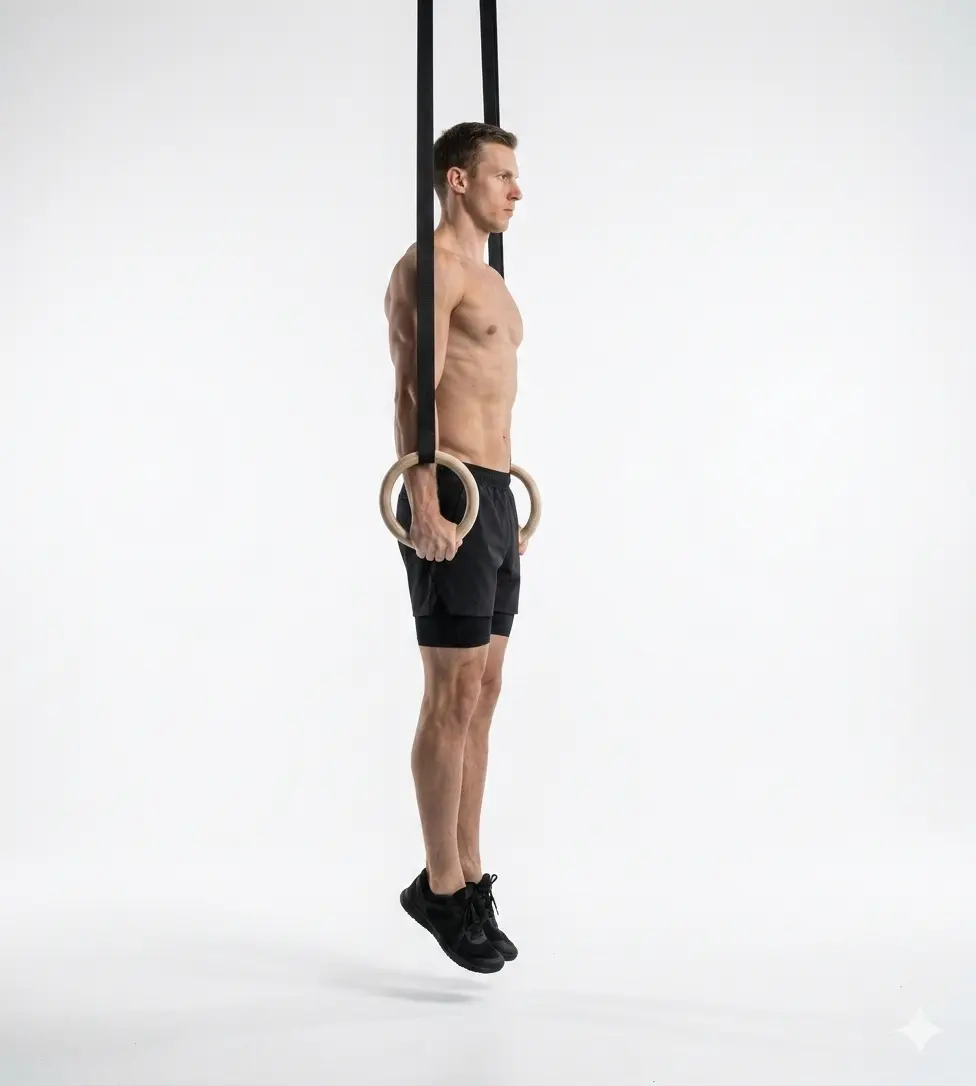
If you have never touched a set of gymnastic rings, the support hold is the first thing to learn, and it is far more approachable than it looks. There is no pressing, no pulling, and no experience required. You simply hold yourself at the top of the rings with straight, locked arms. That is the whole movement. It looks calm and it looks simple, and that is exactly why it is the true starting point for everyone. According to Overcoming Gravity by Steven Low, the support hold is a Level 1 foundation that the entire rings journey is built on, and it can be scaled all the way down so that a complete beginner can start today, on rings, parallel bars, or even two sturdy chairs.
You do not need to already be strong. You do not need to get in shape first. The support hold is how you build the strength, not a test you have to pass before you are allowed to begin. This guide meets you where you are and shows you the smallest possible first step, then the milestones that follow.
What Is the Ring Support Hold?
The ring support hold is a static, straight-arm isometric. You start at the top of the rings, arms locked out at your sides, shoulders pulled down, and your body hanging quietly beneath your hands. Because your arms stay straight, the load is carried mostly by your joints and connective tissue rather than by working muscles through a range of motion. That is the point. Steven Low describes rings support work as one of the most important ways to develop the tendon and ligament strength that every straight-arm rings skill later depends on.
For a beginner, the support hold does three quiet but valuable things. It teaches your shoulders to stay stable and depressed instead of shrugging up toward your ears. It conditions your elbows and wrists to the feeling of bearing your own weight. And it builds the confidence of owning a position that felt impossible the first time you tried it. None of that requires prior training. It only requires showing up and holding on.
Prerequisites: What You Actually Need to Start
Almost nothing, and that is the good news. The support hold has no formal prerequisite in the progression because it is the beginning of the chain. You do not need to be able to do a dip, a pull-up, or a push-up first. What you do need is a way to scale the difficulty so you can hold a clean position, because a shaky, hunched support hold builds a bad habit that follows you into every rings exercise upstream.
The easiest honest starting point is a feet-assisted hold. Set the rings low, or use parallel bars, a dip station, or two solid chairs or counters. Keep your feet on the floor and take as much weight through your legs as you need so that your arms stay straight and your shoulders stay down. Over days and weeks, you gradually take more weight into your arms. Steven Low explicitly lists chairs and counters as valid tools here, which means the very first version of this skill can happen at home with no equipment budget at all.
The Progression Chain: Where the Support Hold Leads
The support hold is the gateway into the rings dip branch. Once you can hold a plain support for time, the next step is the rings-turned-out (RTO) support hold, where you rotate the rings outward to demand more from your shoulders. From there you train the slow lowering of the ring dip eccentric, and finally the full ring dip. Each rung reuses the stability you built in the support hold, which is why rushing past it tends to backfire.
You are at the very first node: the plain support hold. There is no earlier step to unlock. Your job now is simply to accumulate honest, straight-arm hold time until the position feels solid and unremarkable.
Sets, Reps, and Frequency
Because this is an isometric, you train it in seconds of hold time rather than reps. In the app, the support hold unlocks at three sets of a 30 second hold. A sensible beginner target on the way there, drawn from Overcoming Gravity, is to accumulate roughly 60 to 90 seconds of total hold time across as many short sets as you need. If a single clean hold is only 8 or 10 seconds at first, that is completely normal. Stack several of those with rest between them and the total adds up.
Frequency can be generous because the load is low and the movement is not very fatiguing. Two to four short sessions a week works well, and support holds double as an excellent warm-up before any upper-body training. As you improve, aim to reach your total in fewer, longer sets, and only then begin turning the rings out. Consistency here beats intensity every single time.
Coaching Cues
- Lock the arms straight. Fully extend the elbows and keep them extended. Bent arms turn a joint-conditioning hold into an endurance grind and defeat the purpose.
- Pull the shoulders down. Actively depress your shoulder blades away from your ears. A shrugged, hunched support is the single most common fault and it builds a pattern that causes problems in every rings exercise later.
- Press the rings into your sides. Gently squeeze the rings toward your hips to stop them from drifting and wobbling.
- Grip lightly. Hold firmly but not white-knuckled. An overly tense grip fatigues your forearms and cuts your hold time short.
- Stay tall and quiet. Point the toes, squeeze the glutes, and keep the body still rather than swinging for balance.
Common Mistakes
- Shrugging the shoulders. Letting the shoulders ride up toward the ears is the top beginner error. Keep them pulled down throughout, even as you fatigue.
- Bending the arms. A slight bend sneaks in as you tire. When the arms bend, end the set. Quality over duration.
- Chasing the rings-turned-out version too early. Turning the rings out is much harder and demands real shoulder external rotation. Own the plain support first.
- Skipping the regression. Trying to hold your full bodyweight before you are ready produces a shaky, unsafe hold. Keep your feet on the floor and share the load with your legs until the position is calm.
- Neglecting it once dips arrive. Even advanced athletes keep support holds in their warm-up for connective tissue health. Do not throw away the foundation.
Related Guides
Frequently Asked Questions
Can a total beginner do a ring support hold?
Yes. The support hold is designed to be the entry point. By keeping your feet on the floor and sharing weight with your legs, or by using parallel bars or two chairs, you can scale it to any starting strength level and build up from there.
How long should I be able to hold a ring support?
A good early target is 60 to 90 seconds of total hold time across several short sets. The next milestone is three sets of a clean 30 second hold at full bodyweight, after which you can start training the rings-turned-out version.
Why do my shoulders shake in the support hold?
Shaking is normal at first and simply means your stabilizers are learning the position. Reduce the load by keeping more weight on your feet, focus on pulling your shoulders down, and the shake settles as your connective tissue adapts.
Do I need rings, or can I use something else?
You can start on anything stable that lets you support your bodyweight with straight arms: parallel bars, a dip station, or even two solid chairs or a counter. Overcoming Gravity lists all of these as valid tools for support hold work.
BodyTree tracks your progression through all 251 calisthenics skills — automatically generated programs, video proof, and a community of serious practitioners.
Get BodyTree — Free on iOS & Android