
Parallel Squat: How to Learn It
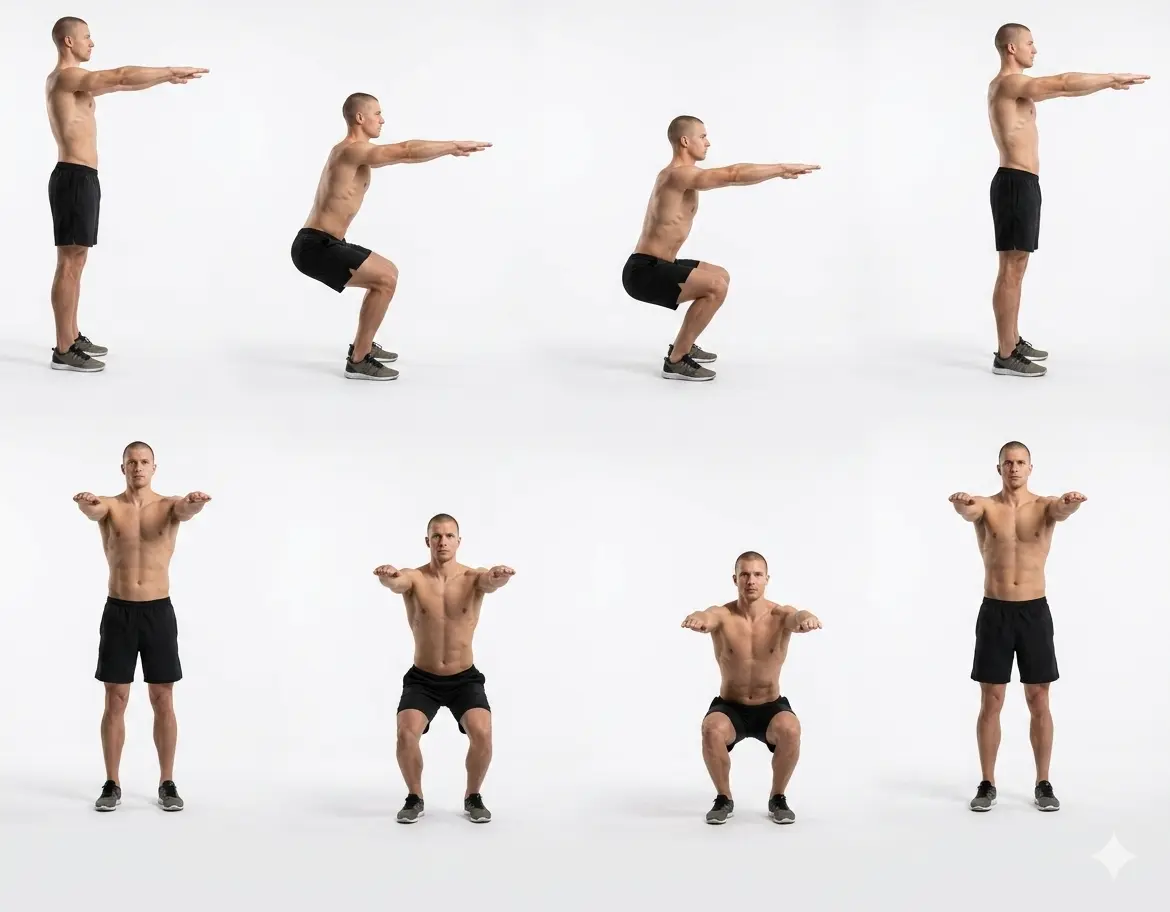
If you have never trained a day in your life, the parallel squat is one of the friendliest places to start. There is nothing to buy, nothing to hang from, and nowhere to go. You stand up, you sit down, and you do it with control. That is the whole movement. Overcoming Gravity treats the squat as one of the fundamental human patterns, the same shape you already use every time you get out of a chair, and this guide simply teaches you to own it on purpose. No shame if your knees creak or your balance wobbles on rep one. That is exactly who this is written for.
What Is the Parallel Squat?
The parallel squat is a bodyweight squat where you lower until your thighs are roughly parallel to the floor, then stand back up. It sits in the Legs family of the BodyTree skill tree, one step up from the chair-assisted Sit-to-Stand. "Parallel" just describes the depth: hips sinking until the top of your thighs are level with the ground. You do not need weights, a rack, or a gym. Your own bodyweight is the resistance, and gravity does the rest.
It is the second rung on the squat branch, and the whole point is to build honest strength through a controlled range of motion before you chase depth or single-leg work.
Prerequisites
The true starting point is not this squat. It is the Sit-to-Stand: standing up from a chair and lowering back down under control. If you can do 3 sets of that comfortably, you are ready to try the parallel squat. If you cannot yet, that is completely fine. Start there, use a higher chair, and come back. There is no minimum fitness level to clear first. You do not need to "get in shape" before you begin. This is how you get in shape.
The Progression Chain
According to Overcoming Gravity, the squat branch runs from the parallel squat up through the full-depth squat and eventually to the single-leg pistol squat. Each step adds either depth or the demand of balancing on one leg. You are near the beginning, and that is a good place to be. Master this, and the full squat is mostly a matter of adding range as your ankles and hips loosen up.
Sets, Reps, and Training Frequency
The parallel squat is a concentric strength movement, so the BodyTree unlock standard is 3 sets of 15 clean reps. Rest a minute or two between sets. Train legs 2 to 3 times per week, leaving at least a day in between so the muscles recover and rebuild. If 15 feels far away on day one, do 3 sets of whatever you can manage with good form, even if that is 5. Add a rep or two each week. Small, steady wins stack into real strength faster than you would expect.
Coaching Cues
- Feet about shoulder width. Toes pointed slightly out feels natural for most people. Find what lets you sink comfortably.
- Drive through your heels. Keep your heels planted the whole time so the power comes from your legs, not your toes.
- Chest tall, back neutral. Think about squatting between your legs rather than folding forward over them.
- Sink to parallel. Lower until the tops of your thighs are level with the floor, then stand fully and squeeze your glutes at the top.
- Control the way down. Do not drop and bounce. A slow, owned descent is where much of the strength is built.
Common Mistakes
- Heels lifting off the floor. Usually a sign of tight ankles. Squat to whatever depth keeps your heels down and let mobility catch up over the weeks. A folded towel under the heels can help early on.
- Knees caving inward. Gently think about spreading the floor with your feet so your knees track over your toes.
- Rushing the reps. Bouncing at the bottom robs you of the strengthening part of the movement. Own every inch.
- Chasing depth too early. A clean parallel squat beats a wobbly deep one. Depth comes with patience.
Prehab and Longevity
Squats load the knees and ankles, so a little care goes a long way for the years ahead. Overcoming Gravity recommends a few sets of bodyweight squats as part of a general warm-up precisely because the pattern gently prepares the joints. Add some ankle circles and a light walk before your first working set. If your knees feel cranky, shorten the range rather than pushing through pain, and build depth slowly. Trained with control and full but pain-free range, the squat is one of the most joint-friendly, longevity-building movements you can own.
Related Guides
Frequently Asked Questions
Do I need any equipment to start squatting?
No. The parallel squat is pure bodyweight. All you need is space to stand. A chair behind you can act as a depth guide and a confidence net when you are just beginning.
What if I can't squat to parallel yet?
That is normal, and usually it is tight ankles or hips rather than weak legs. Squat to whatever depth keeps your heels flat, place a folded towel under your heels, and your range will deepen over a few weeks of consistent practice.
How long until I can do 3 sets of 15?
Most beginners training legs 2 to 3 times a week get there within a month or two. Start with the reps you can do cleanly and add a little each session. Consistency matters far more than intensity.
Are bodyweight squats enough to build leg strength?
For a beginner, absolutely. Bodyweight squats build a real foundation, and when they become easy you progress to full-depth squats and eventually single-leg pistols rather than needing to add weight.
BodyTree tracks your progression through all 251 calisthenics skills — automatically generated programs, video proof, and a community of serious practitioners.
Get BodyTree — Free on iOS & Android