Bodyweight Squat: How to Learn It
If you can stand up from a chair, you already own the first rep of a squat. That is the honest starting point, and it is enough. The bodyweight squat is the single most useful lower-body movement in calisthenics because it needs no gym, no bar, and no prior athletic history. You do not have to get in shape first. This move is how you get in shape. In this guide you will learn where to begin if a full-depth squat feels impossible today, how far to descend, how many reps to chase, and how the humble squat quietly becomes the doorway to the pistol squat down the line.
What Is the Bodyweight Squat?
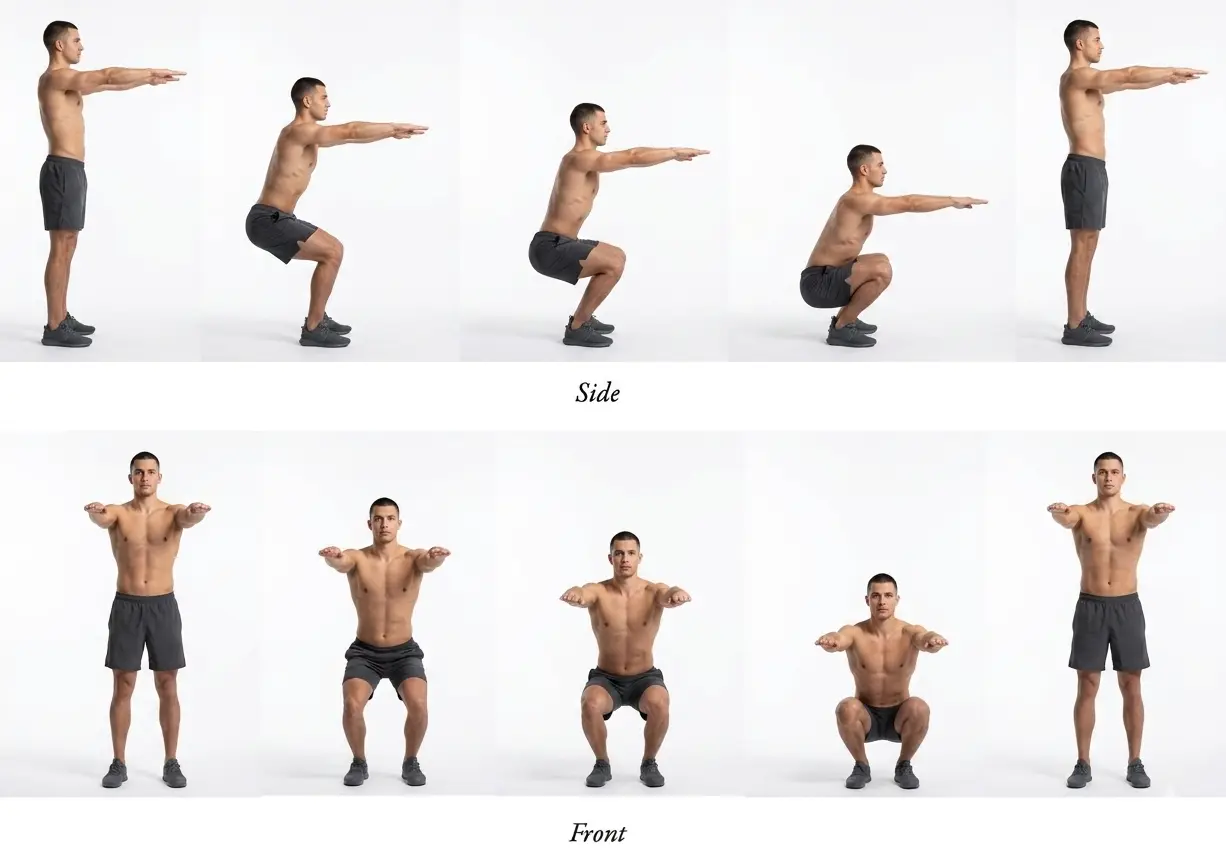
The bodyweight squat is a full-range lower-body bend: you sit back and down until the backs of your thighs meet your calves, then drive back up to standing. It trains your quads, glutes, hamstrings, and the deep stabilisers around your hips and ankles, all with nothing but your own weight. According to Overcoming Gravity by Steven Low, the difference between a parallel squat and a full squat is almost entirely range of motion: parallel stops when your thighs are level with the ground, while the full squat descends all the way until thigh meets calf.
Low makes a reassuring observation here. Watch any toddler and you will see a flawless deep squat. We are all born able to do this. Most adults lose the range not because of a defect but because years of sitting shortened the muscles that let us drop into the bottom position. The good news is that what was lost through disuse comes back through use.
Prerequisites: Where to Actually Start
You need no prerequisites to begin squatting. You need the right regression. If sinking to full depth is not available yet, start higher up the chain and let strength and mobility catch up.
- Sit-to-Stand. Sit on a chair with your feet flat, stand up fully while squeezing your glutes, then lower back down with control. This is the easiest way to build squatting strength from zero, and it is a real exercise, not a warm-up.
- Parallel Squat. Once standing from a chair is easy, squat under control until your thighs are parallel to the floor. Drive through your heels on the way up.
- Full Squat. When parallel feels solid, keep descending until the backs of your thighs touch your calves. This is the target movement.
If mobility, not strength, is the limiter, that is normal and fixable. Low suggests the Asian squat: settle into the deepest squat position you can hold and simply stay there, gently shifting your weight around to load and lengthen the calves, hamstrings, and hips. A minute a day in the bottom position often unlocks depth faster than dedicated stretching.
The Progression Chain
The squat branch is a ladder, and the full bodyweight squat sits near the friendly bottom of it. Once you own it, the path continues into single-leg strength.
- Side-to-Side Squat. From a wide stance, shift your weight onto one leg and lower until your butt touches that calf, then travel across to the other side. This introduces the single-leg loading that the pistol will demand. If it is too hard from the floor, elevate your feet slightly or hold a doorframe for assistance.
- Pistols. A full-depth single-leg squat with the other leg held out in front. This is the marquee bodyweight leg skill, and it grows directly out of the strength and mobility the full squat built.
You do not need to think about pistols yet. Naming the destination just shows you that today's squat is not an endpoint. It is the first rung.
Sets, Reps, and Frequency
Because you cannot easily add weight to a bodyweight squat without a vest, you progress mainly by adding volume and range, not load. Overcoming Gravity notes that beginner adaptations come fast but not so fast that you jump a full progression level every session, so patience with volume is the game.
A practical starting prescription is 3 sets of 15 to 20 controlled reps, resting a minute or two between sets. When 3 sets of 20 at full depth feels manageable across a couple of sessions, that is your cue to progress toward the side-to-side squat. Low points out that lower-body movements recover quickly, so squats tolerate being trained often. Two to three times per week is a sustainable rhythm for a beginner, and consistency at that cadence beats the occasional brutal session.
Coaching Cues
Steven Low's technique notes for the full squat are simple and worth internalising:
- Feet at shoulder width or slightly wider, toes turned out anywhere from 0 to 30 degrees, whatever feels natural for your hips.
- Initiate by sitting back, as if reaching for a chair, keeping your weight over or slightly behind the middle of your foot.
- Keep your back straight the whole way down. Do not let it round at the bottom.
- Descend until your thighs touch your calves, then drive back up the same path using power from your hips and knees.
- Keep your heels planted. Weight biased toward the heels keeps the shins more upright and reduces stress on the knees.
Common Mistakes
- Heels lifting off the floor. This usually signals tight calves or ankles. Rather than forcing depth on your toes, work the Asian squat hold to open the range, or elevate your heels slightly on a small book while you build mobility.
- Rounding the lower back at the bottom. If your back rounds as you reach depth, stop at the depth where your back stays straight and let mobility work extend it over time. Depth earned honestly beats depth stolen from your spine.
- Knees caving inward. Actively spread your knees so they track over your toes.
- Rushing the reps. A squat bounced out of the bottom trains momentum, not strength. Control the descent and own the bottom position.
Related Guides
Frequently Asked Questions
How deep should I squat?
Aim for full depth, where the backs of your thighs touch your calves, but only as far as you can go while keeping your back straight and heels down. If your back rounds or your heels lift, stop at the deepest clean position and work on mobility to extend your range over time.
I can't squat to full depth. Is something wrong with me?
No. Most adults lose deep-squat mobility simply from years of sitting, not from any defect. Steven Low recommends holding the bottom of the squat position (the Asian squat) and gently shifting your weight to open up the calves, hamstrings, and hips. Depth usually returns with regular practice.
How many bodyweight squats should I do?
A solid starting point is 3 sets of 15 to 20 controlled reps, two to three times per week. When that feels easy at full depth, progress toward single-leg work like the side-to-side squat.
Do I need weights or a gym to train legs?
No. The bodyweight squat and its progressions build real lower-body strength with no equipment. You advance by adding reps, deepening your range, and eventually moving to harder single-leg variations rather than by adding load.
BodyTree tracks your progression through all 251 calisthenics skills — automatically generated programs, video proof, and a community of serious practitioners.
Get BodyTree — Free on iOS & Android