
Straddle L-Sit: How to Learn It
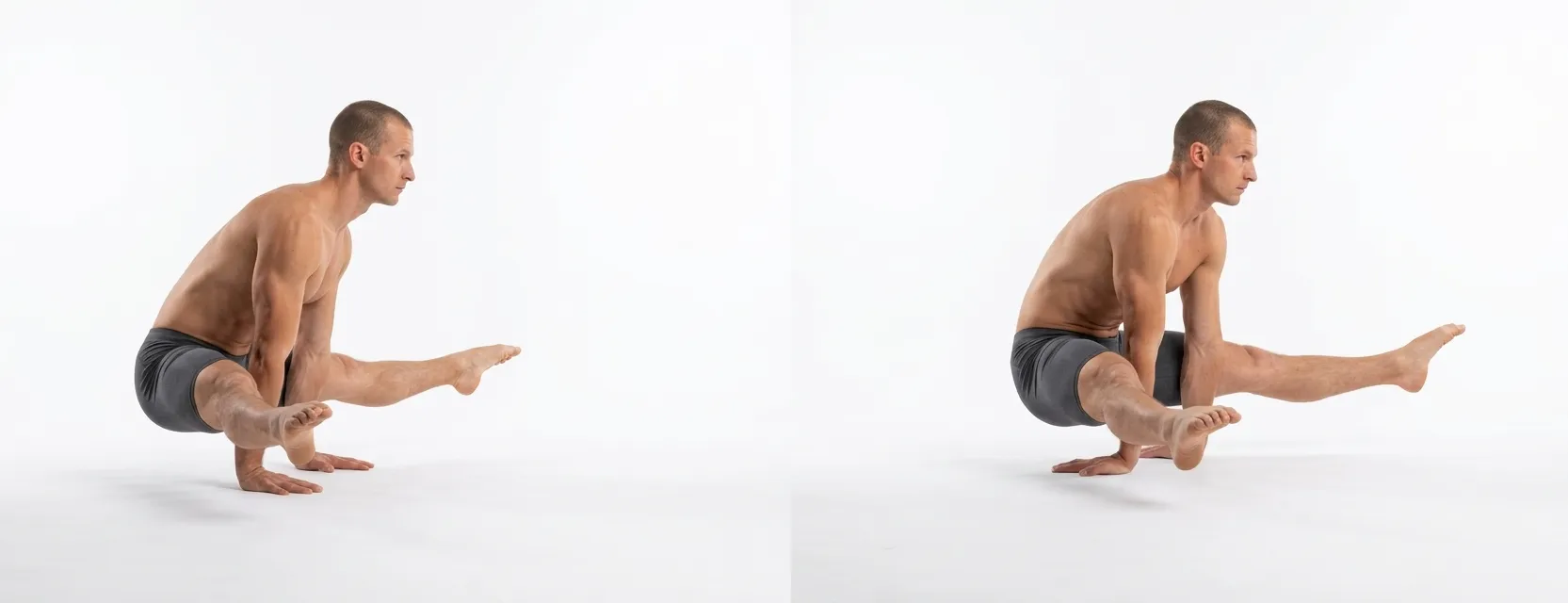
If the straddle L-sit looks like something only gymnasts can do, take a breath: you do not start here, and you were never meant to. Everyone who owns this hold began somewhere far humbler, sitting on the floor learning to press their hands down and lift their knees an inch. That is the real starting point, and it is open to anyone, at any age, with no gym and no background. This guide meets you there and walks the whole road, so the straddle L-sit becomes a destination you train toward rather than a test you are supposed to pass on day one.
What Is the Straddle L-Sit?
The straddle L-sit is a seated support hold. You press through straight arms on parallettes, parallel bars, or the floor, lift your whole body off the ground, and hold your legs out wide in a straddle, at or above hip height. It sits in the L-Sit / V-Sit / Manna branch of the BodyTree tree, one step beyond the standard L-sit and one step before the rings-turned-out version.
Opening the legs into a straddle is not just for show. Widening your legs removes the little bit of swing and momentum a closed L-sit lets you get away with, so the hold becomes an honest test of two things: how hard you can press your shoulders down, and how actively you can pull your legs up. It is a core and compression skill first, a flexibility skill second, and it carries over beautifully to press handstands and the V-sit down the line.
Prerequisites
Before you chase the straddle, own a clean standard L-sit for 30 seconds across three sets, legs together and knees locked. If you cannot yet hold a straight-arm support at all, that is fine and expected: start on parallettes or parallel bars, which give your hands more room and let your legs hang below the bars while you build the pressing strength.
You also want a base of active compression, the ability to pull your straight legs toward your chest using your own core rather than your hands. Most beginners are surprised that the straddle is limited by compression and flexibility long before it is limited by arm strength. That is good news, because compression is trainable from the floor with zero equipment.
The Progression Chain
Each rung asks for a little more open leg position and a little more compression. The tuck teaches you to press and depress the shoulders. Extending one leg, then both, teaches you to hold that press with longer levers. The straddle then widens the legs, and the rings-turned-out version adds shoulder rotation on an unstable surface. Do not skip rungs: the reason the straddle feels achievable is that the earlier holds quietly built the exact strength it needs.
Sets, Reps, and Training Frequency
Isometric holds progress by accumulated time, not by grinding to failure. A proven approach: work up to about 60 seconds of straddle L-sit total per session, broken into as many short sets as you need, and stop each set well before your form falls apart. Quality holds beat one shaking, collapsing attempt.
Pair every session with compression work, three sets of ten-second holds. This split, roughly half hold and half compression, is what actually moves the straddle forward for most people. Train it two to three times per week, leaving a day between sessions so your hip flexors and core recover.
Coaching Cues
- Press the floor away and drive your shoulders down. Depress your shoulder blades as far as they will go so your torso rises out of your shoulders rather than sinking into them.
- Place your hands between your legs and lean forward. Shifting your weight slightly over your hands lets you open the legs wider without falling backward.
- Pull the legs up, do not just let them float. Actively lift with your hip flexors so your legs sit at or above hip height, toes pointed.
- Keep a slight posterior pelvic tilt. Tucking the pelvis under keeps the lower back from arching and helps the legs come up.
Common Mistakes
- Chasing the straddle before you own the L-sit. If your closed L-sit is not solid for 30 seconds, the straddle will only teach you bad compensations. Bank the earlier rung first.
- Letting the legs droop below hip height. A hold with sagging legs trains a sagging hold. Shorten the set and keep the legs high instead.
- Rounding forward and losing shoulder depression. When the shoulders shrug up toward the ears the whole position collapses; reset and re-depress.
- Skipping compression work. This is the single most common reason the straddle stalls. Without it the strength to lift the legs never arrives.
Compression: The Drill That Unlocks It
Compression training is simple, needs no equipment, and is the fastest route to the straddle. Sit on the floor with your legs straight in front of you (or in a comfortable straddle), hands resting by your knees. Keeping your legs straight, contract your core and pull your knees up toward your face. Hold for about ten seconds. If you start to cramp in the front of your hips, you are doing it exactly right. Repeat three to five times, and as it gets easier, slide your hands closer to your toes to make it harder.
Do this alongside a thirty-second hamstring stretch, and over a few weeks the straddle stops being a fight against your own legs. Warm and patient beats forced every time.
Related Guides
Frequently Asked Questions
Is the straddle L-sit harder than a normal L-sit?
In one sense yes: the wide legs remove any swing and demand more active compression and hip flexibility. But many people find the straddle friendlier on the hamstrings than a closed L-sit, because the legs do not have to stay perfectly together. Build the standard L-sit first either way.
Why do my hips cramp when I train this?
That cramping in the front of your hips is your hip flexors working through a range they are not used to. It is a normal sign that compression training is doing its job, and it fades as those muscles adapt over a few weeks.
Do I need parallettes or can I do it on the floor?
The floor works once you can press your whole body up, but parallettes or parallel bars give your legs clearance and make the hold far more accessible while you are building strength. Most beginners should start elevated.
How long until I can hold a straddle L-sit?
If you already own a 30-second L-sit and train compression two to three times a week, a solid straddle hold often comes within four to eight weeks. Consistency with the compression drills matters more than how hard you push any single session.
BodyTree tracks your progression through all 251 calisthenics skills — automatically generated programs, video proof, and a community of serious practitioners.
Get BodyTree — Free on iOS & Android