
Standard Pushups: How to Learn It
If you cannot do a single pushup yet, you are exactly who this guide is for. The standard pushup is not a test you have to pass before you are allowed to start — it is a skill you build, one easier version at a time. You do not need a gym, equipment, or any background in training. You need a patch of floor and a little patience. Almost everyone who trains a wall pushup, then a knee pushup, then holds tight through a slow lowering, arrives at a full pushup. This is how you get there.
What Is the Standard Pushup?
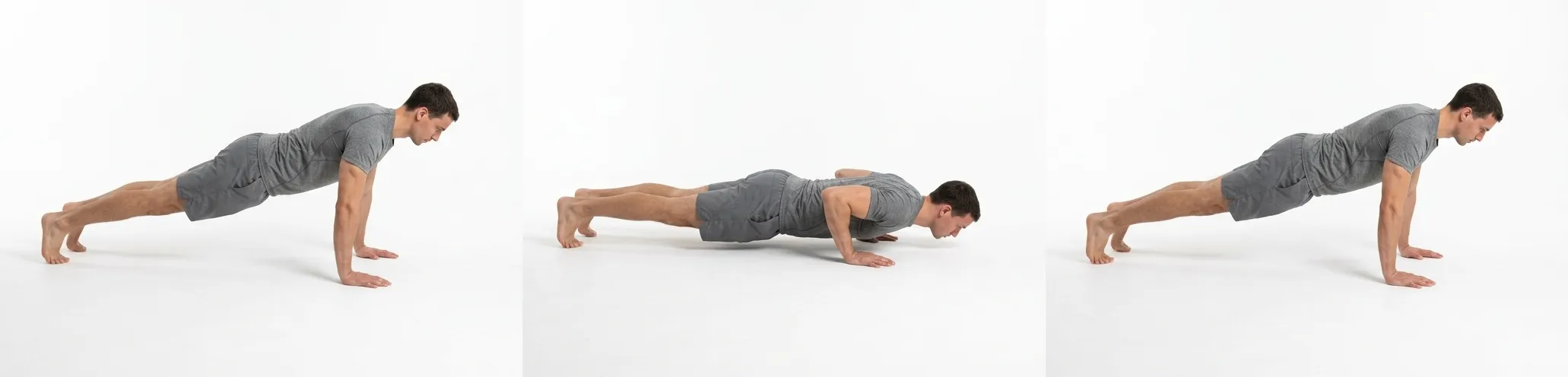
The standard pushup is a horizontal press: you start at the top of a plank with your hands under your shoulders, lower until your chest lightly brushes the floor, then push back to a locked-out arm position. Your whole body moves as one straight unit. It sits in the Push branch of the BodyTree skill tree, and it is the movement that unlocks nearly every pressing skill that follows.
It looks simple, and the shape is simple. What makes it a real skill is doing it with a straight body and full range every rep, rather than sagging hips or half-depth reps that only feel like progress.
Prerequisites (Start Here If You Cannot Do One Yet)
You do not need any strength baseline to begin. If a full pushup is not happening today, that is normal and it is not a problem. Start with an easier version that lets you train the exact same movement:
- Wall pushups — hands on a wall at chest height. The more upright you stand, the easier it is. This is the true starting point for a complete beginner.
- Incline pushups — hands on a sturdy table, counter, or a few stairs. Lower the surface over time to make it harder.
- Kneeling pushups — from your knees, so you move less bodyweight while keeping the same chest-to-floor path.
In the BodyTree progression, the step directly before the standard pushup is the kneeling pushup. Overcoming Gravity suggests that once you can complete clean sets on your current regression, you are ready to move up.
The Progression Chain
Each link removes a bit of assistance and adds a bit of load. Wall pushups teach the pressing pattern upright; kneeling pushups add bodyweight with your knees taking some of it; the standard pushup asks for the full straight-body press. After it, diamond pushups bring your hands together to load the triceps harder. You do not skip links. You earn the next one by owning the current one.
Sets, Reps, and Training Frequency
BodyTree treats the pushup as a concentric strength move, so the unlock standard is 3 sets of 15 clean reps. According to Overcoming Gravity, once you can perform sets of roughly fifteen to twenty good repetitions, you are ready to progress to a harder variation.
Train your push twice or three times per week, leaving at least a day between sessions so the muscle can recover and adapt. If you can only manage a few reps of your current version, that is your workout — stop a rep or two before form breaks, rest, and repeat. Quality reps compound faster than grinding ugly ones.
Coaching Cues
- One straight line. Squeeze your glutes and brace your abs so your body stays flat or very slightly hollow from head to heels. Do not let your hips sag or pike up.
- Elbows tucked, not flared. Keep your elbows somewhere between close to your sides and about forty-five degrees out. Flaring them straight out to ninety degrees stresses the shoulders and, per Overcoming Gravity, invites injury over time.
- Full range. Lower under control until your chest brushes the floor, then press all the way to locked-out arms at the top. Partial reps train partial strength.
- Move as one piece. Every part of you should reach the floor at the same moment. Your shoulder blades will spread apart at the top and draw together as you lower — let that happen naturally.
Common Mistakes
- Sagging hips. When the core lets go, the lower back arches and the hips drop. Overcoming Gravity notes this can pull on the lower back and cause pain. Fix it by bracing the abs and glutes so the body stays rigid.
- Half-depth reps. Stopping short of the floor feels stronger but skips the hardest, most valuable part of the range. Touch the chest down every rep.
- Flared elbows. Elbows winging out to ninety degrees is the most common form fault and the hardest on the shoulders. Tuck them in.
- Rushing the jump. Trying to grind out full pushups when a kneeling version is still shaky just reinforces bad shape. Bank the easier version first — it is faster in the long run.
Related Guides
Frequently Asked Questions
I cannot do a single pushup. Where do I actually start?
Start standing at a wall. Do pushups against the wall with your body straight, then over the following weeks move your hands to a lower surface — a table, then a few stairs — and finally to your knees on the floor. Each step is the same movement with less load, and it leads directly to a full pushup.
How long until I can do a full pushup?
It depends entirely on where you start and how consistently you train, but many beginners get there in a handful of weeks of training their push two to three times a week. Progress comes from adding a rep here and lowering your hand height there, not from forcing it in one session.
Should my elbows be tucked or flared out?
Tucked. Keep your elbows somewhere between close to your sides and about forty-five degrees from your body. Flaring them out to ninety degrees is the most common mistake and, according to Overcoming Gravity, it puts your shoulders at risk over time.
How do I know when I am ready to progress?
When you can perform three sets of about fifteen to twenty clean, full-range reps of your current version with good form, it is time to make it harder — lower your hands, drop the knees, or move to the next link in the chain.
BodyTree tracks your progression through all 251 calisthenics skills — automatically generated programs, video proof, and a community of serious practitioners.
Get BodyTree — Free on iOS & Android