
Box Headstand Pushup: How to Learn It
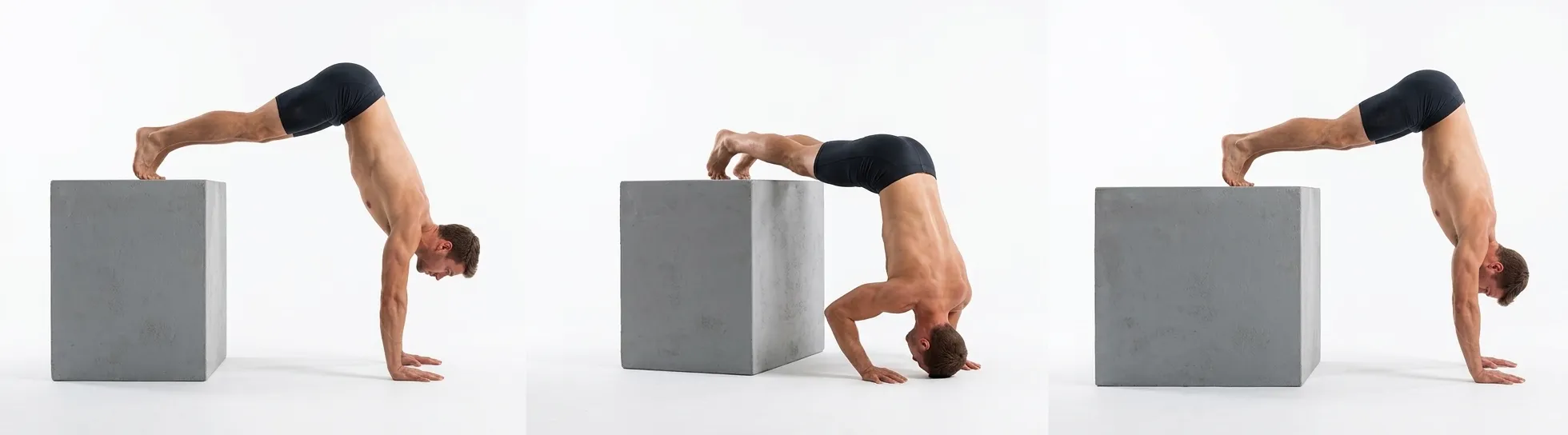
The box headstand pushup takes the pike headstand pushup you already own and raises your feet onto a box, chair, or step. That small change shifts more bodyweight onto your hands and opens your shoulder angle, so the movement starts to feel like real overhead pressing instead of a floor drill.
What Is the Box Headstand Pushup?
The box headstand pushup is a level-2 skill in the Handstand Pushups branch of the BodyTree progression system. You place your hands and feet on the ground in a pike position, but your feet rest on an elevated surface, a block, box, chair, or countertop all work. Bending your arms, you lower your head to the floor and press back out, the same pattern as the pike headstand pushup, just with more of your bodyweight loaded onto your arms.
According to Overcoming Gravity, raising the feet increases both the weight bias on the hands and the openness of the shoulder angle, moving you a step closer to a true vertical press without yet demanding full handstand balance.
Prerequisites
You should already own a solid pike headstand pushup for 3 sets before adding a box. If your pike version is still shaky, wobbling badly, or you cannot keep your elbows tracking over your wrists, spend more time there first. The box headstand pushup asks your shoulders and triceps to hold more load with less room for error, so rushing it tends to show up as poor positioning rather than faster progress.
The Progression Chain
The box headstand pushup sits between the pike version and the wall-assisted eccentric work. Each box height increase nudges more weight onto your arms until you are ready to remove the box entirely and take on the eccentric lowering against a wall.
Sets, Reps, and Training Frequency
Progression standard: 3 sets performed with full-depth reps, head lightly touching the floor on every repetition. Train this as pressing work 2-3 times per week, since it shares recovery demand with your other vertical pressing and handstand skill practice. Increase the box height gradually rather than adding reps past the point where your form starts to break down.
Coaching Cues
- Walk your feet to the edge of the box. The closer your hips sit over your head, the more shoulder-dominant the press becomes, which is the entire point of raising the feet.
- Keep elbows tucked, not flared. Track your elbows in line with your body throughout the descent and press. Flaring makes the rep easier but removes the forward-backward stability you need later.
- Go full depth every rep. Let your head fully contact the floor before pressing back out. Partial-range reps build partial-range strength and stall your progress toward the wall variations.
Common Mistakes
- Letting the body keel forward. If your shoulders and triceps are not yet strong enough, you will feel yourself tipping toward your hands. Lower the box height until you can control the full range again.
- Shifting weight back toward the feet. The opposite fault, easing off the arms by pushing weight toward the box, defeats the purpose of the drill. Both faults come from the same root cause: insufficient pressing strength for the current box height.
- Letting the head come out too far. Pushing the head forward past the natural pike line causes the back to arch, which recruits the wrong muscles and can strain the neck over time.
Prehab and Longevity
Headstand pushup variations load the head, neck, wrists, and shoulders in a fixed, compressive position, so joint care matters here more than in most bodyweight movements. Overcoming Gravity notes that connective tissue such as tendons and ligaments adapts more slowly than muscle does, which is why people who add box height or reps too quickly tend to run into wrist or shoulder irritation rather than simply feeling normal muscular fatigue.
Build in dedicated wrist prehab, extension and flexion stretches, and light rotator cuff work on your non-pressing days. If you already deal with elbow or wrist tendinopathy, Overcoming Tendonitis suggests keeping early-range work limited and controlled rather than driving straight into full compressive depth, then progressing the range slowly once the joint tolerates it well. Warm the wrists and shoulders thoroughly before every session, and back off the box height for a week if you notice nagging joint discomfort rather than pushing through it.
Related Guides
Frequently Asked Questions
How high should the box be for a box headstand pushup?
Start low, a step or short block, so you can control the full range without keeling forward. Raise the height gradually as your shoulders and triceps get stronger, rather than jumping straight to a tall box or chair.
Is the box headstand pushup safe for my neck?
Yes, when the head lightly touches the floor and the body stays in a controlled pike line. Avoid letting the head push forward past that line, since it causes the back to arch and can strain the neck over time.
What comes after the box headstand pushup?
The wall headstand pushup eccentric, a slow, wall-assisted lowering phase that bridges the gap between box work and the full wall headstand pushup.
BodyTree tracks your progression through all 251 calisthenics skills — automatically generated programs, video proof, and a community of serious practitioners.
Get BodyTree — Free on iOS & Android