Jumping Pull-Ups: How to Learn Them
If you cannot do a single pull-up yet, you are not behind and you are not doing anything wrong. Almost everyone starts here. The jumping pull-up exists precisely for this moment: it lets you train the full pull-up motion today, using a small hop from the floor to make up for the strength your arms do not have yet. You do not need a gym, a coach, or a base level of fitness to begin. You need a bar you can reach and the willingness to do a few honest reps. This is the very first rung of the BodyTree Pull-ups branch, and it is where your first strict pull-up quietly begins.
What Is the Jumping Pull-Up?
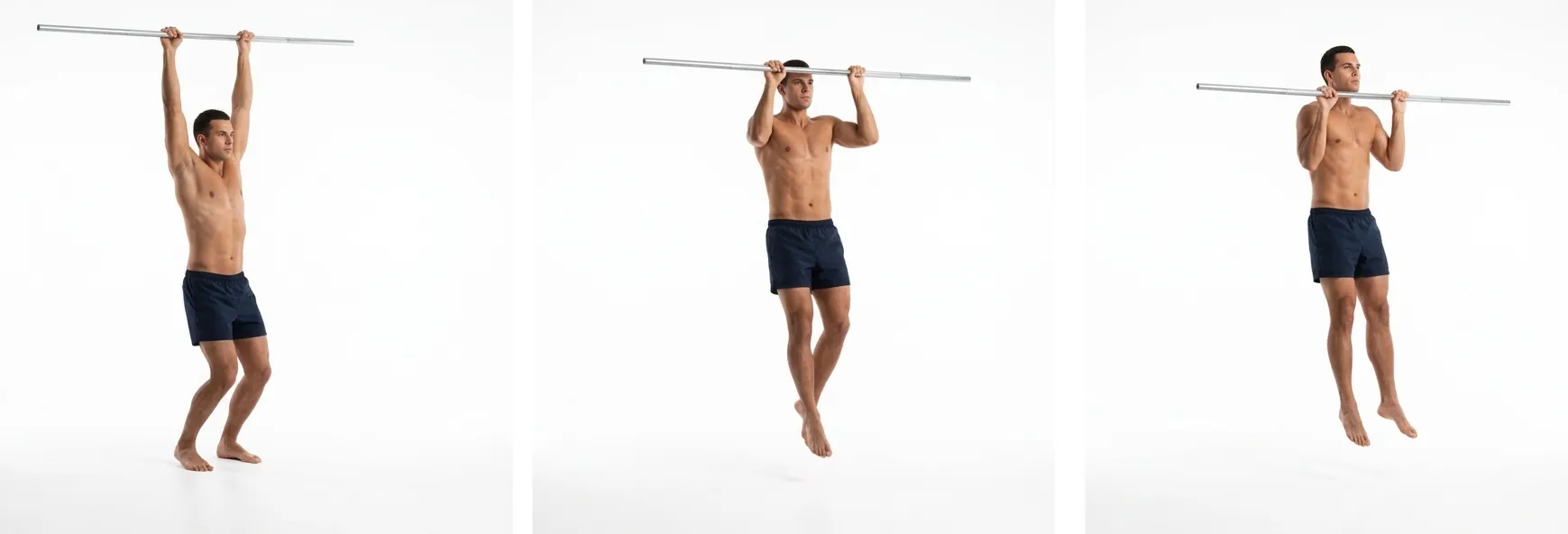
A jumping pull-up is a standard pull-up assisted by a gentle jump. You start hanging from the bar with straight arms, bend your knees slightly, and use just enough leg drive to help your arms pull your chin up and over the bar. It sits at Level 1 of the Pull-ups branch, the entry point to every vertical pulling skill in calisthenics.
The word that matters most here is assisted, not replaced. According to Overcoming Gravity, the jump is only there to cover the gap in your pulling strength while that strength is still being built. Your legs make up the difference; your arms are meant to do as much of the work as they possibly can. Over the weeks, as your back and arms get stronger, you lean on the jump less and less until one day you barely need it at all.
Prerequisites
The honest answer is that there are almost none, and that is the point. If you can hang from a bar and bend your knees, you can start jumping pull-ups. There is no earlier move you must earn first.
Two small things make your first sessions smoother. First, spend a little time simply hanging from the bar with straight arms to wake up your grip and shoulders; even ten to twenty seconds at a time helps. Second, set your bar or rings at a height where you can reach the bar with your arms nearly straight while your feet are still on the floor. If your bar is fixed and too high, stand on a sturdy box or step so you can begin from a proper straight-arm hang rather than a full dangle.
The Progression Chain
This is the road from your first hop to a strict pull-up and beyond. Jumping pull-ups build the pulling pattern and grip. Next come eccentrics (slow lowering from the top), which develop the exact strength that makes your first unassisted rep possible. From there you reach the strict bar pull-up, then harder variations. You do not skip rungs. Each step adds a little more range and a little more load, and the jump you rely on today becomes the strength you own tomorrow.
Sets, Reps, and Training Frequency
The Overcoming Gravity standard for this level is straightforward: work toward 3 sets of 5 to 15 reps, resting around 2 to 3 minutes between sets so each set is genuinely strong rather than exhausted. Use a controlled tempo, especially on the way down; the book recommends taking a slow, deliberate 5-count on the lowering portion of each rep, because that eccentric phase is where a surprising amount of your strength is built.
Train pulling 2 to 3 times per week, leaving at least a day between sessions so your muscles and connective tissue recover. When you can comfortably reach 3 sets of 15 clean reps while needing very little help from the jump, that is your signal to move on to eccentrics.
Coaching Cues
- Depress the shoulder blades first. Begin with your shoulders relaxed and slightly shrugged up, then start each rep by pulling your shoulder blades down and together as you rise. The pull comes from your back, not just your hands.
- Jump as little as possible. Use only enough leg drive to complete the rep. The less you jump, the more your arms are working, and your arms are what you are here to train.
- Aim clavicles to the bar, not chin. Pulling until your collarbones or chest reach the bar trains full range. Chasing a chin-over-bar rep tempts you to crane your neck, which is poor form and can actually reduce how much force you generate.
- Keep the elbows narrow and in front. Drive your elbows down toward your ribs rather than flaring them wide.
- Lower with control. Do not drop from the top. The slow descent is free strength.
Common Mistakes
- Turning it into a leg exercise. The most common error is jumping hard enough that the legs do most of the work. Ease off the jump and let the arms struggle a little; that struggle is the training.
- Craning the neck for the chin. Snapping your head back to get your chin over the bar shortens the range and, per the book, can pinch the nerves that feed your pulling muscles. Reach with your chest instead.
- Half-range reps. Not returning to a full straight-arm hang at the bottom trains partial strength. Own the whole range from the very first session.
- Dropping down. Skipping the controlled lowering throws away the most productive part of the rep.
Related Guides
Frequently Asked Questions
I can't do a single pull-up. Is that normal?
Completely normal. Most beginners cannot, and jumping pull-ups are the standard first step designed for exactly this situation. They let you train the full movement now while your pulling strength catches up.
How long until I get my first strict pull-up?
Training consistently 2 to 3 times per week, many beginners reach their first strict pull-up in roughly 8 to 12 weeks, moving from jumping pull-ups through eccentrics along the way.
What if my pull-up bar is too high to jump from?
Stand on a sturdy box or step, or lower a set of rings, so you can begin from a straight-arm hang with your feet reachable to the floor. Overcoming Gravity explicitly suggests using a box for this reason.
Are bands better than jumping pull-ups?
Both help, but jumping pull-ups keep you in control of exactly how much assistance you use and are simpler to set up. As you strengthen, you simply jump less, which is an easy way to progress the load.
BodyTree tracks your progression through all 251 calisthenics skills — automatically generated programs, video proof, and a community of serious practitioners.
Get BodyTree — Free on iOS & Android