Rings Dips: How to Learn It
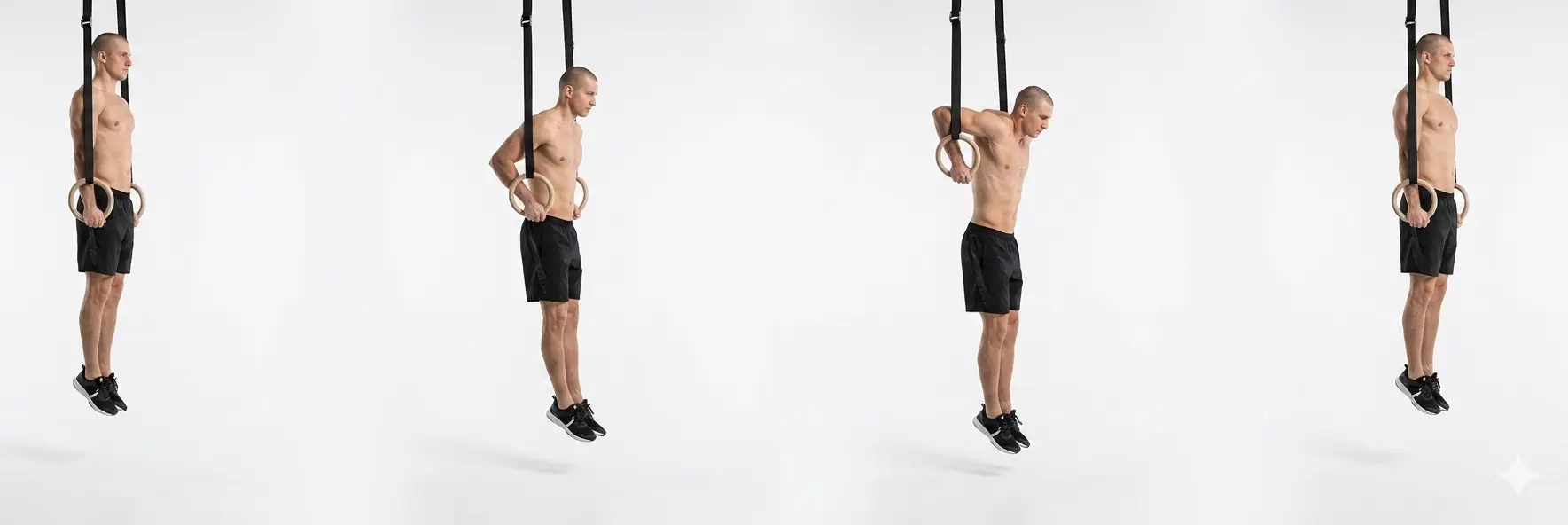
The rings dip is Level 4 in the Rings Dips branch of the Overcoming Gravity system — the first full concentric pressing movement on the rings, and the gateway to nearly every advanced ring skill above it. If you can press to lockout with stable rings and full depth, you have built something the bar will never give you: proprioceptive shoulder strength under real instability.
What Is the Rings Dip?
The rings dip is a Level 4 vertical push movement in the Overcoming Gravity rings progression. Unlike bar or parallette dips, which move along a fixed plane, rings dips require active stabilization through the full range of motion: the rings can oscillate forward, drift outward, and rotate under you, making every rep a coordination demand as much as a strength demand.
In the OG framework, it sits in the Rings Dips branch (vertical push category), alongside handstand push-up progressions. Mastery of rings dips is a prerequisite — stated or implied — for almost every high-level rings movement: L-sit dips, RTO dip variations, muscle-up quality, and eventually the maltese hold. Steven Low in Overcoming Gravity is direct: “Rings dips are critical for building upper-body strength … keep your body in the hollow position and commit yourself to resisting the inclination to arch.”
At Level 4, the movement is concentric-only (full ring dip, top to bottom and back): the eccentric phase was trained at Level 3. The instability of the rings provides greater strength increases than solely working the parallel bar dip progression — you are building not just triceps and chest strength but the deep stabilizing musculature of the shoulder girdle that underpins every advanced skill on the rings.
Prerequisites
Before training rings dips, you need to demonstrate: Rings Dip Eccentrics for 3 sets × 5 reps, with each rep taking 5–10 seconds from the support position to a full-depth bottom.
Why this matters: the eccentric phase pre-loads the pectorals, anterior deltoid, and triceps under the specific instability of the rings before any concentric force is demanded. Tendon and connective tissue adaptation is significantly slower than muscular adaptation — the support hold and eccentric phases exist to build pectoral origin integrity, shoulder-girdle stability, and costochondral (sternal) resilience before the full range-of-motion pressing load is applied. Steven Low notes in Overcoming Gravity that costochondritis — a painful connective tissue irritation at the sternum — occurs most often in athletes who attempt deep ring dips without adequate support hold preparation. Earning the eccentric is the minimum connective tissue investment before loading the concentric.
The Progression Chain
Each step in this chain makes a qualitative demand the previous one did not. Rings Dip Eccentrics trains only the lowering phase — the most critical for connective tissue loading — with 5–10 second descents that develop the full bottom-position range of motion and eccentric tensile capacity. Rings Dips adds the concentric: pressing from a deep, mechanically disadvantaged, unstable bottom position back to full lockout. This requires a qualitatively different kind of strength than the eccentric, because the shoulder girdle now must produce force while the rings simultaneously try to drift outward. Rings L-Sit Dips compounds the challenge by requiring the hip flexors to maintain active compression throughout the set — the L-sit is not a passive position here; it must be held actively against the fatigue accumulating in the pressing muscles. The OG methodology is clear: master each level completely before advancing. For rings dips, this means clean reps with shoulders visibly below the rings and full elbow lockout at the top — not grinding partials where the rings wobble and the bottom is never reached.
Sets, Reps, and Training Frequency
Progression standard: 3 sets × 15 reps (concentric, full depth, full lockout) before advancing to Rings L-Sit Dips.
For athletes learning the movement, OG2 recommends 2–3 sessions per week with at least 48 hours between ring pressing sessions. The proprioceptive adaptation — learning to stabilize the rings — is as important as the strength adaptation and it responds to frequency: consistent ring exposure builds the pattern. If you can perform bar dips but the rings oscillate wildly when you first attempt them, return to support hold work (target a 60-second support hold) before attempting the dip itself.
Volume progression: start with 2 sets of 5–8 reps and add reps per session until 3×15 is reached. Rest 2–3 minutes between sets — ring dips are neuromuscularly demanding and partial recovery between sets is not sufficient. OG2 example programming places ring dips alongside planche and lever work: “3×5 of Ring Dips” in an intermediate routine, scaling to “3×10 Ring Dips + 40 lbs” in an advanced hypertrophy block. The 3×15 bodyweight benchmark is the foundation before adding load or progressing to L-sit dips.
Push-to-pull balance: for every ring dips session, include an equal or greater volume of pulling work — ring rows, pull-ups, or front lever progressions. Low’s own experience in OG2 is explicit: training primarily pushing exercises led to anterior shoulder pain that required aggressive pull-volume correction. Structural balance between pushing and pulling is not optional in ring training.
Coaching Cues
- Lower until shoulders below rings. This is the depth standard. Partial depth (upper arms parallel to the floor) misses the full bottom position where the most tissue adaptation occurs and where the eccentric foundation was built. If you cannot achieve full depth without the rings flying outward, reduce the rep count and build the bottom-position strength separately.
- Stabilize rings throughout. The rings should travel in a consistent arc close to your sides, not swing forward or drift outward. The cue is to press the rings into your lats and squeeze your chest to your body as you descend. Force travels from the palms through the rings into the movement; loose rings mean leaked force.
- Full lockout at the top. Finish every rep with elbows fully extended and shoulders depressed (down, away from the ears). A partial lockout at the top is a sign of fatigue or insufficient support strength. End the set before lockout quality deteriorates.
- RTO on the press phase. As you push out of the bottom, actively attempt to rotate the rings outward (thumbs rotating away from the body). Even a mild external rotation intent engages the posterior deltoid and external rotators, protecting the anterior shoulder and building the rings-turned-out pattern needed for advanced skills. OG2: “Grip the rings firmly during the descent, then actively attempt to turn the rings outward (RTO) during the press phase.”
- Keep a 10–15° forward lean. A slight forward torso lean throughout the movement shifts load toward the chest and reduces shoulder joint shear. Perfectly upright ring dips place more stress on the shoulder joint; the slight forward lean is the biomechanically optimal path for both performance and shoulder health.
- Scapulas depressed and neutral. Throughout the entire movement. It is very easy to allow the scapulas to protract, which caves the chest and loses the structural position. Keep the shoulder blades down and back, especially at the top when lockout is achieved. Shoulder shrug at the top is the most reliable indicator that the set should end.
Common Mistakes
- Shrugging the shoulders at lockout. Completing a rep with the shoulders lifted toward the ears signals that shoulder depression strength is failing. Rebuild support hold time independently before continuing ring dips volume.
- Shallow range of motion. Stopping when the upper arms are parallel to the floor bypasses the full bottom position. The standard is shoulders visibly below the rings on every rep. Partial reps do not meet the OG standard for progression and do not train the range of motion the next level requires.
- Rings drifting outward on the descent. Allowing the rings to swing wide shifts shoulder loading abruptly and increases impingement risk. Maintain consistent ring-to-body proximity throughout — the drill is to press the rings into your lats as you lower.
- No forward lean. Attempting rings dips with a perfectly vertical torso increases shoulder joint shear. The natural 10–15° forward lean is not a cheat — it is the correct technique for rings dips, distinct from bar dips where the torso can remain more upright safely.
- Skipping RTO on the way up. Failing to apply the rings-turned-out intention on the press phase builds a pressing pattern that will create problems on every advanced ring exercise above it. The RTO cue costs nothing to apply and builds the external rotation habit that underpins all rings-turned-out dip variations and iron cross preparations.
Prehab and Longevity
Costochondritis (Tietze Syndrome) is the most common injury risk specific to ring dips. It manifests as soreness or pain at the sternum — where the costal cartilages attach — typically felt at the bottom of the movement when the pectorals are fully stretched. OG2 is explicit: this injury “tends to occur in people who have not previously used rings … and is triggered by deep ring work (RTO support, ring pushups, ring dips) before the connective tissue has adapted.” Treatment: rest and avoid all chest-loading movements until pain resolves, then rebuild from support holds. It is a connective tissue injury, not a muscle injury — rest is the first intervention, not just load reduction. Prevention: build a 60-second support hold before starting eccentrics, and a 30-second RTO support hold before beginning full ring dips.
Anterior shoulder health depends on push-to-pull balance. Ring dips are a vertical push movement. Chronically undertrained pulling musculature (lats, posterior deltoids, external rotators) relative to pushing leads to forward-rounded shoulder posture and predisposes to anterior impingement. For every ring dips session, include equal or greater pulling volume. Pair ring dips with ring rows, pull-ups, or front lever progressions in the same session.
Rotator cuff: rings are more protective for the rotator cuff than fixed bars because they allow free rotation. As the Overcoming Tendonitis book notes, rings “allow for free rotation, enabling your wrists, elbows, and shoulders to avoid getting stuck in a particular movement pattern that can aggravate upper-body tendinopathies.” The RTO cue on the press phase actively contracts the infraspinatus and teres minor (external rotators), further protecting the anterior shoulder capsule. Use this cue intentionally, especially in high-volume training blocks.
Related Guides
Frequently Asked Questions
Are ring dips much harder than bar dips?
Yes — significantly. The rings’ instability forces the stabilizing muscles to work continuously through the entire movement. Athletes who can perform 20+ bar dips typically struggle to complete 5 ring dips when they first start. The instability provides greater strength increases than the bar dip progression, as OG2 confirms.
How long does it take to learn ring dips?
Starting from no ring experience: building the support hold takes 2–4 weeks, completing the eccentric phase takes another 4–8 weeks, and ring dips typically progress to 3×15 within another 4–8 weeks. Total: 3–6 months from zero ring experience to the progression standard is realistic with 2–3 sessions per week.
Should I feel ring dips in the chest or the triceps?
Both — but the 10–15° forward lean and RTO cue shift emphasis toward the chest and anterior deltoid. Perfectly upright ring dips with no forward lean are more tricep-dominant and place greater shear stress on the shoulder joint. For chest development and shoulder health, use the forward lean and apply the rings-turned-out intention on the press.
Why does my chest or sternum hurt after ring dips?
This is likely costochondritis — a connective tissue irritation at the pectoral origin where it attaches to the costal cartilages at the sternum. It is most common in new ring trainees who attempt deep ring dips before building adequate support hold time. Rest until pain resolves completely, then rebuild from support holds. See a medical professional if pain persists.
BodyTree tracks your progression through all 251 calisthenics skills — automatically generated programs, video proof, and a community of serious practitioners.
Get BodyTree — Free on iOS & Android