
Side-to-Side Squat: How to Learn It
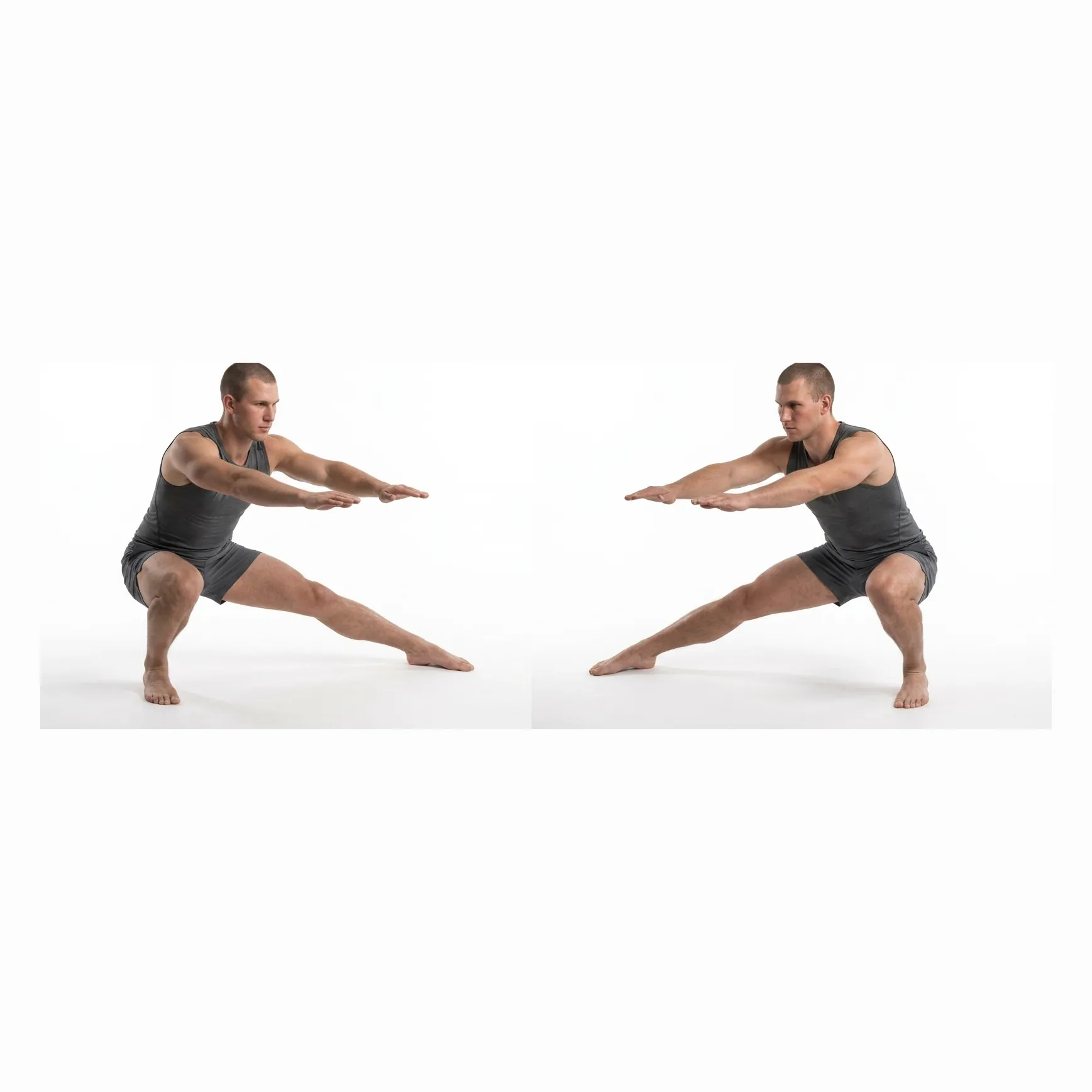
If you can stand up from a chair and lower into a full squat, you are already ready to start the side-to-side squat. You do not need a gym, weights, or a background in sport. This move takes the two-legged strength you have and gently teaches each leg to carry more of the load on its own, which is exactly the bridge most people are missing on the road to a single-leg squat. It looks impressive, but the entry point is friendly, and every rep is scalable to where you are today.
What Is the Side-to-Side Squat?
The side-to-side squat, also called the Cossack squat, is a wide-stance squat where you shift your weight onto one bent leg while the other leg stays straight out to the side, then rock across to the other leg. According to Overcoming Gravity by Steven Low, it sits between the full squat and the pistol in the leg progression because it starts biasing your bodyweight onto a single leg without asking you to balance on one foot right away. It lives in the Legs branch of the BodyTree skill tree at level 4.
Because both feet stay planted the whole time, it feels far more secure than a pistol. You get most of the single-leg strength benefit while keeping a stable base and a built-in stretch for the straight leg. That combination is why it is such a good first taste of unilateral leg training for a complete beginner.
Prerequisites
You are ready when you can perform a controlled full squat for 3 sets of 15 reps, sinking your hips below your knees with your heels flat and your torso upright. That is the single requirement. If your full squat is not there yet, spend a couple of weeks on the sit-to-stand and bodyweight squat first; there is no rush, and building that base makes everything after it easier.
You do not need special mobility to begin. If your hips or ankles feel tight, the regressions below meet you exactly where you are so you can still train the pattern today.
The Progression Chain
Each step shifts a little more of your weight onto one leg. The full squat trains both legs together; the side-to-side squat loads one leg at a time while the other assists and stretches; the pistol asks a single leg to do all the work in balance. Steven Low notes that as you get stronger you can gradually move the non-working leg in closer to your body, which quietly turns the side-to-side squat into something that looks and feels much more like a pistol.
Sets, Reps, and Training Frequency
Progression standard: 3 sets of 15 reps counting a full pass to each side as one rep, all with your own bodyweight. Overcoming Gravity uses the Rule of Fifteen for concentric moves like this — aim for at least fifteen quality reps across your sets before you make the exercise harder. Train legs 2 to 3 times per week with at least a day of rest between sessions. Deeper, slower reps build more strength than fast, shallow ones, so trade quantity for range as soon as you can.
Coaching Cues
- Start in a wide straddle. Feet wider than your shoulders, toes turned out slightly, chest tall.
- Sit into one side. Bend one knee and lower your hips until your glute settles toward that calf, keeping the other leg straight with the heel down.
- Track the knee over the toes. Let the bending knee travel in the direction your toes point, never caving inward.
- Cross low, not high. Shift straight across to the other side while staying deep, so the working muscles never get a rest at the top.
- Reach the arms forward as a counterbalance if you feel like you are tipping back — it makes the bottom position far easier to control.
Common Mistakes
- Going too deep too soon. If your heel lifts or your back rounds hard, you have gone past your current range. Shorten the depth and earn it over weeks.
- Rushing the reps. Bouncing through the bottom skips the exact range that builds single-leg strength. Move slowly and deliberately.
- Letting the knee collapse inward. Guide the knee out over the toes on every rep to keep the load where it belongs.
- Skipping the regression. Struggling is not a badge of honor here. Elevate the heels or hold a support (below) and train the full pattern well.
Prehab and Longevity for the Knees
Deep single-leg squatting loads the knee more than a normal squat, so treat depth as something you build, not something you force. Overcoming Gravity's guidance is simple and beginner-safe: if the full-range version is too hard, elevate your heels on a mat or a rolled towel to make the bottom easier, or hold onto a doorframe or sturdy table to assist yourself out of the deep position. Warming up your hips and ankles for a minute first, keeping the movement smooth, and stopping a rep or two before your form breaks will keep your knees happy for the long run. Mild muscle fatigue is normal; sharp joint pain is a signal to reduce depth or add support.
Related Guides
Frequently Asked Questions
Is the side-to-side squat good for beginners?
Yes. Because both feet stay on the floor, it gives you single-leg strength and depth without the balance demand of a pistol, making it one of the friendliest ways to start unilateral leg training.
What is the difference between a side-to-side squat and a Cossack squat?
They are the same movement. Cossack squat is the common name; Overcoming Gravity lists it as the side-to-side squat in the leg progression.
How do I make the side-to-side squat easier?
Elevate your heels on a mat or rolled towel to reduce the mobility demand, or hold onto a doorframe or sturdy table to assist yourself out of the bottom. Both let you train the full pattern while you build strength.
What comes after the side-to-side squat?
The pistol squat. Once side-to-side reps feel controlled, gradually move your non-working leg closer to your body to mimic the pistol, then start practicing single-leg squats to a box.
BodyTree tracks your progression through all 251 calisthenics skills — automatically generated programs, video proof, and a community of serious practitioners.
Get BodyTree — Free on iOS & Android