Straight-Arm Frog Stand: How to Learn It
If you have never balanced on your hands before, the planche can look like something only gymnasts on a screen get to do. It is not. Every person who holds a planche began exactly where you are now, on the floor, learning to trust their hands. The straight-arm frog stand is one of the first honest steps on that road, and you can start practising it today with no gym, no bar, and no background in training. Your true starting point is even simpler: a plain frog stand, where your knees rest on your bent elbows. Once that feels steady, straightening the arms is the next small win. Take it slowly, keep your wrists happy, and let the balance come to you.
What Is the Straight-Arm Frog Stand?
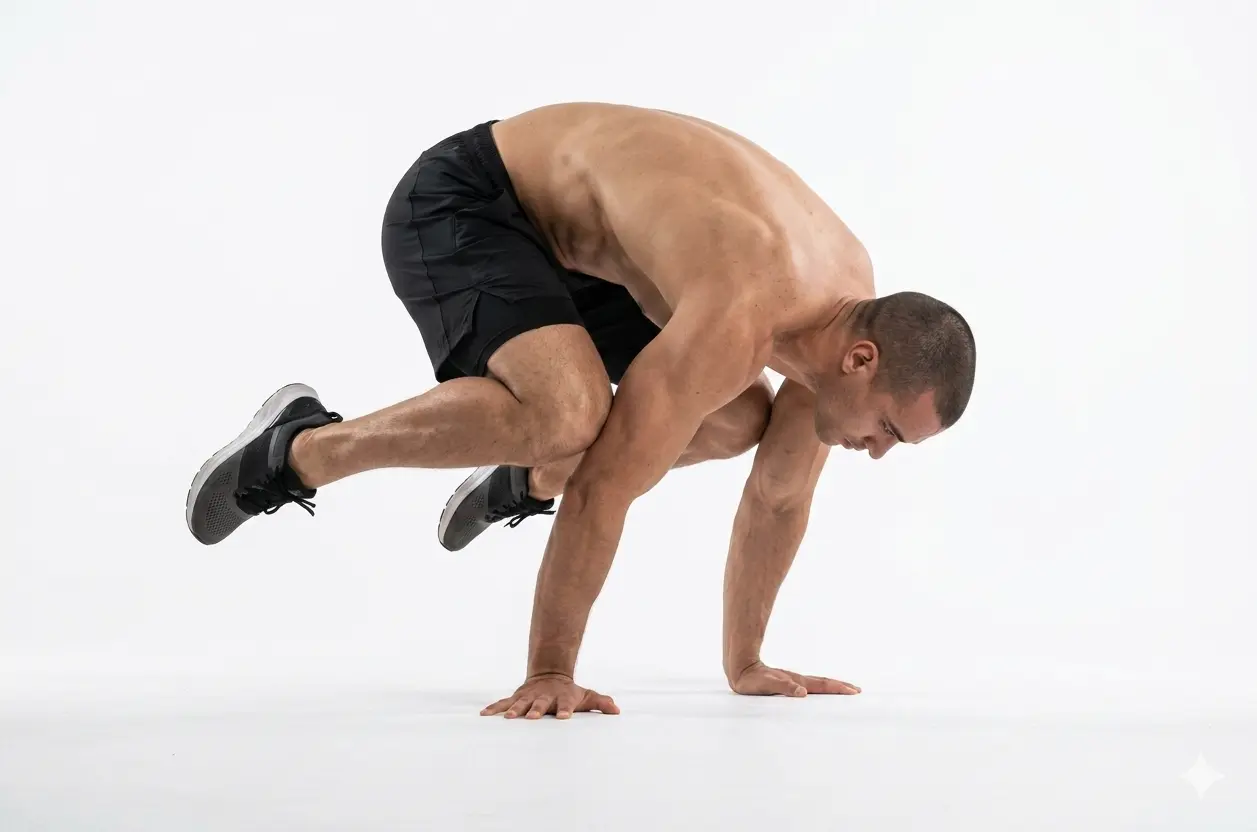
The straight-arm frog stand is a balance hold where you support your whole body on your hands with your arms locked straight and your knees floating just above your elbows. It sits at level 4 in the Planche (Floor) branch of the BodyTree progression system, one step above the basic frog stand.
The difference between the two is where the work lives. In the ordinary frog stand your knees rest on the shelf of your bent elbows, so your arms carry the load like a table. In the straight-arm version that shelf disappears. With the elbows locked, your shoulders and abs have to hold the position on their own. According to Overcoming Gravity by Steven Low, the frog stands are less a strength skill and more a balance skill at first, but the straight-arm version quietly begins building the straight-arm strength that every planche position later demands.
Prerequisites
You do not need to be strong or lean to begin. You need one thing in place first: a steady frog stand held for 30 seconds across 3 sets, with your knees resting on your bent elbows and your feet fully off the ground. If you cannot yet unload your feet, stay with the frog stand a little longer, that is the real starting line and there is no shame in it.
Because all of your bodyweight now rests on your hands, a few minutes of wrist preparation before every session matters as much as the hold itself. Gentle wrist circles, presses, and stretches wake up the joint and let you train tomorrow as well as today.
The Progression Chain
The path is deliberate and forgiving. The frog stand teaches you the balance point and conditions your wrists. The straight-arm frog stand keeps that same shape but hands the job to your locked arms and shoulders. From there the tuck planche lifts the knees off the arms entirely and floats the whole body, the first true planche position. Each rung is a small, reachable step, not a leap. Skipping ahead only stalls you; earning each one is what keeps you moving.
Sets, Reps, and Training Frequency
As an isometric hold, you train it by time, not reps. The BodyTree standard to unlock the next step is 3 sets of a 30-second hold. When you start, even five to ten steady seconds is a genuine win worth celebrating; add a little time each week.
Practise it 2 to 3 times per week, leaving a day of rest between sessions so your wrists and shoulders recover. Balance skills improve fastest when you are fresh, so place the frog stand work early in your session, before you are tired, rather than at the end.
Coaching Cues
- Lock your elbows fully. A soft elbow quietly turns this back into the easier version. Straight arms are the whole point.
- Spread your fingers wide and grip the floor with all ten fingertips before you lean. Your grip is your steering wheel.
- Lean forward to find balance. The more you lean, the more weight leaves your feet and settles onto your hands. Find the smallest lean that lets your feet float.
- Keep your shoulders active and pushing away from the floor, and look slightly ahead rather than straight down.
Common Mistakes
- Letting the knees rest on the arms. In the straight-arm version the knees float close but free. Any contact turns off the straight-arm demand and stalls your progress.
- Rushing the lean. Set your hands, find your fingers, then shift weight forward slowly. Jerky movement is how wrists get sore.
- Bending the elbows to survive the hold. It is fine to bend slightly in the very first weeks while you learn the balance, but make locking out the goal every session.
- Skipping wrist prep. The fastest way to derail this skill is an aggravated wrist. A few minutes of preparation protects months of progress.
Prehab and Longevity
Balancing on your hands puts your full bodyweight through the wrists, and Overcoming Gravity is direct about the risk: overuse here is easy, and the most common sore spot is the outer edge of the hand near the little finger, where the small stabilising tissue of the wrist can get aggravated by too much load too soon or by jerky movement. The fix is patience, not toughness.
Warm the wrists up before every session with circles, gentle extensions, and slow compressions. If bent-wrist positions ever bother you, Steven Low notes that neutral-wrist options such as parallettes let you keep training the same skill while the joint settles. Build hold time gradually, respect early twinges rather than pushing through them, and give the outer wrist a rest day between sessions. Trained this way, the frog stand becomes the foundation of years of hand-balancing rather than a two-week injury.
Related Guides
Frequently Asked Questions
Do I need any equipment for the straight-arm frog stand?
No. You can learn it on the floor with nothing but your hands. Parallettes are a nice option later if bent-wrist positions bother you, since they keep the wrist in a more neutral, comfortable line.
Is the straight-arm frog stand a beginner move?
It is an early step, but it builds on a solid basic frog stand. If you can hold a frog stand for 30 seconds with your feet off the ground, you are ready to start straightening your arms. If not, spend more time on the frog stand first.
How long until I can hold it with locked arms?
Most people who practise 2 to 3 times per week and prepare their wrists reach a locked-out 30-second hold within a few weeks to a couple of months. Balance skills reward steady practice more than intensity.
My wrists hurt when I practise. What should I do?
Stop pushing through it. Warm up thoroughly beforehand, keep hold times short at first, and try parallettes for a more neutral wrist. If soreness lingers beyond a couple of weeks, rest the skill and see a professional.
BodyTree tracks your progression through all 251 calisthenics skills — automatically generated programs, video proof, and a community of serious practitioners.
Get BodyTree — Free on iOS & Android