Wall Headstand Pushup Eccentric: How to Learn It
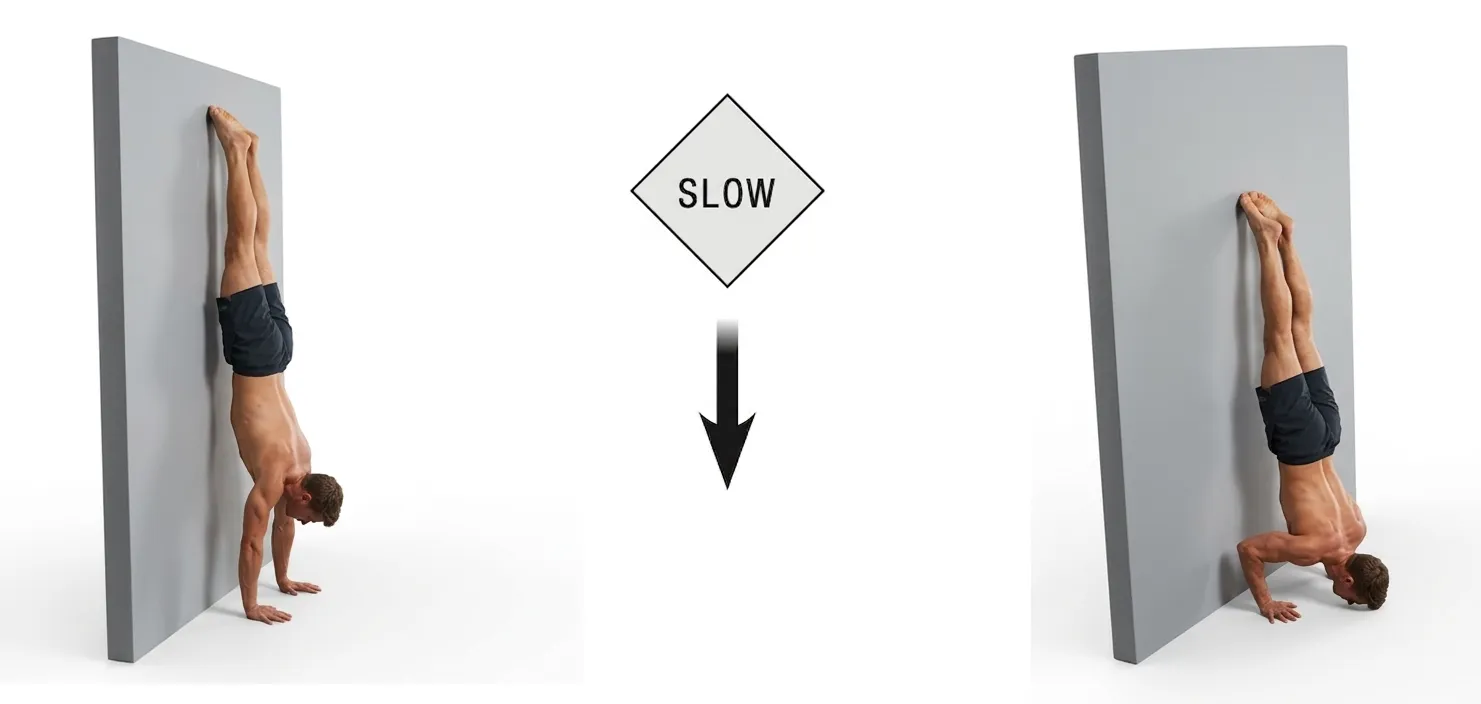
The wall headstand pushup eccentric is the quiet workhorse of the vertical pressing chain. It teaches you to own your full bodyweight overhead by controlling only the lowering half of the movement, with the wall handling balance. Master a slow, straight descent here and the full wall headstand pushup stops feeling impossible and starts feeling inevitable.
What Is the Wall Headstand Pushup Eccentric?
The wall headstand pushup eccentric is the controlled lowering phase of a headstand pushup performed against a wall. You start in a wall handstand with the body straight and heels barely touching the wall, then bend at the elbows and lower your head toward the floor as slowly as possible before stepping or kicking back to reset. There is no pressing phase to fight for: the entire exercise is the descent.
It sits at Level 3 in the Handstand Pushups branch of the BodyTree progression system, a vertical pressing line that runs from pike pushups all the way to freestanding handstand pushups. According to Overcoming Gravity, this is the intermediate eccentric step between the box headstand pushup and the full wall headstand pushup, the point where you first carry your entire bodyweight through the overhead range.
Prerequisites
Before training wall HSPU eccentrics you should own the box headstand pushup for 3 clean sets, keeping your elbows tucked and reaching full depth to the floor each rep. You also need a confident wall handstand hold, ideally in the stomach-to-wall position, so you can enter the top of the movement under control rather than crashing into it.
If the wall handstand still feels precarious, spend a few weeks accumulating stable 30 to 45 second holds before loading the eccentric. A shaky entry turns a strength exercise into a balance scramble.
The Progression Chain
Each step increases how much bodyweight your shoulders and triceps carry through the overhead range. The eccentric bridges the gap: box pushups bias weight onto the arms gradually, while the wall eccentric asks you to control all of it on the way down. Once you can lower under control, the concentric wall headstand pushup becomes the natural next rung.
Sets, Reps, and Training Frequency
Progression standard: 3 sets of 5 controlled eccentrics, each descent lasting 5 to 10 seconds. Train vertical pressing 2 to 3 times per week with a full day of rest between sessions. Overcoming Gravity is explicit that eccentrics fatigue the body more than ordinary concentric reps because they recruit the high-threshold motor units immediately, so respect the recovery cost. If your descents get faster or your form breaks down week to week, that is a signal to add rest, not volume.
Coaching Cues
- Lower for a full 5 seconds. A 3 second drop is too fast. Count out loud or use a metronome, because the slow phase is where the adaptation lives.
- Keep the body straight, do not arch. Use the stomach-to-wall position and keep your hands close to the wall to prevent the back from bowing as your head descends.
- Let the elbows track over the wrists. A natural 30 to 45 degree flare during the descent is fine. Fighting to keep them fully pinned can strain the wrists.
- Heels are the only wall contact. If the back of your head brushes the wall, you are arching.
Common Mistakes
- Rushing the descent. The most common error is treating this as a controlled fall. Five full seconds, minimum. Speed here steals the whole benefit.
- Arching the back. Using the back-to-wall variation with heels pinned tends to force a lumbar arch. Switch to stomach-to-wall and keep hands close to the wall.
- Flaring the elbows wide. A little flare is natural, but letting the elbows blow out to the sides, especially as fatigue sets in, robs you of forward-backward stability and stalls later skills.
- Chasing volume over quality. Ten sloppy negatives build less than three clean ones. Stop the set when control goes.
Prehab: Protecting the Wrists and Shoulders
Inverted pressing stacks real load on the wrists and shoulders, so prime them before every session. Spend a few minutes on wrist mobility, such as gentle floor rocks and finger and palm pushes in both directions, then activate the shoulders with light overhead reaches. Overcoming Tendonitis frames this as the warm-up and mobility phase whose entire job is to prepare tissues that are otherwise easy to reinjure.
If a nagging wrist or elbow ache appears, do not train through pain that steadily worsens. Overcoming Tendonitis warns about the trap of tissue that warms up enough to feel fine mid-session yet keeps degrading. Reduce volume or intensity early rather than pushing into a stubborn tendinopathy.
Longevity: Training Vertical Pressing for the Long Haul
The vertical pressing chain rewards patience. Eccentrics are potent but taxing, so treat them as a concentrated dose rather than an everyday staple. Two or three quality sessions a week, framed by consistent wrist and shoulder prehab, will carry you further than daily grinding. Overcoming Gravity's guidance is blunt: when progress stalls on eccentric-heavy work, the fix is usually more rest, not more reps. Build the habit of ending sets while form is still crisp and this movement becomes a durable bridge to years of pressing skills.
Related Guides
Frequently Asked Questions
How slow should the wall headstand pushup eccentric be?
Aim for a 5 to 10 second lowering phase. Overcoming Gravity recommends this range for the intermediate eccentric because control and consistency, not speed, drive the adaptation. A descent faster than 5 seconds is too quick to build the strength you need.
Should I use the stomach-to-wall or back-to-wall position?
Stomach-to-wall is preferred because it keeps the body straight and discourages arching. The back-to-wall variation is acceptable if you are not yet comfortable facing the wall, but pinning your heels there tends to force a lumbar arch, so keep your hands close to the wall to limit it.
How long until I can do a full wall headstand pushup?
Most trainees who own the box headstand pushup and train eccentrics consistently 2 to 3 times per week reach a controlled concentric wall headstand pushup within a few months. The pace depends on wrist and shoulder recovery, so add rest rather than volume when progress stalls.
BodyTree tracks your progression through all 251 calisthenics skills — automatically generated programs, video proof, and a community of serious practitioners.
Get BodyTree — Free on iOS & Android