
60-Second Plank: How to Learn It
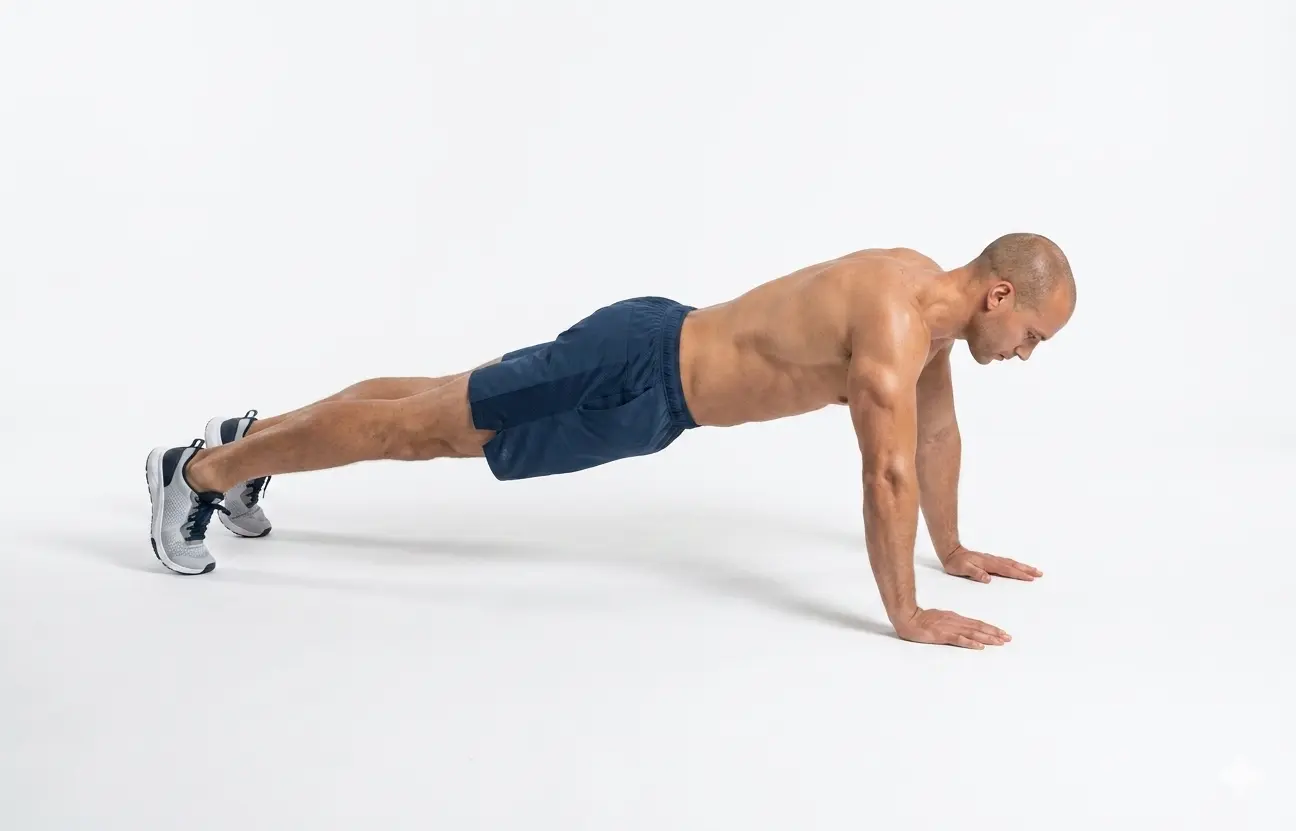
If you have ever set a timer, dropped into a plank, and watched your hips sink while your lower back begged you to stop at twenty seconds, you are in exactly the right place. You do not need a strong core to start training the plank. The plank is how you build one. A steady 60-second hold is one of the most useful milestones a beginner can chase, because it teaches your whole midsection to stay braced and still under load, which is the same skill every harder calisthenics move quietly depends on. No gym, no equipment, no background required. Just the floor and a little patience.
What Is the 60-Second Plank?
The plank is an isometric hold: you get into a straight, braced position and simply keep it, rather than moving up and down. In the push-up-position plank, your arms are fully extended under your shoulders, your body forms one straight line from the back of your head to your heels, and your core holds that line against gravity. The 60-second plank sits in the Core branch of the BodyTree progression system, one step past the 25-second hold, and the target is a calm, honest minute with no sagging and no shaking your way through it.
Trainers call this anti-extension work: your abs are fighting to stop your lower back from arching and your hips from dropping toward the floor. That is a real, trainable strength quality, and it carries directly into moves like the ab wheel, the L-sit, and eventually holding a rigid body in a handstand.
Prerequisites
The only true prerequisite is a shorter plank done well. Before chasing a full minute, you want a clean 25-second plank for 3 sets with your hips level and your breathing steady. If a straight-arm plank is still too much, start on your knees or with your hands raised on a couch or a sturdy table. Raising your hands makes the hold dramatically easier, and lowering them over the weeks is its own smooth progression toward the floor.
The Progression Chain
Each rung adds either time or instability, never both at once. You earn the 60-second hold from a solid 25-second one, and once a strict minute feels genuinely stable, you stop adding time and start removing points of contact instead. Longer and longer planks have sharply diminishing returns. The smarter next step is to lift one arm and the opposite leg, which forces your core to resist twisting on top of resisting the sag.
Sets, Reps, and Training Frequency
Progression standard: 3 sets of a 60-second hold with strict form. You do not need to reach a minute in one go. Accumulate it. Hold for as long as your form stays honest, whether that is 20 or 40 seconds, rest a minute, and repeat until you have banked three quality sets. Add roughly 5 seconds per set each week. Train it 2 to 3 times per week, easily folded into the start or end of any session, and stop each set the moment your hips start to drop rather than grinding out ugly seconds that only teach your body to sag.
Coaching Cues
- Squeeze your glutes and tuck your hips slightly under. This is the single cue that flattens a sagging lower back and turns a wobbly hold into a solid one.
- Push the floor away. Actively press through your hands so your upper back rounds into a very subtle dome instead of collapsing between the shoulder blades.
- Breathe steadily. Do not hold your breath. Take slow, shallow breaths while keeping your stomach braced, so you can stay tense for the full minute.
- Long, straight line. Reach the crown of your head forward and your heels back, keeping your neck neutral rather than craning to watch the timer.
Common Mistakes
- Sagging hips. The most common fault by far. A dropped hip loads your lower back instead of your abs. Stop the set when it happens; that failed rep is your real limit.
- Piking up. Lifting the hips high into an upside-down V makes the hold easier by cheating the tension out of your core. Keep the straight line.
- Holding your breath. Bracing is not the same as not breathing. Holding your breath spikes tension and cuts your hold short.
- Chasing five-minute planks. Once a strict minute is easy, more time barely helps. Progress by adding instability, not endless seconds.
Related Guides
Frequently Asked Questions
How long should a beginner be able to hold a plank?
A strict 60-second hold with level hips and steady breathing is an excellent beginner goal. Once you can do three honest sets of a minute, add difficulty rather than more time.
Is a longer plank always better?
No. Past about a minute, extra time gives sharply diminishing returns and mostly builds endurance for standing still. Progress by removing points of contact, such as lifting one arm and the opposite leg.
Why do my hips sag or my lower back hurt during planks?
That usually means your glutes and abs are not braced enough, so your lower back takes the load. Squeeze your glutes, tuck your hips slightly under, and stop the set the moment the line breaks.
How often should I train planks?
Two to three times a week is plenty. The plank recovers quickly, so you can add it to the start or end of most sessions without needing a dedicated core day.
BodyTree tracks your progression through all 251 calisthenics skills — automatically generated programs, video proof, and a community of serious practitioners.
Get BodyTree — Free on iOS & Android