
Bent-Knee Plank: How to Learn It
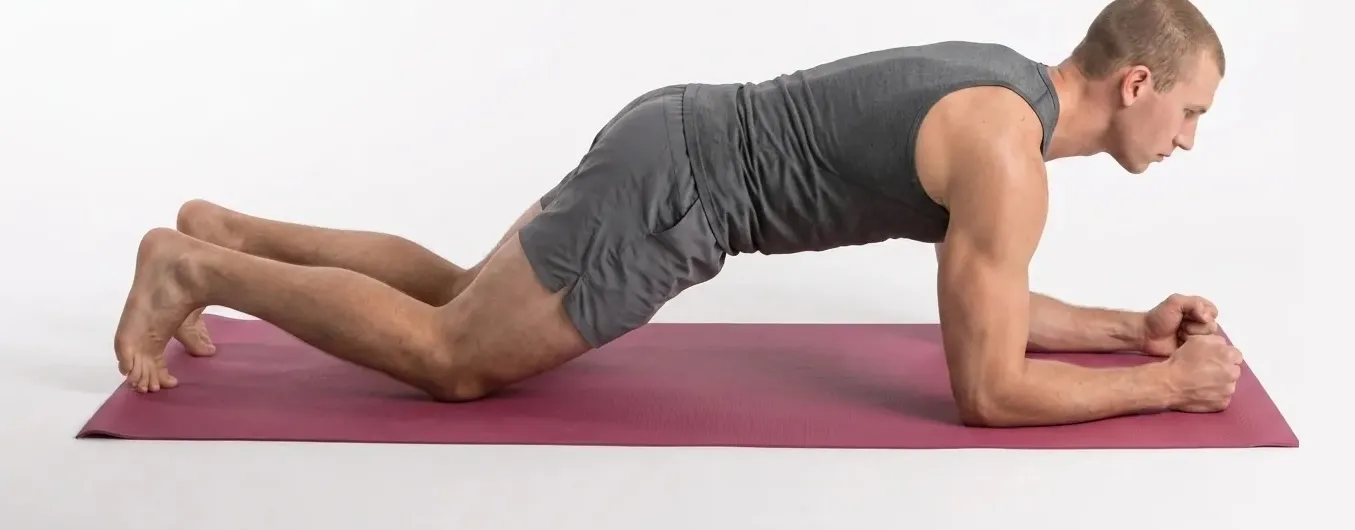
If you have never trained your core and you are not sure you can hold a plank at all, this is the exact place to begin. The bent-knee plank is a plank done from your knees instead of your toes, and it asks for almost nothing on day one: a patch of floor, your own bodyweight, and about twenty seconds of honest effort. You do not need a gym, a flat stomach, or any background in fitness. This is the first node in BodyTree's Core branch for a reason. It teaches your body the single most important lesson in calisthenics, which is how to hold one solid, straight line under tension, and it does so at a level a complete beginner can actually reach today.
What Is the Bent-Knee Plank?
The bent-knee plank is an isometric core hold. You rest on your forearms and your knees, keep a straight line from your knees through your hips to your head, and simply do not let that line break. Because your knees carry part of your bodyweight, the lever your abs have to control is shorter, so the exercise is far more forgiving than a full plank on your toes.
In Overcoming Gravity, Steven Low groups the plank family under what he calls positional or body-tension drills. These are not about grinding out reps. Their whole job is to teach your body proper positioning and to build the stabilizing strength in your core that every later skill depends on. Low is direct about this: for beginners, these drills are vital, and the plank is where you learn to hold a hollow, braced position in the first place.
Who This Is For, and Why It Works
This move is written for the person who has never done calisthenics and quietly doubts they can. You do not need to "get in shape first." The bent-knee plank meets you where you are: if a full plank makes your lower back sag or your arms shake within a few seconds, dropping to your knees removes exactly enough load for you to hold good form instead of just surviving.
It works because core strength in calisthenics is mostly about resisting movement, not creating it. Your abs learn to keep your spine still while the rest of your body is under load. That anti-movement strength is what keeps your lower back safe in push-ups, what stops your hips from sagging in a hang, and what eventually holds your body rigid in advanced skills. Every one of those starts here.
Prerequisites
There are none beyond being able to get down onto the floor. That is the point. If you can lie face down and prop yourself onto your forearms, you can start today. If kneeling is uncomfortable, fold a towel or mat under your knees. The only real requirement is a willingness to hold the position honestly rather than letting your hips drift up or your back cave in.
The Progression Chain
The bent-knee plank is the very first node in the Core branch, so there is nothing before it. Once you can hold it for 20 seconds across 3 clean sets, you graduate to the full plank on your toes, first for 25 seconds, then 60. From there the branch introduces instability with the one-arm, one-leg plank, and eventually loads the core dynamically with the ab wheel. Each step adds either time, leverage, or instability, but they all trace back to the position you learn right here.
Sets, Reps, and Training Frequency
The BodyTree unlock standard for the bent-knee plank is 3 sets of a 20-second hold. Rest about a minute between sets. Because planks are stability work rather than heavy strength work, they recover quickly, so you can train them often. Two to four short sessions a week is plenty for a beginner, and you can even fold a set or two into your warm-up. Low actually recommends 30 to 60 seconds of plank as part of a warm-up routine, which tells you these holds are meant to be frequent and low-stress, not maximal grinders.
Progress by adding a few seconds at a time. When 20 seconds feels controlled and your form holds from the first second to the last, add five seconds, or add a fourth set, before you think about moving to your toes.
Coaching Cues
- Straight line, knees to head. Your hips should not pike up toward the ceiling or sag toward the floor. Picture a broomstick laid along your back touching your head, upper back, and hips at once.
- Brace the core and squeeze the glutes. Think about gently pulling your ribs down and tucking your hips under. Low describes creating a very subtle dome through the back rather than an arch. Squeezing your glutes helps lock the pelvis in place.
- Forearms down, shoulders active. Press your forearms into the floor and push the ground slightly away so your upper back does not collapse between the shoulder blades.
- Breathe. Keep breathing shallowly through the hold. Holding your breath makes 20 seconds feel like a minute.
Common Mistakes
- Letting the back arch or sag. This is the big one. Low warns that when your back arches, your hip flexors (the psoas) take over from your abdominals and pull on the lumbar spine, which is a common source of plank-related back pain. Keep the line flat and the abs, not the low back, doing the work.
- Hips flexors doing the job. If you feel the front of your hips straining more than your stomach, your hips have piked up. Lower them until the effort moves into your abs.
- Chasing time before owning position. A shaky 45-second hold with a sagging back teaches your body the wrong pattern. A clean 20-second hold is worth far more. Quality of position beats duration every time at this stage.
- Skipping it because it feels too easy or too basic. The plank is unglamorous, but it is the literal foundation of the Core branch. Give it a couple of weeks of honest attention and everything above it gets easier.
Related Guides
Frequently Asked Questions
How long should I hold a bent-knee plank as a beginner?
Aim for 3 sets of 20 seconds with clean form. That is the BodyTree unlock standard. When 20 seconds feels controlled from start to finish, add five seconds or a fourth set before moving to a full plank on your toes.
Is the bent-knee plank easier than a normal plank?
Yes. Resting on your knees shortens the lever your abs have to control, so it takes far less strength to hold good position. That makes it the ideal starting point if a full plank makes your back sag or your arms shake within seconds.
Why does my lower back hurt during planks?
Usually because your back is arching or sagging instead of staying flat. When it arches, your hip flexors pull on your lumbar spine. Fix it by squeezing your glutes, gently tucking your pelvis, and keeping a straight line from knees to head.
How often can I train the plank?
Often. Planks are stability work and recover quickly, so two to four short sessions a week works well, and you can even use a set or two as part of your warm-up.
BodyTree tracks your progression through all 251 calisthenics skills — automatically generated programs, video proof, and a community of serious practitioners.
Get BodyTree — Free on iOS & Android