
L-Sit Dips: How to Learn It
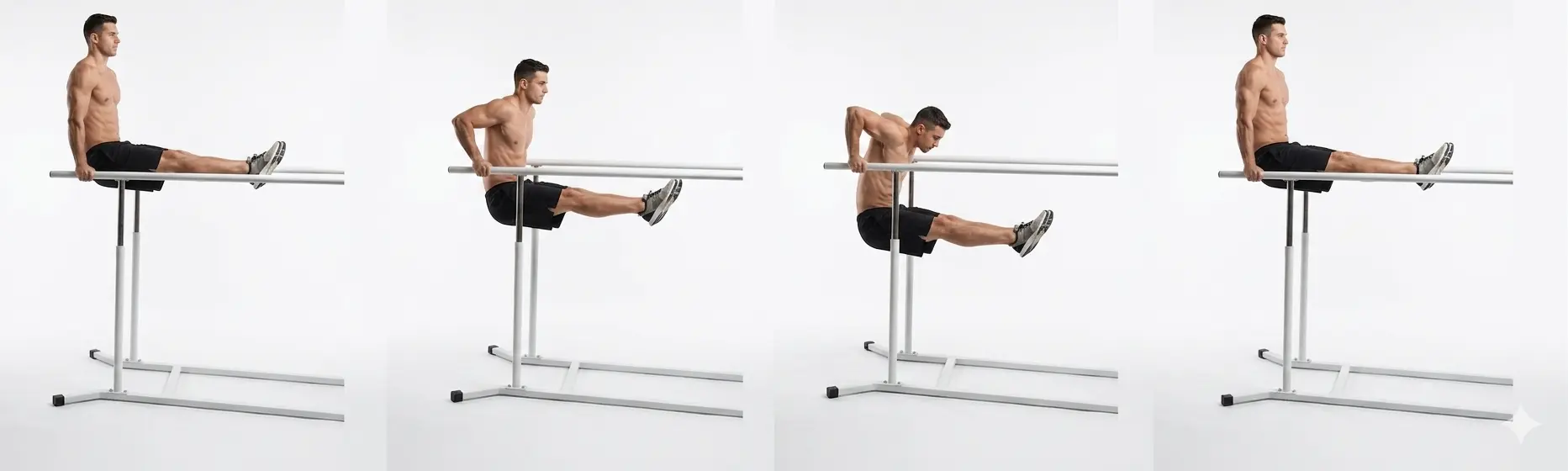
If the words "L-sit dips" sound like something only a gymnast could do, take a breath. This is not your starting point, and nobody expects it to be. It is a milestone you grow into, one honest rep at a time. The real beginning is much smaller and much friendlier: learning to sit at the bottom of a dip without your shoulders shrugging up to your ears, and learning to hold your legs out in front of you for a few seconds. Master those two humble skills and the L-sit dip stops being a party trick and becomes the obvious next step. This guide meets you wherever you are today, whether you are still building your first full dip or already banging out clean sets and looking for what comes next.
What Is an L-Sit Dip?
An L-sit dip is a parallel bar dip performed with your legs held straight out in front of you, parallel to the floor, so your body makes the shape of the letter L the whole time. You lower until your shoulders drop below your elbows, then press back up to a locked-out support position, all while your legs never drop.
Holding that L position does something clever and slightly cruel: it shifts your center of mass backward by several inches. That small shift increases the load on your triceps and shoulders and forces your core to stabilize hard against the tendency to swing. The result is a dip that looks similar to a normal one but demands noticeably more control, strength, and balance. It is the same reason an L-sit pull-up is harder than a regular pull-up. Nothing magic, just leverage working against you on purpose.
Prerequisites: What You Need First
You do not attack an L-sit dip cold. It sits on top of two separate skills, and the honest path is to own both before you combine them.
- Strict parallel bar dips. You should be able to perform clean, full-depth dips with your shoulders sinking below your elbows and your scapulas staying down, not shrugged. A working target is three sets of comfortable full-range reps before you add the L. If a full dip is still out of reach, that is your true starting point, not this move.
- A basic L-sit hold. You need enough compression and hip-flexor strength to hold your legs out in front of you for several seconds. A tuck L-sit, where the knees stay bent, is a perfectly good place to begin and lets you train the position without the full difficulty.
If either piece is missing, that is not failure. It is simply information about which brick to lay next. Build the strict dip and the L-sit separately, and the combination arrives far sooner than if you grind away at the full version before you are ready.
Where L-Sit Dips Sit in the Progression Chain
Every skill lives inside a chain, and seeing the whole road removes the mystery. A true beginner starts at jumping dips, using a small hop to get to the top, then lowers under control. From there you earn slow eccentrics, then full strict dips, and only then does the L-sit dip enter the picture. After it, the path continues toward forward-lean dips and eventually the one-arm dip, a genuinely elite feat that most people never need to chase.
The point is not to rush. Each rung builds the strength and joint tolerance the next one assumes you already have. If you skip ahead, the gap does not disappear, it just shows up later as a stalled rep or a cranky shoulder. Respect the order and the order rewards you.
Sets, Reps, and Frequency
Because the L position steals some of your strength, you will complete fewer reps than in a normal dip, and that is expected. Do not chase a rep count you would hit without the L. Chase clean reps with your legs pinned in place.
A sensible approach is three working sets, stopping each set a rep or two before your legs start to sag or your form breaks down. Full range of motion beats extra reps every time here: a deep, controlled L-sit dip is worth more than three shallow ones. Two or three sessions a week, with at least a day of rest between hard pushing days, gives your triceps, shoulders, and connective tissue time to adapt. When you can hold the L cleanly across all three sets with full depth, you are ready to nudge the difficulty upward.
Coaching Cues That Make It Click
- Start and finish depressed. Begin in the L-sit support with your shoulders pulled down away from your ears. Keep them there as you descend. At the very bottom you may let them relax, but pull them back down before you press up.
- Legs stay level. Fight to keep your legs parallel to the floor for the entire rep. They will want to drop as you press out of the bottom. That is the exact moment to squeeze harder.
- Go deep. Lower until your shoulders pass below your elbows. Shallow reps feel easier but skip the strength you came for.
- Let the elbows flare slightly. A small amount of elbow flare is normal and fine here. Do not force them pinned to your sides.
- Expect a shorter range at first. The balance demand may limit how deep you can go early on. That improves quickly as you practice, so give it a few sessions before judging yourself.
Common Mistakes to Avoid
- Letting the legs drop. The single most common fault. Sagging legs turn an L-sit dip back into a regular dip and rob the move of its purpose. Keeping your hands slightly in front of you can help counter the forces that pull your legs down.
- Shrugging the shoulders. If your shoulders creep up toward your ears at the top, you lose the stable, safe position and stress the joint. Keep them packed down.
- Cutting the depth. Half-reps feel productive but build half the strength. Prioritize hitting full depth even if it means fewer reps.
- Rushing past the prerequisites. Trying to force L-sit dips before your strict dip and basic L-sit are solid leads to sloppy reps and sore joints. Back up, build the base, and return stronger.
Prehab: Keeping Your Shoulders and Elbows Happy
Dips load the shoulders and elbows through a deep range, so a little maintenance goes a long way. The research on tendon health is consistent: connective tissue adapts more slowly than muscle, so it needs patience and gradual loading, not heroics.
Warm up the pushing muscles before you dip. A few sets of easy support holds, some band work for the shoulders, and light wrist and elbow prep prime the tissues for load. If you feel a sharp pinch at the bottom of a dip, shorten your range slightly rather than pushing through it, and build the depth back gradually. Slow, controlled eccentrics, lowering under tension for a two or three count, are one of the most reliable tools for keeping elbows resilient. Discomfort that lingers into the next day is a signal to reduce volume, not to tough it out.
Longevity: Training This for the Long Haul
The people who still train dips happily years from now are the ones who treated their joints as partners rather than obstacles. That means progressing when your form is clean, not when your ego is impatient. It means adding difficulty in small steps, holding a rep quality standard across every set, and taking the occasional lighter week when things feel run down.
L-sit dips are a foundation move for bigger skills down the line, including smooth muscle-ups, so the control you build here pays forward for years. Treat every rep as practice in staying tight, staying deep, and staying honest, and this skill will serve you long after the novelty wears off.
Related Guides
Frequently Asked Questions
Do I need to master the full L-sit before trying L-sit dips?
Not the full straight-leg version. A tuck L-sit, where your knees stay bent, gives you enough of the position to start. Build the full L-sit alongside your dips and combine them as both improve.
Why do my legs keep dropping when I press up?
That is the most common fault and it usually shows up at the hardest part of the rep. Squeeze your hip flexors harder as you press, and try keeping your hands slightly in front of you to counter the forces pulling your legs down.
How many L-sit dips should a beginner aim for?
Fewer than your normal dip count, and that is correct. Aim for three sets of clean, full-depth reps with your legs held level, stopping a rep or two before your form breaks.
Are L-sit dips bad for my shoulders?
Not when you build them on a solid strict-dip base and progress gradually. Warm up, keep your shoulders packed down, and shorten your range if you feel a sharp pinch. Discomfort that lingers overnight means back off the volume.
BodyTree tracks your progression through all 251 calisthenics skills — automatically generated programs, video proof, and a community of serious practitioners.
Get BodyTree — Free on iOS & Android