
Parallel Bar Dip Eccentrics: How to Learn It
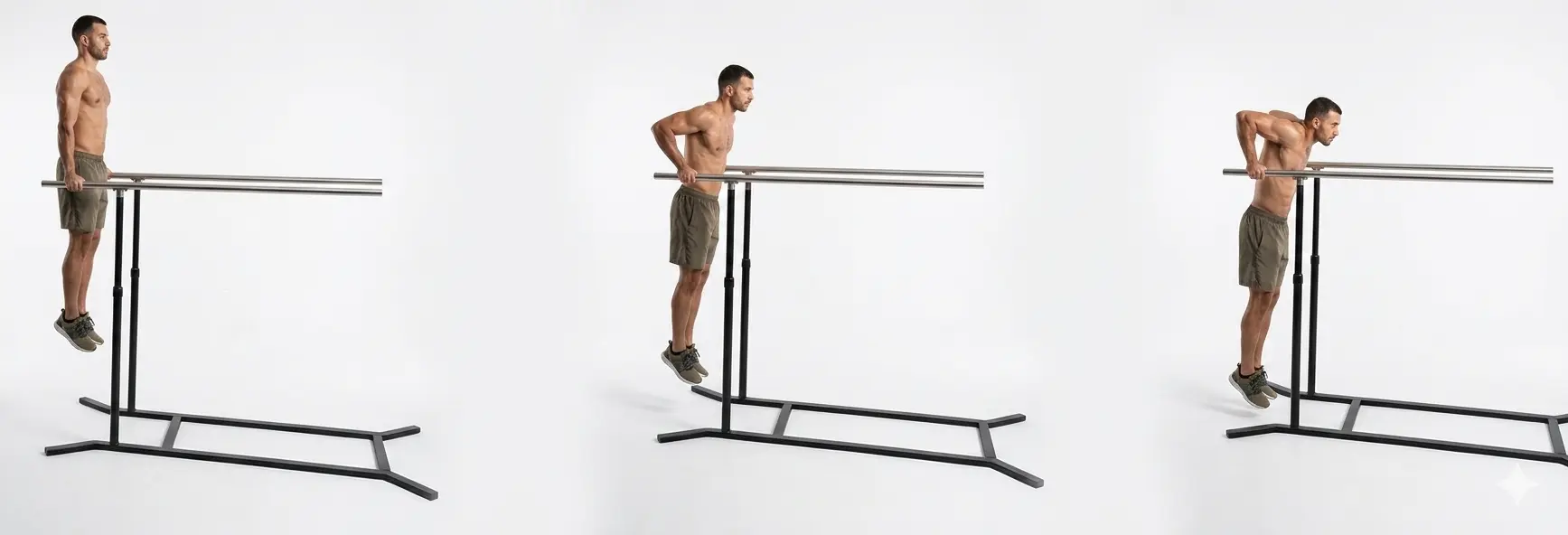
If you have never done a dip in your life and you are not sure you ever will, this is the exercise that changes that. The parallel bar dip eccentric asks you to do only the easy half of a dip: you start at the top and lower yourself down slowly. You do not have to press yourself back up, and that is exactly the point. Lowering under control is something almost anyone can start today, and it is one of the few negatives that Overcoming Gravity actually recommends for beginners because it is the fastest honest route to your first real dip. No gym membership, no strength background, no ego required. Just a set of parallel bars and a willingness to go slow.
What Is the Parallel Bar Dip Eccentric?
A dip is a vertical push: you support yourself on two parallel bars, lower your body until your shoulders drop below your elbows, then press back up to straight arms. The eccentric version keeps only the lowering half. You get to the top however you can, usually with a small jump, and then you lower yourself as slowly as you can manage all the way to the bottom. That slow lowering is called the eccentric, or negative, phase.
This move lives in the Dips (Parallel Bar) branch of the BodyTree progression system. It sits one step above jumping dips and one step below the full dip. Training it builds the exact strength and muscle you need to eventually press yourself back up on your own.
Prerequisites
You do not need to be able to do a single dip to start here. That is the whole idea. What you do need is a way to reach the top support position, usually a small hop off the ground, and enough shoulder comfort to sit in that position with straight arms and your shoulder blades pulled down. If getting to the top feels like too much, spend a couple of weeks on PB jumping dips first, then come back. If the bottom of the dip pinches or hurts your shoulder, Overcoming Gravity is blunt about it: put the skill on the shelf and work on shoulder mobility until you can do it pain free.
The Progression Chain
Each step adds a little more of the work back onto you. Jumping dips let your legs help on the way up. The eccentric removes the press entirely and asks you to own the lowering. The full dip removes the jump and demands you press yourself up unassisted. Building strong, controlled negatives is what makes that first full rep possible instead of a lucky struggle. To reach this step you would have trained 3 sets of jumping dips; the standard to move on from here is 3 sets of 5 slow, clean negatives.
Sets, Reps, and Training Frequency
The book's target is deliberately low in reps and high in control: aim to take six to eight seconds to lower a single repetition, working up toward seven to ten seconds as you get stronger. Start with two to three sets of two to three reps, and build toward the BodyTree unlock standard of 3 sets of 5. Train pushing movements two to three times per week, leaving at least a day between hard dip sessions so the shoulders and elbows recover. This is quality over quantity work: five beautiful negatives beat fifteen sloppy ones every time.
Coaching Cues
- Start tall and depressed. Reach the top support with straight arms and your shoulder blades pulled down away from your ears before you begin lowering.
- Lower uniformly. The most common error is lowering too slowly at the top, burning all your energy, then dropping through the bottom half fast and out of control. Spread the six to eight seconds evenly across the whole range.
- Chase depth. Lower until your hands are next to your armpits, or as deep as your current mobility allows without pain.
- Reset at the bottom. Once you reach the bottom, step or hop off rather than grinding out a bad press. You are only training the negative for now.
Common Mistakes
- Dropping instead of lowering. If gravity is doing the work, the exercise is not. Fight the descent the entire way down.
- Front-loading the tempo. Going super slow for the first inch then plummeting the rest wastes the rep. Lower at a steady, uniform speed.
- Shrugging into your ears. Letting the shoulders ride up at the top puts strain on the joint. Keep the shoulder blades pulled down.
- Pushing through pain. Sharp shoulder pinching is a signal, not a challenge. Back off, build mobility, and return when it is pain free.
Prehab: Protecting Your Shoulders and Elbows
Dips load the shoulder and elbow harder than almost any beginner push, so a little insurance goes a long way. Warm the shoulders with easy support holds and band pull-aparts before you train. If you feel nagging elbow tenderness, Overcoming Tendonitis points out that free-rotating grips often calm irritated tendons because they do not lock the joint into one fixed path; that is one reason rings can feel kinder than a fixed bar for some people, though rings are also less stable. The research the book cites also favors combining slow eccentric work with light isometric holds for cranky tendons, which is essentially what disciplined negatives already give you. Progress the load gradually and let mild soreness, not pain, be your guide.
Longevity: Playing the Long Game
The riders who still train dips years later are the ones who never rushed the bottom range. Shoulder mobility is the limiter for most beginners: if you cannot reach a comfortable deep position, spend a few weeks opening the chest and shoulders before chasing depth or reps. Keep your volume modest, respect rest days, and treat any joint pain as a reason to regress rather than push. Strength built slowly on healthy joints compounds for a lifetime; strength forced through pain tends to collect injuries.
Related Guides
Frequently Asked Questions
Are eccentric dips safe for complete beginners?
Yes, with control. Overcoming Gravity generally steers beginners away from eccentrics, but dips and pull-ups are the two named exceptions because the negative is the most effective way to build toward the first full rep. Keep the load light, lower under control, and stop if you feel shoulder pain.
How long until I can do a full dip?
Most beginners training negatives two to three times a week reach their first full parallel bar dip within a couple of months. Progress comes from steadily lengthening your lowering time and cleaning up depth, not from adding lots of reps.
What if I do not have parallel bars?
Sturdy parallettes, the corner of two kitchen counters, or the back of two solid chairs can stand in, though you lose some range of motion. A gym's assisted dip machine also works well for building toward an unassisted rep.
Why lower for six to eight seconds specifically?
That window gives your muscles and tendons enough time under tension to build real strength and size across the full range. Faster than that and you skip the hard part; much slower and you burn out before reaching the bottom in good form.
BodyTree tracks your progression through all 251 calisthenics skills — automatically generated programs, video proof, and a community of serious practitioners.
Get BodyTree — Free on iOS & Android