
Parallel Bar Dips: How to Learn It
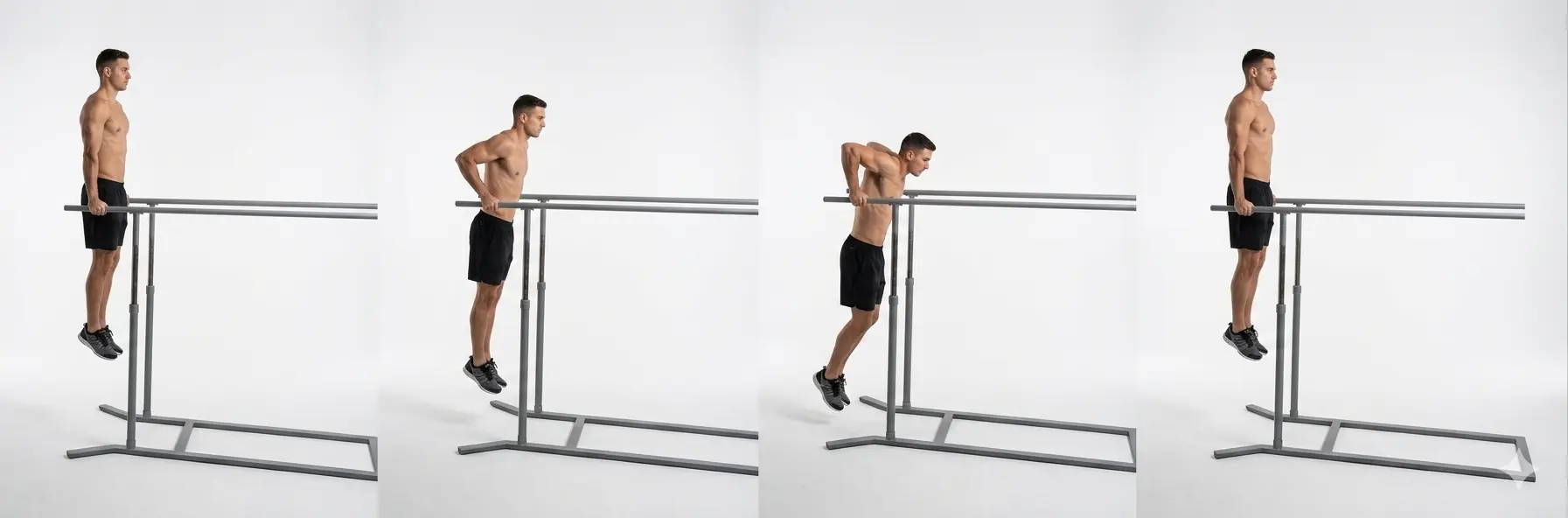
If you have never done a dip in your life, that is completely fine. You do not need to already be strong, and you do not need a gym membership to start. All a dip really asks is that you hold yourself up between two bars and lower under control, and there is a gentle on-ramp for every part of that. In this guide we start at the very bottom, with a jump-assisted version almost anyone can attempt today, and walk step by step toward a clean, full-range dip. No shame, no rush, no need to "get in shape first."
What Is a Parallel Bar Dip?
A dip is a vertical push. You support yourself on two parallel bars with your arms straight, lower your body until your shoulders drop below your elbows, then press back up to a locked-out top. It is one of the staples of gymnastics strength work and it lives in the Push family of the BodyTree progression tree. According to Overcoming Gravity (Steven Low), once you can perform five to ten honest full-range dips your pressing base is strong enough to start unlocking bigger skills like the muscle-up.
You can train dips on a dip station, on sturdy parallettes, or even on the corner of two kitchen counters or the arms of two solid chairs. The movement is the same wherever you find your bars.
Prerequisites
The one thing worth owning before you chase full dips is the support hold: climb to the top of the bars, arms locked straight, shoulders pushed down away from your ears, and simply hold still for 20 to 30 seconds. If that already feels shaky, that is your first training target and it is a perfectly good place to begin. Beyond that, no special mobility or background is required. If your shoulders complain in the deep bottom position, shorten your range for now and build depth over time rather than forcing it.
The Progression Chain
Each rung adds a little more of the load your arms have to carry. Jumping dips let your legs share the work, eccentrics teach your body to control the lowering, and the full dip is where you finally press your own bodyweight with no help. You do not skip ahead — you earn the next rung when the current one feels genuinely easy.
Sets, Reps, and Training Frequency
The BodyTree unlock standard for a full parallel bar dip is 3 solid sets of clean, full-range reps. While you are still building, Overcoming Gravity suggests treating the eccentric step as its own drill: lower for six to eight seconds per rep, two to three reps per set, two to three sets, to bank the controlled strength that makes your first real dip possible. Train pushing two to three times per week and leave at least a day between sessions so your elbows and shoulders recover. Consistency across weeks beats any single heroic workout.
Coaching Cues
- Depress your shoulders. Push the tops of the bars down and away so your shoulders sit low, not shrugged up by your ears.
- Lower until your shoulders drop below your elbows. That is a full dip; anything shallower is a partial that trains partial strength.
- Stay tight and straight. Keep your core braced and your body in one line so the press stays honest.
- Keep your head neutral. Try not to crane your chin up as you push out of the bottom.
Common Mistakes
- Cutting the depth. Half-reps feel productive but stall real progress. Own the full range even if it means fewer reps.
- Rushing past regressions. Skipping jumping dips and eccentrics to grind ugly reps builds bad habits and cranky joints. The regressions are the fast route, not the slow one.
- Lowering unevenly. Dropping fast then jamming the bottom robs you of the control you are training. Lower at one steady speed the whole way down.
- Ignoring shoulder discomfort. Sharp pain in the deep position is a signal to shorten range and build mobility, not to push through.
Prehab and Longevity
Dips load the shoulders and elbows through a big range, so a little care keeps them feeling good for years. Warm up your shoulders and wrists before pressing, and build depth gradually rather than dropping into a painful deep stretch on day one. Overcoming Tendonitis frames dips as one of the scalable pressing movements you can dial up or down: if your elbows or shoulders are grumpy, regress to a shorter-range dip or a support hold, keep the volume light, and progress by small steps. Pain-free full range beats deep range that hurts, every single time.
Related Guides
Frequently Asked Questions
I cannot do a single dip yet. Where do I start?
Start with the support hold and jumping dips. Holding yourself at the top for 20 to 30 seconds, then using a light jump to assist each rep, builds the exact strength a full dip needs. Most beginners get there in a few weeks of consistent practice.
How deep should a dip go?
Lower until your shoulders drop below your elbows, as far as your shoulders comfortably allow. If the deep position pinches, shorten your range for now and build depth gradually rather than forcing it.
Do I need a gym to train dips?
No. Sturdy parallettes, a dip station at a park, or even two solid, matched surfaces like heavy chairs will work. The movement is the same wherever your two bars are.
How often should I train dips?
Two to three pushing sessions per week with at least a rest day between them. Your elbows and shoulders make their strength gains while you recover, so more is not better here.
BodyTree tracks your progression through all 251 calisthenics skills — automatically generated programs, video proof, and a community of serious practitioners.
Get BodyTree — Free on iOS & Android