One-Arm One-Leg Plank: How to Learn It
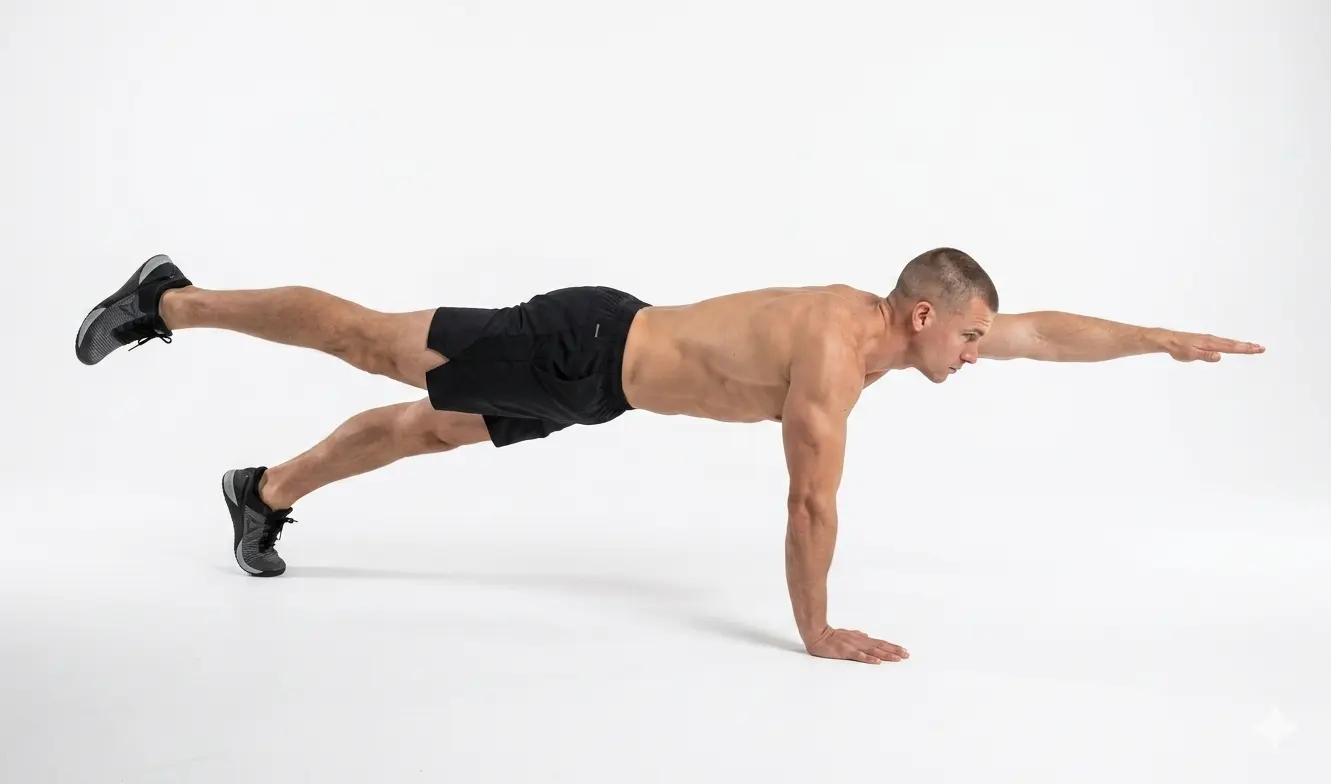
If you can already hold a steady plank, you are closer to a genuine core skill than you think. The one-arm one-leg plank is the plank's next honest step, and it needs no gym, no equipment, and no athletic background. You lift one hand and the opposite foot, and suddenly your core has to fight to keep your hips from twisting toward the floor. That anti-rotation challenge is what builds a core that holds you steady in every other movement. This guide meets you where you are, whether your plank is thirty seconds or two minutes, and walks you from a comfortable regression up to the full hold.
What Is the One-Arm One-Leg Plank?
The one-arm one-leg plank is a plank held on just two points of contact, one hand and the opposite foot, forming a diagonal line across your body. Because those two points sit on opposite corners, gravity tries to rotate your torso toward the open side, and your deep core has to resist that twist. It sits in the Core branch of the BodyTree progression system, one level above a solid sixty-second plank.
Trusted calisthenics references treat the standard plank series as a way to teach your body to stay rigid against gravity. The one-arm one-leg version simply adds a rotational force to that same lesson, so you learn to brace in a way that carries straight into pull-ups, push-ups, and eventually harder core skills.
Prerequisites
You are ready for this move once you can hold a clean, motionless plank for sixty seconds with your hips level and your lower back neither arching nor sagging. If sixty seconds feels shaky, spend another week or two there first. There is no shame in building the base longer, a stable plank is the whole point. You do not need any strength beyond that, and you do not need to be lean or fit to start.
The Progression Chain
Each step teaches your core to stay rigid under a little more demand. The knee plank teaches the position, the full sixty-second plank builds the endurance, and the one-arm one-leg plank adds the anti-rotation challenge that prepares you for rollout-style core work like the ab wheel.
Sets, Reps, and Training Frequency
This is an isometric hold, so you train time rather than reps. Aim for 3 sets of a 30-second hold on each side, working up toward sixty seconds as you get stronger. A useful minimum from the research is twenty-five seconds per side before you consider the level owned. Train it two or three times per week on non-consecutive days, either at the end of a session or as part of a warm-up. Always match your sets left and right so one side does not lag behind.
Coaching Cues
- Brace before you lift. Squeeze your abs and glutes and set a tall plank first, then raise the hand and opposite foot.
- Keep the hips level. The goal is to not let your body twist toward the open side. Imagine balancing a glass of water on your lower back.
- Squeeze your stomach in, do not arch. A subtle rounding is fine, an arched lower back shifts the work off your abs and can cause back ache.
- Breathe steadily. Slow, quiet breaths keep your brace honest through the whole hold.
Common Mistakes
- Letting the hips rotate open. If your torso twists toward the floor, the anti-rotation training is lost. Shorten the hold and keep the hips square instead.
- Arching the lower back. This hands the work to your hip flexors and lower back rather than your abs, and is the usual cause of plank-related back discomfort.
- Rushing past sixty-second planks. If your base plank is not rock solid, the one-arm one-leg version just wobbles. Build the foundation first.
- Lifting the limbs too high. Raise the hand and foot only a few inches. This is a stability drill, not a limb raise.
Related Guides
Frequently Asked Questions
Is the one-arm one-leg plank good for beginners?
Yes, as long as you can already hold a steady sixty-second plank. It needs no equipment and can be regressed by lifting only one hand at a time, making it a very accessible next step.
Why does my body want to twist to one side?
That twist is the exercise. With only two diagonal contact points, gravity places a rotary force on your core, and resisting it is exactly what builds anti-rotation strength. Shorten the hold until you can keep your hips square.
How long should I hold it?
Aim for 30 seconds per side across 3 sets, working up toward sixty seconds. A minimum of about twenty-five seconds per side is a good marker that you own the level.
Will planks help my other calisthenics skills?
Yes. Learning to keep a rigid, braced body carries directly into push-ups, pull-ups, and later core skills. A strong plank is one of the best foundations you can build.
BodyTree tracks your progression through all 251 calisthenics skills — automatically generated programs, video proof, and a community of serious practitioners.
Get BodyTree — Free on iOS & Android