Pull-Up Negatives: How to Learn It
If you have never done a single pull-up, you are exactly who this move is for. There is no shame in that starting point, and you do not need a gym, a coach, or a "base level of fitness" before you begin. You need a bar you can reach and the willingness to do one thing well: lower yourself slowly. That is a pull-up negative, and it is the single most reliable way for a true beginner to build a first real pull-up. The pulling-up part may feel impossible today, but you are almost always stronger lowering down than lifting up, so we start where you are already strong and let that strength grow into the full movement.
undefined
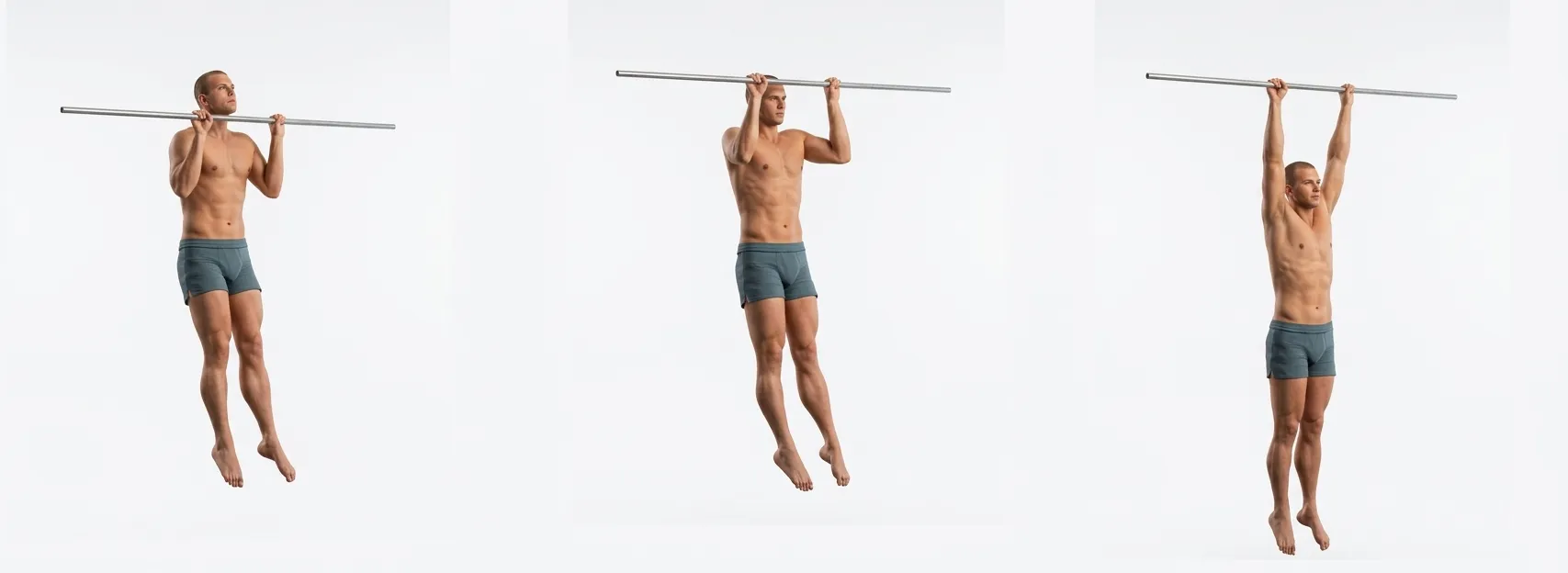
A pull-up negative, also called an eccentric pull-up, is just the lowering half of a pull-up performed on its own. You get your chin above the bar however you can, by jumping up or stepping off a box, and then you resist gravity on the way down, taking roughly five seconds to reach a full, straight-arm hang at the bottom. That is one rep.
The reason this works so well for beginners comes down to a quirk of how muscles produce force. According to Overcoming Gravity by Steven Low, your muscles are meaningfully stronger when lengthening under load than when shortening, on the order of 120 to 150 percent of your lifting strength. So even if you cannot pull yourself up a single inch, you can very likely control the way down. Training that controlled lower is what closes the gap to your first unassisted pull-up.
undefined
You do not need to master anything before your first negative, but a little foundation makes early reps feel safer and more productive. Two things help most:
- A comfortable dead hang. Being able to hang from the bar for 15 to 20 seconds tells you your grip and shoulders can handle the load you are about to control.
- Jumping pull-ups. The move directly before this one in the progression is the jumping pull-up, where a small jump helps you to the top so you get used to the full pattern. Once you can do three sets of those, you are ready to start slowing the lowering phase down into true negatives.
If the bar is too high to jump to, use a sturdy chair or box to step up to the top position. Nothing here requires equipment beyond a pull-up bar and something to stand on.
undefined
Pull-up negatives sit at level 2 in the Pull-ups branch. The move before it is the jumping pull-up (level 1), which teaches the shape of the movement with assistance. To move on from negatives, the goal is three sets of five slow, controlled lowers with a five-second descent each. Clear that and you graduate to the bar pull-up (level 3), the first full-range, pull-yourself-up repetition. Negatives are the honest middle rung that turns "I can't do one" into "I can."
undefined
Keep it simple and keep it frequent. A good beginner target is 3 sets of 5 reps, with each rep lasting about five seconds on the way down. Rest two to three minutes between sets so each lower is genuinely controlled rather than a drop.
Two or three sessions a week is plenty. Overcoming Gravity is clear that eccentric work is demanding and fatigues the body more than ordinary reps, so more is not automatically better. If your progress stalls, the fix is often an extra rest day, not extra volume. Quality of each slow descent beats chasing numbers.
undefined
- Own the top. Start each rep with your chin clearly above the bar and your shoulders pulled down, not shrugged up around your ears.
- Count it down. Aim for a slow, even five-second lower. Fighting gravity the whole way is the entire point.
- Finish long. End every rep in a full dead hang with arms straight. The bottom range is where beginners are weakest, so do not cut it short.
- Stay tight. Squeeze your glutes and brace your midsection so your body stays in one line instead of swinging.
undefined
- Dropping instead of lowering. If you fall the last third of the way, the rep did almost nothing. Slow that bottom range even if it means fewer reps.
- Rushing to add reps. Ten sloppy fast negatives build less than five controlled ones. Progress the tempo and the range first.
- Skipping the full hang. Stopping with bent arms hides your weakest position and delays your first real pull-up.
- Training them every day. Eccentrics need recovery. Two or three sessions a week, with rest between, is the sweet spot for a beginner.
Related Guides
Frequently Asked Questions
undefined
undefined
undefined
undefined
undefined
undefined
BodyTree tracks your progression through all 251 calisthenics skills — automatically generated programs, video proof, and a community of serious practitioners.
Get BodyTree — Free on iOS & Android