Ring Muscle-Up: How to Learn It
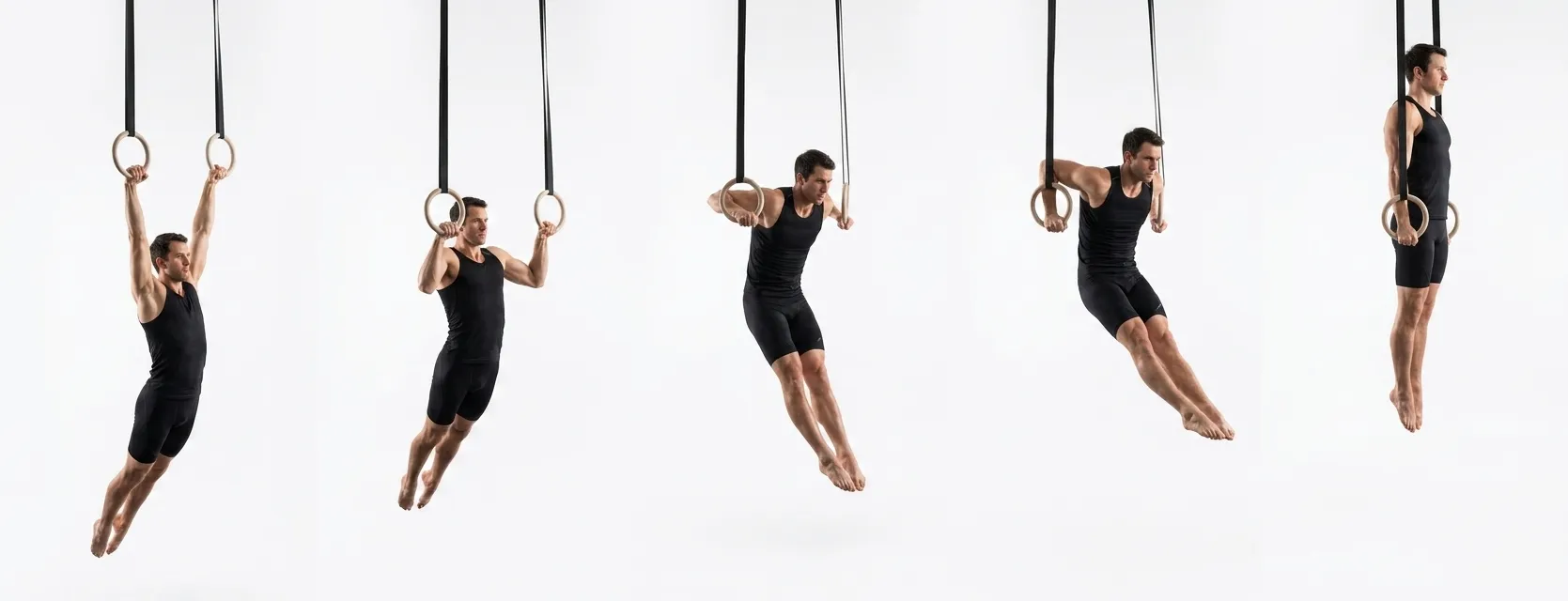
The ring muscle-up is the exercise that divides calisthenics practitioners into two camps: those who have it, and those who have been chasing it for months. It demands real explosive pulling strength, precise false grip mechanics, and the commitment to push through a transition that most beginners bail on at the last moment. According to Overcoming Gravity, the kipping ring muscle-up sits at Level 4 on the multi-plane progression chart — a landmark that marks a genuine step change in upper-body pulling capacity and coordination.
What Is the Ring Muscle-Up?
The ring muscle-up is a pulling movement that takes you from a hang below the rings to a locked-arm support position above them in a single fluid rep. The kipping version uses a hip-driven arch-hollow swing to generate momentum through the transition phase — the hardest part of the movement. It sits in the Muscle-ups branch of the BodyTree progression system, a multi-plane category that combines vertical pulling and pressing in a single sequence.
Most people achieve their first ring muscle-up via the kip. The strict version (Level 5) follows later, once the transition pattern is dialed in and raw pulling strength catches up. The kipping version is not a shortcut; it is the prescribed entry point to the skill.
Prerequisites
According to Overcoming Gravity: "It is possible to perform a muscle-up when you can achieve five dips and five chest-to-bar pull-ups with full range of motion if you utilize a correct false grip." Before training the ring muscle-up, make sure you own all three of the following:
- 5 chest-to-ring pull-ups — chin clearing the rings is not enough. You need full-range pulling strength that brings your chest to the rings.
- 5 ring dips — performed with hands reaching your armpits at the bottom. This is the support-position strength required to press out above the rings.
- False grip hang for 20 seconds — the wrist positioning must be stable and pain-free before you add dynamic loading.
If you have both the pull-up and dip strength but still cannot complete the movement, the limiting factor is almost always the transition technique, not raw strength. The fix is specific: train the transition, not more pull-ups.
The Progression Chain
The muscle-up progression follows a deliberate sequence. Muscle-up Negatives (Level 3, eccentric) come first: starting in the support position, you lower slowly through the transition to a dead hang. This builds the motor pattern in reverse and develops the transition strength before you need it concentrically. Once you complete 3 sets of 5 slow negatives, the kipping muscle-up becomes accessible.
After owning clean kipping reps, the goal shifts to Strict Muscle-ups (Level 5): the same movement performed without the arch-hollow kip, relying entirely on pulling strength and false grip leverage. Beyond that, Wide No-False-Grip Muscle-ups (Level 6) remove the false grip advantage, forcing more shoulder contribution and explosive power through the transition.
The False Grip: The Highest-Leverage Technique Change You Can Make
The false grip is the single most important technique detail for ring muscle-ups. Overcoming Gravity dedicates a full section to it because errors here explain the majority of failed attempts in athletes who otherwise have sufficient strength.
A false grip is achieved by shifting your hands up on the side of the ring so that the crook of your wrist — on the pinky side — sits on top of the ring. Wrap your hand tightly around the ring from this elevated position. In the hang, your palm faces inward. Through the transition, this wrist-over-ring position gives you mechanical leverage to pull your forearms into the dip without having to flip your hands manually, which would require a brief moment of releasing the ring mid-rep.
Common problems when starting with the false grip:
- Wrist discomfort from poor flexibility. Add daily wrist circles, wrist extension stretches, and supported wrist mobility before training.
- Grip fatigue or inability to hang. Wrist curls, rice bucket work, and grippers build the specific hand strength required to maintain the false grip under load.
- Position errors. Your palm should be at the bottom of the ring through the transition phase. Most beginners position their hand too far up the ring or too low. The correct position feels firm, with the ring pressing against the inner part of your wrist.
If your wrists are being torn up during false grip training, reduce frequency first. Skin toughens into calluses over weeks. Athletic tape around the wrist can reduce friction in the short term, though it slightly reduces grip security.
Sets, Reps, and Training Frequency
The kipping muscle-up is a concentric exercise. The progression standard is 3 sets of clean reps. Train ring muscle-up work two to three times per week, leaving at least one full day between sessions. Because the false grip and transition phase place significant load on the wrist flexors and elbow flexors, connective tissue recovery matters here as much as muscle recovery.
A productive session structure while building toward the kipping muscle-up:
- Muscle-up negatives as accessory: 3 sets of 3 reps, lowering for 3 to 5 seconds per rep. These build the transition strength that translates directly to the concentric.
- Transition-specific work: Lower the rings until your feet barely touch the ground at the bottom of the dip. Use minimal foot assistance to push through the transition while practicing correct hand and elbow mechanics. This isolates the weak point without requiring full pulling strength from the hang.
- Support hold practice: 3 sets of 20 to 30 second ring support holds (straight-arm, rings turned out) develop the stability needed above the rings.
Once you can consistently perform 3 clean kipping reps per set, begin reducing kip momentum progressively. This is how the kipping muscle-up becomes the strict version over time.
Coaching Cues
From the Overcoming Gravity technique description for the kipping muscle-up:
- Start the arch-hollow swing. Push your hips and shoulders alternately forward and backward. Build swing momentum over two to three cycles before initiating the pull.
- Initiate the pull on the final arch. As your body swings forward from the arch, pull. The timing of the pull with the forward swing is where momentum accumulates.
- Pull all the way to your chest. Most failed reps stop at chin height. You need to pull until your hands are at your armpits. Think of the top of a pull-up as reaching your sternum, not your chin.
- Shoot your elbows straight back. As your hands near your chest, keep your arms close to your body and shoot your elbows back behind you while your head moves up and forward between the straps.
- Glue the rings to your sides. From the bottom of the dip position, press to support while keeping the rings pressed against your hips. Ring drift in the dip causes failed reps and is a support strength issue, not a transition issue.
Common Mistakes
- Not pulling high enough. This is the most common failure mode. The transition requires chest-level pulling, not chin-level. Train chest-to-ring pull-ups as a prerequisite, not as a nice-to-have.
- Bailing at the transition. The transition feels disorienting the first few times because your body crosses from pulling to pressing in a fraction of a second. Lower the rings, practice from a rowing position, or use a spotter specifically at the transition point.
- Skipping negatives. Muscle-up negatives teach you exactly what the movement feels like in reverse. Skipping them means you enter the transition cold, without the motor pattern already encoded. Train negatives as the first step.
- Using the kip as a crutch. The kip is a tool, not the goal. If you are using a large kip to compensate for insufficient pull-up depth, you will plateau at the kipping version and never build the strength to go strict. Fix the pulling strength, then reduce the kip.
- Weak support position. If your arms buckle or the rings wobble above the transition, you need more ring support hold and ring dip work. Pressing out of the dip is the second half of every muscle-up rep.
Prehab and Longevity
The false grip and explosive transition create two specific injury risks worth addressing before they become problems.
Wrist flexor load. The false grip position isometrically loads the wrist flexors through every rep. According to Overcoming Tendonitis, ring training generally allows freer wrist rotation than fixed bar work, which can reduce medial elbow tendinopathy risk compared to bar muscle-ups. Still, if you feel medial elbow soreness (along the inner elbow, where the common flexor tendon originates), reduce false grip volume immediately. Add wrist curl eccentric-concentrics as a targeted loading exercise to increase tendon load tolerance before returning to full volume.
Skin and grip fatigue. The false grip creates friction against the inner wrist. Tearing skin here is a training interruption, not a badge of honor. Build calluses gradually by starting with shorter false grip hangs, and use chalk rather than gloves (gloves reduce grip security and do not develop the required hand strength).
General connective tissue preparation. The elbows and shoulders take load during the transition that differs from standard pulling. Warm up with arm circles, wrist rotations, and a few slow ring rows before attempting muscle-up work. The five minutes of specific warm-up is worth more than the extra set it displaces.
Related Guides
Frequently Asked Questions
How strong do I need to be to attempt a ring muscle-up?
According to Overcoming Gravity, 5 chest-to-ring pull-ups and 5 ring dips with a false grip is the minimum strength threshold. If you have both and still cannot complete the movement, the issue is transition technique, not strength.
Why do I keep failing at the transition?
The transition is a rowing motion that most people underpower. Two fixes: lower the rings so your feet can provide assistance, and practice muscle-up negatives in reverse to learn the pattern. Also check that you are pulling to your chest, not just to your chin.
Should I start with kipping or strict ring muscle-ups?
Start kipping. Overcoming Gravity places the kipping version at Level 4 and the strict version at Level 5 precisely because the kip reduces the explosive pulling demand and lets you practice the transition pattern first. Build the pattern, then build the strength to remove the kip.
Do I need a false grip for ring muscle-ups?
Yes, for all early progressions. The false grip keeps your wrist over the ring through the transition, giving you leverage to pull your forearms into the dip position without releasing and re-gripping mid-rep. No-false-grip muscle-ups are a Level 6 progression, not the starting point.
BodyTree tracks your progression through all 251 calisthenics skills — automatically generated programs, video proof, and a community of serious practitioners.
Get BodyTree — Free on iOS & Android