Ring Row Eccentrics: How to Learn It
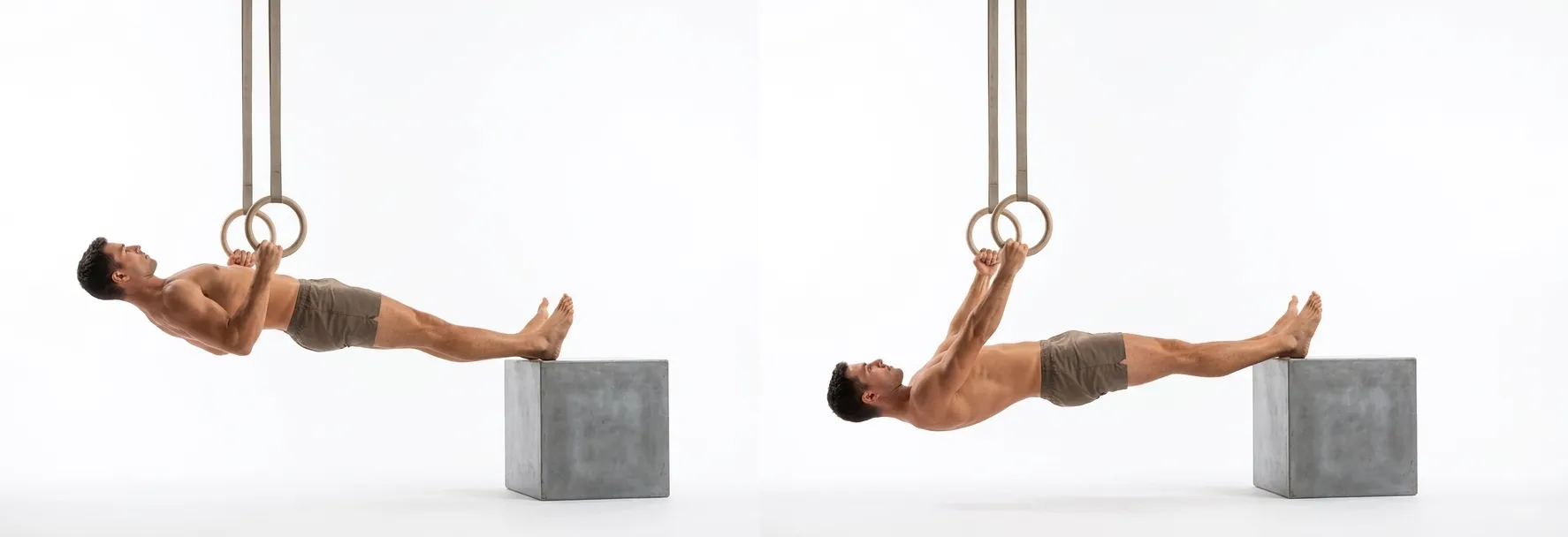
If you have never trained calisthenics and you are not sure you can pull your own bodyweight yet, this is the exact move to start with. Ring row eccentrics ask only one thing of you: lower yourself slowly. You do not need a gym, a strong back, or any pulling experience. You set the rings roughly chest-height, lean back, and control the way down. That is it. Because your body is far stronger at lowering a load than at lifting it, this is often the very first pulling exercise a true beginner can succeed at on day one. It is the first rung of BodyTree's Rowing branch, and it quietly builds the strength that makes a full ring row possible.
What Is a Ring Row Eccentric?
A ring row is a horizontal pull. You hold a pair of gymnastic rings (or a low bar, or even a sturdy table edge), walk your feet forward so your body hangs at an angle, and pull your chest toward your hands. The eccentric version isolates the lowering half of that movement: you get to the top position with a little help, then lower yourself as slowly as you can until your arms are straight again.
This matters more than it sounds. According to Overcoming Gravity by Steven Low, a muscle is roughly 120 to 150 percent stronger during the lowering (eccentric) phase than during the lifting (concentric) phase. In plain terms: even if you cannot yet pull yourself up, you can almost certainly lower yourself down under control. That gap is the beginner's best friend. It lets you train real pulling strength from your very first session, long before you can complete a single full rep.
Rowing also does something your body genuinely needs. Horizontal pulling develops the muscles that sit behind the shoulder and around the shoulder blades, the scapular retractors, the rear deltoids, and the external rotators. These are the muscles that keep your shoulders healthy and balanced against all the pushing (push-ups, dips) you will eventually do. Starting your calisthenics journey with rowing is not just accessible, it is smart.
Prerequisites
There are almost none, and that is the point. You do not need to "get in shape first." You do not need to already do a push-up or a pull-up. If you can stand up, lean back holding a set of rings or a low bar, and lower yourself with control, you are ready today.
The only things worth having in place are a stable anchor (rings, a low bar, a suspension trainer, or a solid horizontal edge that will hold your weight) and enough shoulder comfort to reach forward without pain. If your feet are further forward and your body is closer to horizontal, the movement is harder; if you keep your feet back and your torso more upright, it is easier. That single adjustment means you can scale this move to your exact starting point, no matter how new you are.
The Progression Chain
Ring row eccentrics are level 1 of the Rowing branch. Each step ahead adds range, then load, then balance demands. Once you own the slow lower here, the next milestone is the full ring row, where you both pull up and lower down under your own power. From there the chain widens your grip, then shifts load onto one arm at a time, eventually building toward a true one-arm row. You are not expected to look up the chain and feel intimidated. You are expected to master this rung, then take the next small step when you are ready.
Sets, Reps, and Training Frequency
The BodyTree unlock standard for this move is 3 sets of 5 controlled reps. Aim for a lowering phase of roughly 5 seconds per rep, arriving at a full, straight-arm hang at the bottom every time. Rest a couple of minutes between sets so each rep stays genuinely slow rather than a controlled fall.
Train pulling two to three times per week, leaving at least a day between sessions so the tissue can adapt. Overcoming Gravity's "Rule of Fifteen" is a helpful north star: aim to accumulate at least fifteen quality repetitions across your sets for a given exercise. When 3 sets of 5 slow negatives start to feel controlled and repeatable, you are ready to begin attempting full ring rows, pulling up as well as lowering down.
Coaching Cues
- Start from the top. Step or hop your feet in to reach the top position with your chest near your hands, then begin the slow lower from there.
- Lead with the shoulder blades. Think about squeezing your shoulder blades together and down as you hold the top, and letting them spread apart smoothly as you lower.
- Count the lower. A slow five-second descent is the whole exercise. If you drop in one second, make it harder to control by lowering more slowly, not by dropping faster.
- Finish with straight arms. Reach a full, relaxed hang at the bottom of every rep so you train the entire range, not just the easy top portion.
- Keep a straight line. Hold your hips up so your body stays roughly straight from head to heels. Do not let your hips sag toward the floor.
Common Mistakes
- Dropping instead of lowering. The strength is built in the slow descent. A fast fall skips the exact part that makes you stronger. Slow it down until five seconds feels honest.
- Starting too horizontal. If your body is fully flat and you can barely control the lower, walk your feet back and stand more upright. There is no shame in an easier angle, and there is nothing earned by failing reps.
- Short range of motion. Stopping before your arms are straight trains only part of the movement. Reach a full hang at the bottom each time.
- Sagging hips. Letting the hips drop turns a pull into a slump. Keep the glutes and core lightly engaged so the line from shoulders to heels stays straight.
- Skipping ahead. Rushing to full rows before the negatives feel controlled usually means messy, half-range reps. Earn the next rung and it will feel far more solid.
Why This Move Rewards Beginners
Most people quit new training because the first exercise makes them feel weak. Ring row eccentrics do the opposite. On day one you will already succeed at something that looks and feels like real calisthenics, because lowering is a strength you already have. Small, repeatable wins are what build a training habit, and this move is engineered to deliver them. Show up two or three times a week, keep the descents slow, and the full ring row will arrive sooner than you expect. This is the calm, patient way into pulling, and it works for any body and any starting point.
Related Guides
Frequently Asked Questions
I can't do a single row or pull-up. Can I really start here?
Yes, and this is the move designed for exactly that. Lowering your own bodyweight is far easier than lifting it, so most complete beginners can control a slow ring row negative on their first session. That controlled lowering is what builds the strength for your first full row.
What if I don't have gymnastic rings?
A low bar, a suspension trainer, or even a sturdy table edge you can grip works fine. Any anchor that lets you lean back and lower yourself under control will train the same pulling pattern.
How do I make it easier or harder?
Your foot position is the dial. Feet further back with a more upright body is easier; feet forward with a more horizontal body is harder. Start upright and gradually walk your feet out as you get stronger.
How long until I can do a full ring row?
Training two to three times a week with slow, controlled negatives, many beginners reach their first full ring rows within a few weeks. Consistency matters far more than intensity.
BodyTree tracks your progression through all 251 calisthenics skills — automatically generated programs, video proof, and a community of serious practitioners.
Get BodyTree — Free on iOS & Android