Rings Dip Eccentrics: Your First Ring Dip
If the rings feel impossible right now, you are in exactly the right place. Almost nobody presses out of a ring dip on their first attempt, and that is not a sign you are behind. It is a sign you have not trained the half of the movement that comes first. The rings dip eccentric is that half: you start at the top, where you are already strong, and lower yourself slowly. No gym membership, no partner, no press required. Just a set of rings, a few minutes, and the patience to go down slower than feels natural.
What Is a Rings Dip Eccentric?
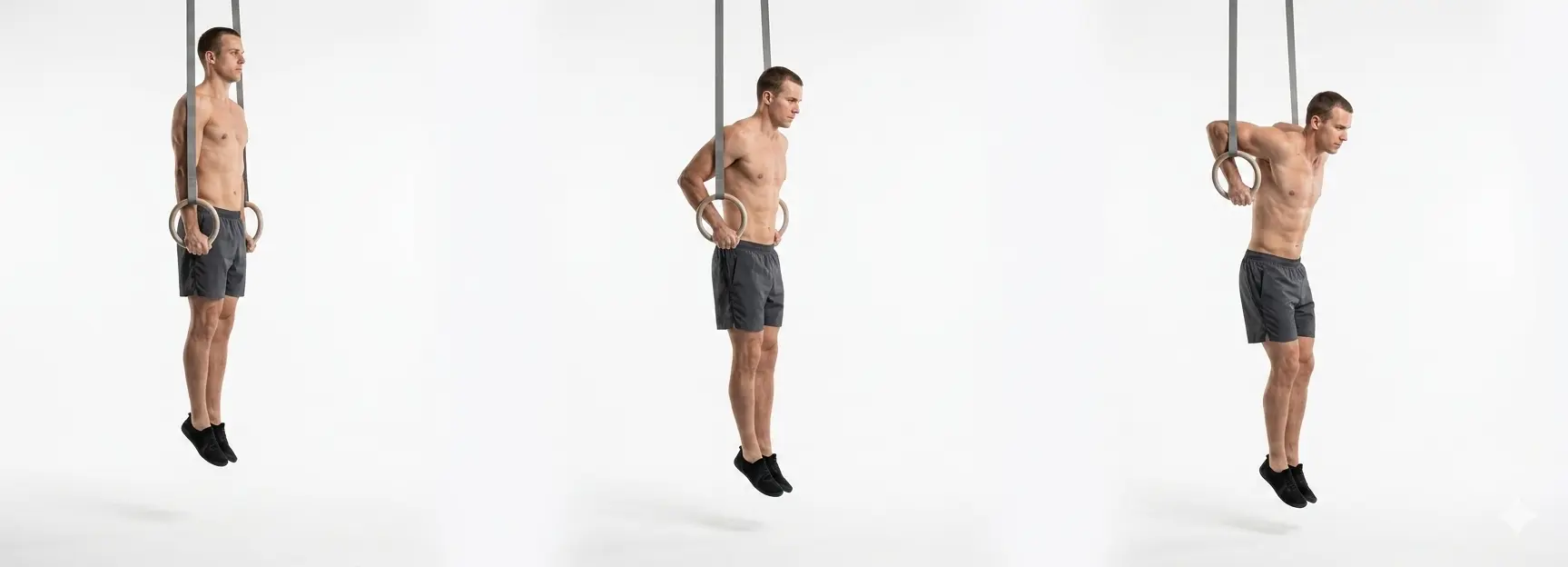
An eccentric is the lowering half of an exercise, the part where the working muscle lengthens under load. A rings dip eccentric means you climb or jump into a locked-arm support at the top of the rings, then lower yourself under full control until your shoulders drop below the rings. You do not press back up. You step off, reset, and go again.
That sounds like half a rep, and it is. It is also the more useful half when you are starting out. Most people can control noticeably more load on the way down than they can push on the way up, which means the eccentric lets you train the full range of a ring dip weeks before you can perform one. In the BodyTree tree this sits in the Rings Dips branch at level 3, one step past the ring support holds and one step short of the dip itself.
The rings add the wrinkle that makes this movement worth its own page. A parallel bar is fixed. Rings are not. They rotate, they drift apart, they wobble under a beginner. That instability is the whole point: it recruits the stabilising muscles around your shoulder girdle that a fixed bar lets you skip. It also means you should expect to feel shaky at first, and should not read shakiness as failure.
Prerequisites
Two things should be in place before you start lowering.
- A ring support hold with the rings turned out. The step before this one in the chain asks for 3 sets of a 30 second hold with the rings rotated outward so your palms face forward. If you cannot yet hold the rings turned out, hold them neutral and build the time first. This is not a formality: the top of every eccentric rep is a support hold, so if the top position collapses, the rep has nowhere to start.
- Straight, comfortable elbows. The bottom of a ring dip asks a lot of the biceps tendon and the front of the shoulder. Before loading it, you want to be able to lock your arms out fully and hold that lockout without a pinch or a sharp complaint.
If neither of those is true today, that is your training plan for the next few weeks and it is a perfectly good one. Established calisthenics methodology treats time on the rings as the prerequisite for everything else the rings can teach, and support work is the cheapest way to accumulate it.
You do not need parallel bar dips first. They help, and many people arrive here with them, but the support-hold-then-eccentric route works from scratch.
The Progression Chain
The chain moves from holding still, to holding still in a harder position, to moving under control, to moving in both directions, to adding a core demand on top. Each step keeps the ring instability constant and changes only one variable, which is why it works.
The step you are on is the first one that asks you to move. Treat it as the bridge it is. Once you can lower slowly and consistently, the full ring dip usually arrives without a separate campaign to earn it.
Sets, Reps, and Training Frequency
BodyTree unlocks the next node when you complete 3 sets of 5 controlled eccentrics. That is the target, not the starting point.
Eccentrics are usually programmed by how long each lowering lasts rather than by rep count alone, because the time under tension is what drives the adaptation. A practical starting protocol, drawn from standard calisthenics programming:
- Weeks 1 to 2: 2 to 3 sets of 2 to 3 reps, lowering for about 3 seconds each, with 2 to 3 minutes of rest between sets.
- Weeks 3 to 6: keep the sets and reps, and add a second to the lowering each week until you are at 6 to 8 seconds per rep.
- Then: extend toward 3 sets of 5 at 6 to 10 seconds, and start shortening the rest between reps within a set.
Grow the lowering time before you shorten the rest. That order gives you more tension per session, which is what actually builds the strength.
Train it 2 to 3 times per week with at least one full day between sessions. Eccentric work is more fatiguing than it feels in the moment, particularly for the connective tissue around the elbow, so more is genuinely not better here. If your progress stalls, the first thing to try is fewer sets and more rest, not more work.
One rule of thumb worth knowing: an athlete who can chain three eccentrics of 7 to 10 seconds each, back to back, at full range and with no rest between them, can usually perform one full repetition of the same movement. That is your test. When three slow lowerings in a row stop feeling like a maximum effort, attempt a ring dip.
Coaching Cues
- Set the top before you move. Arms locked, shoulders pressed down away from your ears, rings squeezed against your sides. Every good rep starts from a good support hold.
- Glue the rings to your body. The most common reason a beginner falls out of the bottom is that the rings drifted outward. Actively pull them in toward your ribs the whole way down.
- Elbows at roughly 45 degrees. Not flared straight out to the sides, which loads the front of the shoulder in a position it does not like, and not crushed tight to the ribs, which cuts your range short. Somewhere between 45 and 60 degrees from your torso is the honest middle.
- Lower at one speed. A rep that drops fast for the first half and then brakes is not a controlled eccentric. Pick a count and hold it evenly from lockout to depth.
- Go all the way down. Full depth means your shoulders end clearly below the rings, not upper arms parallel to the floor. The bottom is where the strength you are missing lives.
- Stay hollow. Squeeze your glutes, brace your midsection, and keep your body in one line. A sagging lower back turns a dip into a shoulder-only exercise.
- Step off, do not fall off. Set the rings low enough that your feet reach the floor from the bottom. Ending a rep on your own terms is part of the rep.
Common Mistakes
- Cutting the depth. Stopping at parallel skips the exact range you came here for. If full depth is not available yet, lower the rings, keep a toe on the floor for assistance, and use the full range with help rather than a partial range alone.
- Racing the descent. A two second drop is a controlled fall. If you cannot slow it down, regress: use a band under your feet, keep one foot lightly on the ground, or start on parallel bars until the tempo is real.
- Letting the rings flare. Rings that wander outward at the bottom put the shoulder in its most vulnerable position under its heaviest load. Squeeze them in.
- Training it every day. Enthusiasm is not the limiter here; recovery is. Elbows and biceps tendons in particular take longer to adapt than the muscles pulling on them.
- Skipping the support work. Dropping the ring support holds once you can lower is a false economy. They stay in the warm-up for years, and they are the cheapest shoulder insurance on the rings.
- Waiting to feel ready. Nobody feels ready for their first ring session. Set the rings low, keep your feet available, and start.
Prehab for Shoulders, Elbows, and Biceps
Ring dips load the front of the shoulder and the biceps tendon at end range, which is why they deserve a warm-up that other exercises do not need. Five minutes buys you a lot here.
- Ring support holds, rings turned out. One to three sets, working toward 60 seconds total. This warms the shoulder girdle and, done consistently, is genuinely protective for the elbows and biceps.
- German hangs, held short. Five to ten seconds at a time, rings set low, letting your shoulders open behind you. Never hold a static stretch longer than about fifteen seconds before training; longer holds can blunt your strength for the session.
- Wrist preparation. Gentle wrist push-ups and circles in every direction. Your wrists carry the support position.
- Light external rotation work. A band, a few slow sets, at the end of a session rather than the start.
Then the honest part: if the front of your shoulder or the crease of your elbow gives you a sharp, localised complaint during or after a set, stop lowering that day and go back to support holds. The research on tendon loading is clear that tendons respond well to steady, progressive load and badly to sudden spikes in it. A week of holding still is cheaper than three months of managing an angry elbow.
Training It for the Long Haul
Ring dips reward people who stay in the game, and staying in the game is mostly about restraint at the start.
Add time to your lowering before you add reps, and add reps before you add sets. When you hit a plateau, deload rather than push: drop back one step in the progression for a week, keep the range full, and let the connective tissue catch up. A lighter week done deliberately is prehabilitation with a training effect, not lost ground.
Keep horizontal pulling in your week alongside this. Pressing on rings without rowing on rings tips the shoulder girdle in one direction, and balanced shoulders are what let you keep pressing for years. Two pulling exercises for every two pushing ones is a simple structure that holds up.
Finally, keep logging. Eccentric progress is slow enough to be invisible week to week and obvious month to month. Recording that you lowered for six seconds today when you managed three in July is what makes the next session easy to start.
Related Guides
Frequently Asked Questions
How long until I can do a full ring dip?
Most beginners who already own a 30 second ring support hold reach their first ring dip in 8 to 12 weeks of training eccentrics two or three times per week. The strongest predictor is being able to chain three lowerings of 7 to 10 seconds each with no rest between them.
Do I need parallel bar dips before ring dips?
No, but they help. Parallel bars are fixed, so they remove the stability demand and let you build pressing strength faster. If you have them, use them alongside ring work. If you only have rings, the support hold to eccentric route works from zero.
Why do the rings shake so much?
Because they are free to move, and your stabilising muscles have not learned to hold them yet. Shaking is normal in the first few weeks and fades with time on the rings. Pull the rings firmly into your sides and set them lower until the shake settles.
Is it safe to go all the way down?
Full depth is the goal, but earn it. Build the range gradually and keep your elbows at roughly 45 degrees rather than flared wide. If the front of the shoulder or the elbow crease gives a sharp complaint, shorten the range that day and return to support holds.
BodyTree tracks your progression through all 251 calisthenics skills — automatically generated programs, video proof, and a community of serious practitioners.
Get BodyTree — Free on iOS & Android