Rings Strap Handstand: How to Learn It
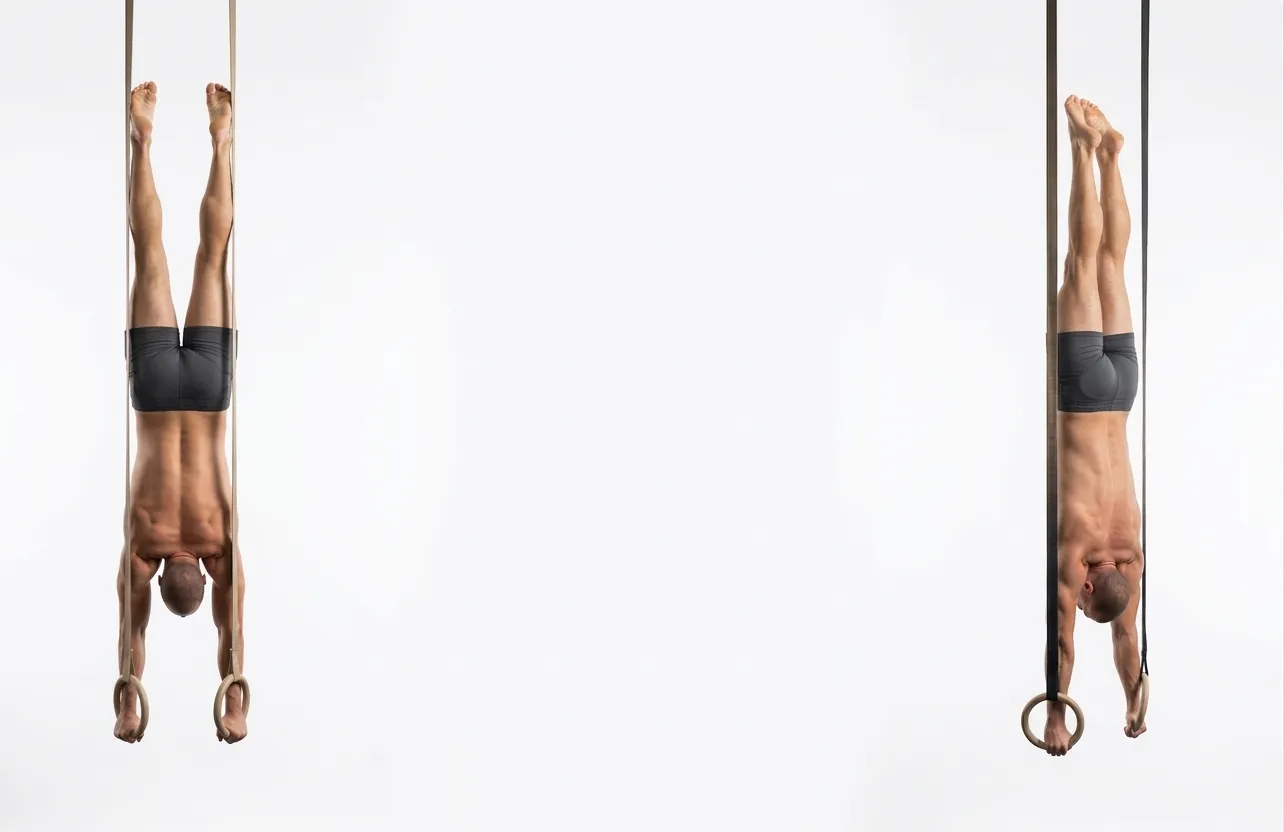
The rings strap handstand is the moment your rings work stops looking like a shoulder stand and starts looking like a handstand. You are still leaning on the straps for balance, but your body is stacked straight from hands to feet and your shoulders are doing the real work for the first time. According to Overcoming Gravity, it is the bridge skill that teaches straight-arm shoulder positioning before the straps come away entirely.
What Is the Rings Strap Handstand?
The rings strap handstand (abbreviated R Strap HS in Overcoming Gravity) is an inverted, straight-body hold on gymnastic rings in which the feet hook onto the straps or cables for partial balance assistance while the arms stay locked out. It sits at Level 6 of the Rings Handstands branch in the BodyTree progression system, directly after the rings shoulder stand and directly before the fully freestanding rings handstand.
Unlike the shoulder stand, where the elbows stay bent and the rings sit tucked near the chest, the strap handstand demands a fully extended, stacked body: hands, shoulders, hips, knees, and feet all in one line. The straps are there to catch you, not to hold you up.
Prerequisites
Before attempting the rings strap handstand you should own a solid rings shoulder stand — 30-second holds for 3 sets, controlled entry from an L-sit swing, and a reliable forward roll-out for safety. Overcoming Gravity is explicit that a forward roll-out should be drilled at least ten times before any inverted rings support work begins. If you are using high rings, treat the roll-out as a non-negotiable prerequisite, not an afterthought.
You should also be comfortable with deep ring dips, since the transition from shoulder stand into strap handstand asks your arms to press out from a bent position under load.
The Progression Chain
The rings shoulder stand teaches wrist-driven balance control with bent arms. The strap handstand adds the straight-arm, straight-body requirement while the straps still offer a safety net for the legs. The next step, the fully freestanding rings handstand, removes that net entirely and asks your wrists and shoulders to do all of the balancing.
Sets, Reps, and Training Frequency
Progression standard: 3 sets of a 30-second hold, matching the isometric protocol used across the Rings Handstands branch. Train this 2-3 times per week alongside your other pressing and handstand work, and pair it with rest days for wrist and shoulder recovery — the wrists take a disproportionate share of the balancing load in every rings-inverted position.
Coaching Cues
- Lock the elbows first. Any bend in the arms shifts load away from the shoulders and makes the position easier but wrong — straighten out completely before chasing balance.
- Push shoulders toward the ears. Full scapular elevation centralizes strength in the shoulders and control in the wrists, exactly where Overcoming Gravity says it belongs.
- Move your feet to the inside of the cables. Wrapping your legs around the outside relies on the cables for balance; working from the inside pushes the workload back onto your shoulders.
- Turn the rings out, not in. Letting the rings turn in and ride against your forearm makes the hold easier but stunts the strength adaptation you are training for. Work progressively toward parallel rings, then past parallel.
Common Mistakes
- Skipping roll-out practice. Attempting inverted support work on rings without a drilled forward roll-out is the fastest way to an unnecessary fall. Practice it on the floor and low rings first.
- Letting the rings turn in. It reduces difficulty in the moment but caps your long-term shoulder and wrist adaptation — fight to keep the rings turning out toward parallel.
- Wrapping legs around the outside of the cables. This offloads balance onto the straps instead of your wrists, which defeats the purpose of the drill.
- Bent elbows at the top. A slight bend makes the hold feel more stable but trains the wrong muscle group — lock out fully before working on balance.
Related Guides
Frequently Asked Questions
Is the rings strap handstand the same as a regular handstand?
No. It shares the straight-body requirement of a floor handstand, but the straps offer partial leg support and the unstable rings demand far more wrist and shoulder control than a fixed surface.
How long does it take to progress from shoulder stand to strap handstand?
It varies with existing shoulder and wrist strength, but most lifters who train the isometric protocol consistently 2-3 times a week move through the strap handstand in a few weeks to a couple of months before working toward the freestanding version.
Do I need special rings straps?
No special equipment beyond standard gymnastic rings with adjustable straps or cables. Lowering the rings close to the ground with mats underneath is the main safety setup Overcoming Gravity recommends.
What should I train alongside the strap handstand?
Continue deep ring dip work and general handstand practice on the floor — both build the shoulder strength and balance awareness that transfer directly into this skill.
BodyTree tracks your progression through all 251 calisthenics skills — automatically generated programs, video proof, and a community of serious practitioners.
Get BodyTree — Free on iOS & Android