Freestanding Handstand with One-Arm Support
The freestanding handstand with one-arm support is the structured bridge between a solid two-arm handstand and the one-arm handstand, one of the rarest and most demanding skills in bodyweight training. Rather than jumping to a true one-arm hold, Overcoming Gravity prescribes a four-level sequence, Levels 6 through 9, in which you remove one finger at a time from the assisting hand while keeping the other arm progressively lighter on the floor. This method trains the wrist balance and shoulder alignment you actually need, not the wall-leaning pattern that looks similar but develops the wrong adaptations.
What Is the Freestanding Handstand with One-Arm Support?
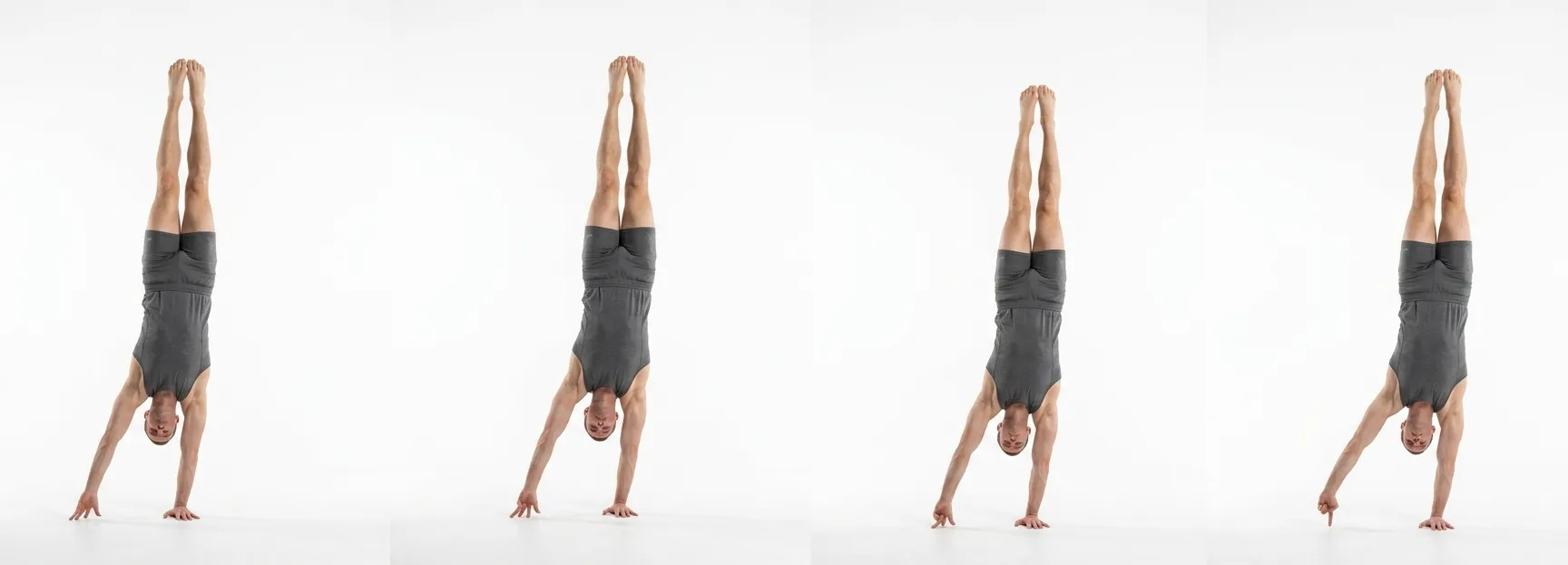
This exercise is a family of four variations performed in a straddle handstand position. From a balanced freestanding handstand, you spread your legs into a straddle, shift your hips laterally over your dominant arm, and rest the non-dominant hand on the floor with progressively fewer fingers providing assistance. The four levels are:
- Level 6 — Four-Finger Support: all four fingers of the free hand on the floor.
- Level 7 — Three-Finger Support: pinky removed.
- Level 8 — Two-Finger Support: ring finger also removed.
- Level 9 — One-Finger Support: only the index finger contacts the floor.
In BodyTree it appears as a single node representing the full Level 6 to 9 arc, with the unlock target being a 30-second hold at the current finger-reduction stage across 3 sets.
Prerequisites
According to Overcoming Gravity, you need a consistently held, straight-body freestanding handstand for at least 60 seconds before attempting any one-arm variation. That is not a personal record; it is a number you can hit reliably. Beyond hold time, you should be able to change positions mid-handstand (shifting leg angle, adjusting head position) without losing balance, and you should be comfortable in a straddle handstand since that is the position from which the weight shift is safest to practice.
If you have any active wrist soreness, address it before starting this progression. The load concentration on a single wrist is significantly higher than in the two-arm handstand, and the connective tissue demand is not forgiving of pre-existing irritation.
The Progression Chain
Each step in the chain builds the specific balance and strength quality the next requires. The wall handstand builds shoulder endurance and hollow-body alignment. The freestanding handstand adds wrist proprioception and kick-up control. The one-arm support arc (this exercise) trains the lateral weight shift and single-wrist balance that makes the true one-arm handstand possible. The one-arm handstand at Level 10 is the culmination, requiring 5 to 6 days per week of practice over one to two years according to Yuri Marmerstein, the professional acrobat who contributed the one-arm handstand section of Overcoming Gravity.
Sets, Reps, and Training Frequency
Because this is an isometric skill, the unlock criterion in BodyTree is 3 sets of 30-second holds at the current finger-reduction level. In practice, you will start much shorter: 5 to 10 second holds per side, 3 to 5 attempts per side per session, working toward the full 30 seconds over weeks. Train the skill 4 to 6 days per week for best results since balance skills respond to frequency more than to volume in any single session. Keep sessions short and fresh; 10 to 15 minutes of focused one-arm support work is typically more productive than 30 minutes of fatigued attempts.
Use a straddle position when you shift weight. The wider leg stance lowers your center of gravity and gives you lateral leverage in both directions, making it considerably more stable than a closed-leg shift. As the hold becomes consistent, slowly close your legs to increase difficulty within the same finger-support level before removing the next finger.
Coaching Cues
- Shift everything, not just your arm. Move your hips laterally over the support hand. If only your arm moves but your center of mass stays centered, you are not learning the correct balance pattern.
- Lock the support shoulder in an active position. Think ear-to-earmuff: the shoulder should be fully elevated and pressing into the floor, not passive.
- Let the assisting hand float, do not push. The free hand's job is balance awareness. If you find yourself pressing weight into it, you are not yet building the one-arm balance you need.
- Balance through the wrist, not through body wobble. If your core or legs are waving during the weight shift, you are not developing correct single-wrist control. Reduce the shift angle and re-establish stillness before progressing.
- Concentrate pressure into the ring and pinky fingers of the support hand. As you shift, the center of balance migrates toward the ring-finger joint. Developing sensitivity here is what separates a reproducible hold from a lucky one.
Common Mistakes
- Skipping the straddle and attempting a closed-leg shift. The closed-leg position raises your center of gravity and removes lateral stability. Straddle first, narrow later.
- Using a wall to assist. Overcoming Gravity notes that wall-assisted one-arm handstands look impressive in photos but develop the wrong skill set. The wall eliminates the balance demand, which is exactly the thing you are training.
- Removing fingers too quickly. Spend time at each level until 30 seconds feels controlled, not rushed. Impatience here leads to reverting to the assisting hand for weight rather than balance.
- Ignoring wrist discomfort. A small amount of unfamiliar pressure is expected. Sharp or joint-specific pain is a signal to stop and address tissue health before continuing. Overuse injuries at this stage can sideline you for months.
- Overcorrecting with the shoulder. Large shoulder-shrug corrections on the support side are a sign the wrist is not controlling balance. Trust the fingers and reduce the shift until wrist corrections become sufficient.
Prehab and Longevity
The wrist is the primary stress point in this progression. Overcoming Gravity recommends treating wrist health as a regular part of your warm-up and recovery rather than something you address only when pain appears. Practical protocols that work well alongside one-arm support training:
- Wrist circles, 10 to 15 each direction before every session.
- Passive wrist mobilization: place your palms flat on the floor and shift your bodyweight slowly forward over them, taking the wrist to its edge of range without muscular contraction.
- Rice bucket: 3 sets of 1 minute of finger and wrist movements in a bucket of uncooked rice. Low-load, high-range conditioning that builds the grip endurance needed for long hold attempts.
- Grip-specific strengthening for the ring and pinky fingers: grippers, towel pull-ups, or wrist roller work with emphasis on the last two fingers. The center of balance in a one-arm handstand is near the ring-finger joint, so those fingers bear disproportionate load.
If wrists become acutely sore, Overcoming Gravity is explicit: stop performing handstands through the pain. Regain mobility with isolation work, then return. Continuing through soreness leads to overuse injuries that set progress back far more than a few days off would have.
Related Guides
Frequently Asked Questions
How long does the one-arm handstand support progression take?
Expect 6 to 18 months to work from Level 6 (four-finger support) to Level 9 (one-finger support), depending on your starting balance quality and training frequency. Yuri Marmerstein writes in Overcoming Gravity that a true one-arm handstand (Level 10) typically requires 1 to 2 years of dedicated practice at 5 to 6 days per week.
Should I use a wall for one-arm handstand practice?
No. Overcoming Gravity is explicit that wall-assisted one-arm handstands do not develop the balance skill you need. The wall removes the wrist-balance demand, which is exactly the adaptation the support progression is designed to build.
Why does Overcoming Gravity recommend the straddle position?
Straddling lowers your center of gravity and gives you lateral leverage in both directions, making the position more stable during the weight shift. A closed-leg shift is considerably harder because any imbalance quickly amplifies without the counterleverage of an open leg position.
My wrist gets sore during one-arm support practice. What should I do?
Stop handstand practice until the soreness resolves, then return with an extended wrist warm-up. Overcoming Gravity warns that continuing through wrist soreness in this progression reliably leads to overuse injuries that sideline training for months. Invest in wrist circles, passive floor mobilization, and rice bucket work as regular maintenance.
BodyTree tracks your progression through all 251 calisthenics skills — automatically generated programs, video proof, and a community of serious practitioners.
Get BodyTree — Free on iOS & Android