
Wide Ring Rows: How to Learn It
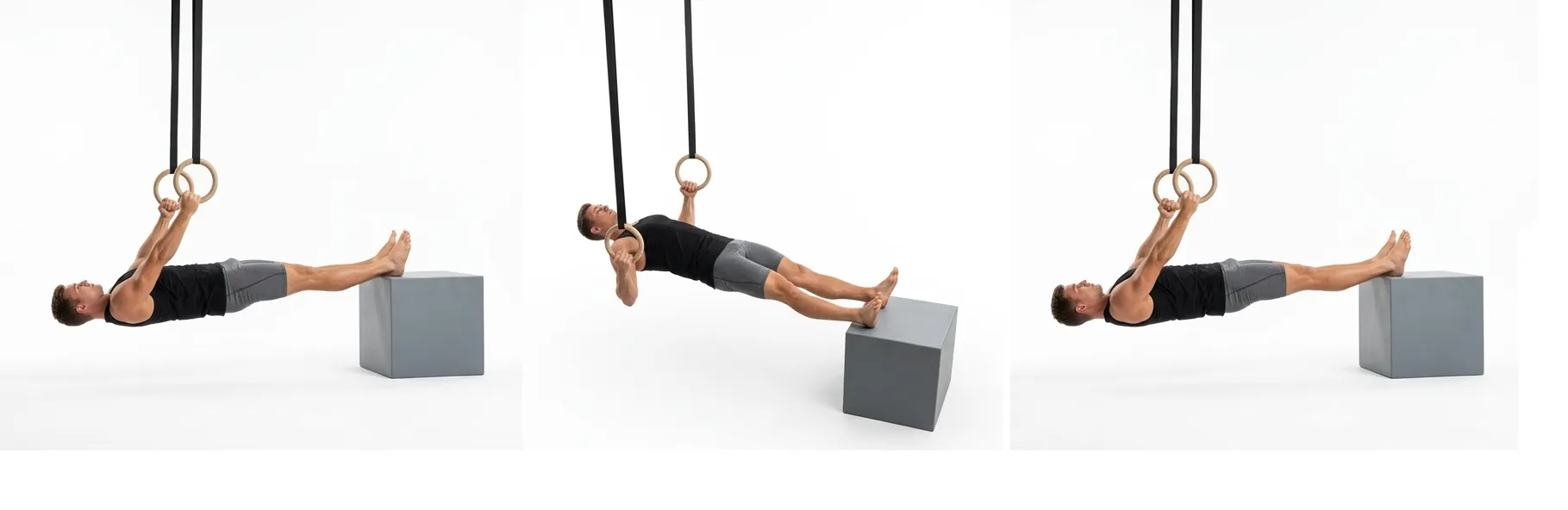
If you have never done a real pulling exercise in your life, the wide ring row is one of the friendliest places to start. You are not hanging off a bar hoping to haul your whole bodyweight up. Your feet stay on the ground, and you get to choose exactly how hard the movement is just by changing how upright you stand. Stand tall and it is almost gentle. Walk your feet forward until your body is nearly level with the floor and it becomes genuinely demanding. That dial is yours, which means there is a version of this exercise you can do today, no matter how new you are.
You do not need a gym, a background in sport, or any strength you think you are missing. A set of gymnastic rings or a low suspension trainer and a little patience is enough. This guide walks you through what the wide ring row is, how to earn it from the easiest possible version, and where it leads once it starts to feel light.
What Is the Wide Ring Row?
The wide ring row is a horizontal pulling exercise. You hold a pair of rings, lean back so your bodyweight hangs from your hands, then pull your chest toward the rings while your elbows travel out wide, away from your sides. It sits in the Pull branch of the BodyTree progression system, on the horizontal-pull line that builds the muscles of your upper back and the backs of your shoulders.
The word wide matters. In a standard ring row your elbows tuck closer to your body. Moving your hands and elbows wider shifts more of the work onto your rear deltoids and the muscles between your shoulder blades. According to Overcoming Gravity by Steven Low, keeping the shoulders and shoulder blades working well is the single most important key to bodyweight strength, and horizontal rows that pull the elbows back to squeeze the shoulder blades together are exactly how you build that foundation.
Prerequisites
You do not need much, and that is the point. Before adding the wide variation you should own the standard ring row for 3 sets of 15 clean reps with your body held in a straight line. If a set of 15 upright rows already feels easy, you are ready to make it harder by widening your grip and lowering your angle.
Beyond that, the only real requirement is a way to hang: rings or a suspension trainer anchored overhead, or even a sturdy bar set at hip height. If you cannot yet do a full set of standard rows, that is completely fine. Start more upright, or begin with the easier step below and build toward this one. Nobody skips the early rungs, and you are not behind for being on them.
The Progression Chain
Each step adds either range, leverage, or single-arm demand. Ring row eccentrics teach you to control the lowering. Standard ring rows build the base pull. Wide ring rows load the upper back and rear shoulders harder. From there, archer rows begin shifting the work onto one arm at a time, which is the road that eventually leads to a true one-arm row. You do not have to see the whole path today. You only have to own the rung you are on.
Sets, Reps, and Training Frequency
The wide ring row is a concentric exercise, so the BodyTree unlock standard is 3 sets of 15 reps with clean form. Overcoming Gravity programs it in the classic beginner routine as roughly 3 sets building from 5 up to 15 reps, resting a couple of minutes between sets, with a slow and controlled tempo.
Train horizontal pulling 2 to 3 times per week, leaving at least a day between hard sessions so the muscles and connective tissue can recover. When you can hit 3 clean sets of 15, make it harder by walking your feet forward to lower your body angle, then rebuild your reps back up. That is progressive overload without a single plate: same movement, more of your bodyweight, one small step at a time.
Coaching Cues
- Straight line from head to heels. Squeeze your glutes and brace your core so your hips do not sag. You are one rigid plank rotating around your heels.
- Lead with the shoulder blades. Start each pull by drawing your shoulder blades down and together, then let the arms follow. The pull comes from the back, not just the biceps.
- Elbows travel wide. In this variation your elbows flare out away from your sides as you pull the rings toward your outer chest.
- Full range every rep. Straighten the arms fully at the bottom and touch the rings to your chest at the top. Partial reps build partial strength.
Common Mistakes
- Sagging hips. When the core tires, the hips drop and the exercise turns into a wobble. Keep the glutes tight and stop the set before your form breaks.
- Shrugging the shoulders. Letting the shoulders creep up toward the ears removes the upper back from the movement. Keep the shoulders pulled down away from your ears.
- Pulling only with the arms. If your shoulder blades never move, you are missing the whole point of the row. Initiate from the blades.
- Cutting the range short. Half reps feel easier and teach you almost nothing. Full extension at the bottom, rings to chest at the top.
Related Guides
Frequently Asked Questions
Are wide ring rows good for beginners?
Yes. Because your feet stay on the ground and you set the difficulty by changing how upright you stand, there is always a version you can do. Start more upright and lower your angle as you get stronger.
What muscles do wide ring rows work?
Mainly your upper back, the muscles between your shoulder blades, and your rear deltoids, with help from the biceps and forearms. The wide elbow path emphasizes the rear shoulders more than a standard row.
How do I make wide ring rows harder or easier?
Walk your feet forward and lower your body toward horizontal to make them harder, or stand more upright to make them easier. This lets you fine-tune the load without any added weight.
How often should I do ring rows?
Train horizontal pulling two to three times a week with at least a rest day between hard sessions. Aim for 3 sets of up to 15 clean reps before progressing the angle.
BodyTree tracks your progression through all 251 calisthenics skills — automatically generated programs, video proof, and a community of serious practitioners.
Get BodyTree — Free on iOS & Android