
Archer Ring Rows: How to Learn It
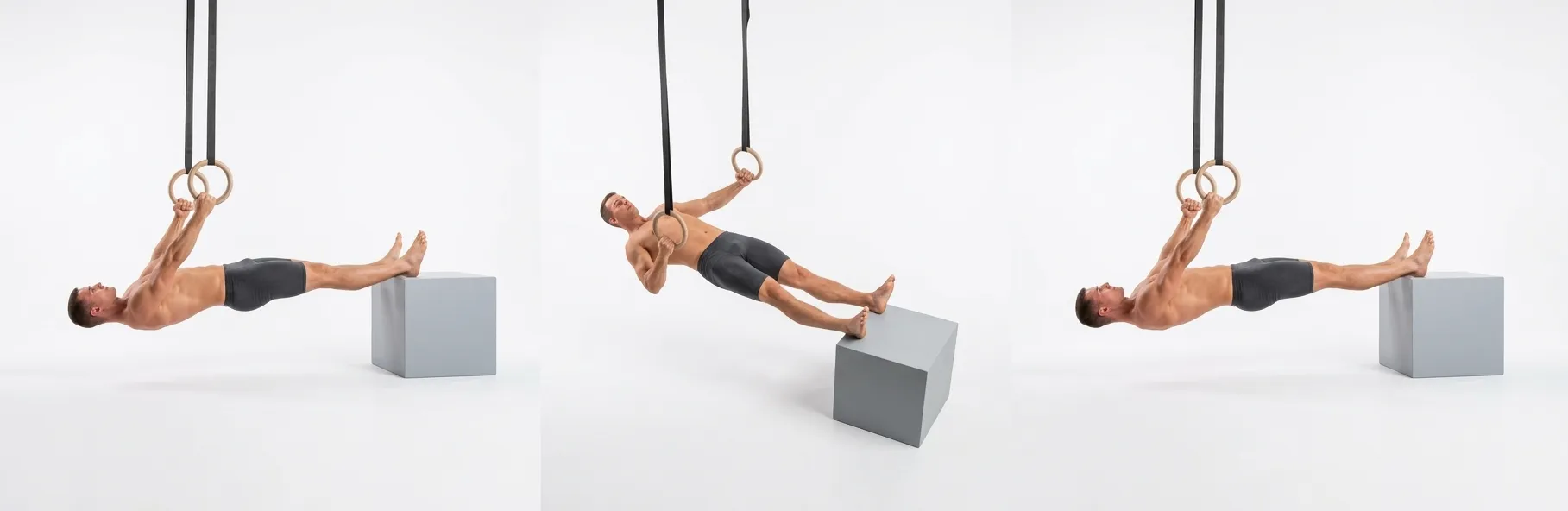
If the archer ring row looks like something only strong people do, read this first: you do not start here. You start by leaning back against a pair of rings or a bar and pulling your chest toward your hands. That is a row, and it is completely learnable at home with no gym and no training background. The archer row is simply the point on that path where one arm begins to take most of the load, which is how you build toward pulling with a single arm. This guide meets you wherever you are today and shows you the whole road, one honest step at a time.
What Is the Archer Ring Row?
An archer ring row is a horizontal pull done on gymnastic rings where one arm does the pulling while the other stays straight out to the side for assistance, like an archer drawing a bow. You hold your body in a straight line from head to heels, lean under the rings, and pull your chest toward one hand while the opposite arm extends and offers just enough help to complete the rep. It sits in the Rowing branch of the BodyTree progression system, the horizontal-pull side of your training.
Horizontal pulling matters more than most beginners realise. According to Overcoming Gravity by Steven Low, rowing movements build the muscles that stabilise the back of the shoulder blade, and for most people who are new to real training the back is the weak link. Rows are also the honest antidote to the forward-hunched posture that comes from years at a desk. The archer row is where that horizontal pull starts asking one arm to carry the day.
Prerequisites
You do not need any special mobility or a strong back to begin the rowing journey. To be ready for the archer variation specifically, you should first own comfortable wide ring rows for 3 sets of 15 clean reps with your body held in a straight line. If that feels far away, that is not a problem, it is your starting point. Raise the rings or your body angle so the pull is easier, train the earlier steps below, and the archer row arrives on its own schedule.
The true beginner entry to this whole pattern is an incline row: stand tall, hold the rings or a bar at chest height, walk your feet forward so you lean back slightly, and pull. The more upright you stand, the easier it is. Lower the angle only as you get stronger.
The Progression Chain
Each step keeps the same straight-body row and slowly shifts more load onto the working arm. You begin by controlling only the lowering phase, then earn full ring rows, then widen your grip, then reach the archer, where the straight arm gives less and less help. From there the assistance arm tucks closer to your body, and eventually you are rowing with one arm alone. Your job is never to skip ahead. Own the current step for 3 sets of 15 before you touch the next one.
Sets, Reps, and Training Frequency
Archer ring rows are a concentric strength movement, so the BodyTree unlock standard is 3 sets of 15 reps per side with clean form. Train your pulling two to three times per week, leaving at least a full day between hard sessions so the muscles and connective tissue can recover and adapt. Start every set on your weaker side and match the reps on your strong side to it, so the two arms grow together rather than drifting apart. When 3 sets of 15 per side feel controlled, progress to the archer-arm-in variation rather than adding endless reps.
Coaching Cues
- Straight body, head to heels. Squeeze your glutes and brace your abs so your hips do not sag. The row trains your back, not a saggy plank.
- Lead with the shoulder blade. Begin each pull by drawing your shoulder blade down and back, then let the arm follow. Squeeze the blades toward your spine at the top.
- Pull toward your lower chest. Aim the working hand at the bottom of your ribcage, not your neck, to keep the elbow driving down and back.
- Keep the straight arm honest. The assistance arm should stay long and give only as much help as you truly need. Less help over time is how you progress.
- Control the lowering. Take two to three seconds to return to the start of each rep. The slow return builds as much strength as the pull.
Common Mistakes
- Letting the hips sag. A drooping midsection turns a back exercise into a struggle. Reset your plank before every set.
- Yanking with the arm. Pulling from the biceps and forgetting the shoulder blade limits your back development and stalls progress. Initiate from the scapula.
- Over-helping with the straight arm. If the assistance arm does half the work, you are really just doing a wide row. Give only the help you need.
- Training one side more than the other. It is tempting to grind extra reps on your strong arm. Match both sides to the weaker one to stay balanced.
- Chasing the archer too early. If your straight-body wide rows are not solid for 3 sets of 15, spend more time there. Rushing the progression is the slowest way to get strong.
Related Guides
Frequently Asked Questions
I have never trained before. Can I really do this?
Yes. You do not begin with archer rows, you begin with incline rows: stand tall, hold the rings at chest height, lean back only slightly, and pull. The more upright you stand, the easier it is. As you get stronger you lower the angle and eventually reach the archer. Everyone starts on the easy end of the same movement.
Do I need gymnastic rings?
Rings are ideal because they let your wrists rotate freely and adjust easily, but you can train the same horizontal pull under a sturdy bar, a low railing, or a solid table edge. The key is a stable anchor and the straight-body pull toward your hands.
Why row one arm at a time instead of just adding weight?
Shifting load onto a single arm through the archer position is how calisthenics adds resistance without plates. According to Overcoming Gravity, changing leverage is a real increase in load, and the archer row is the leverage step that builds toward a genuine one-arm row.
How long until I can do archer ring rows?
Most beginners who train pulling two to three times a week and progress through incline, ring, and wide rows first reach clean archer rows within a few months. Consistency and honest form matter far more than speed.
BodyTree tracks your progression through all 251 calisthenics skills — automatically generated programs, video proof, and a community of serious practitioners.
Get BodyTree — Free on iOS & Android