Rings Handstand: How to Learn It
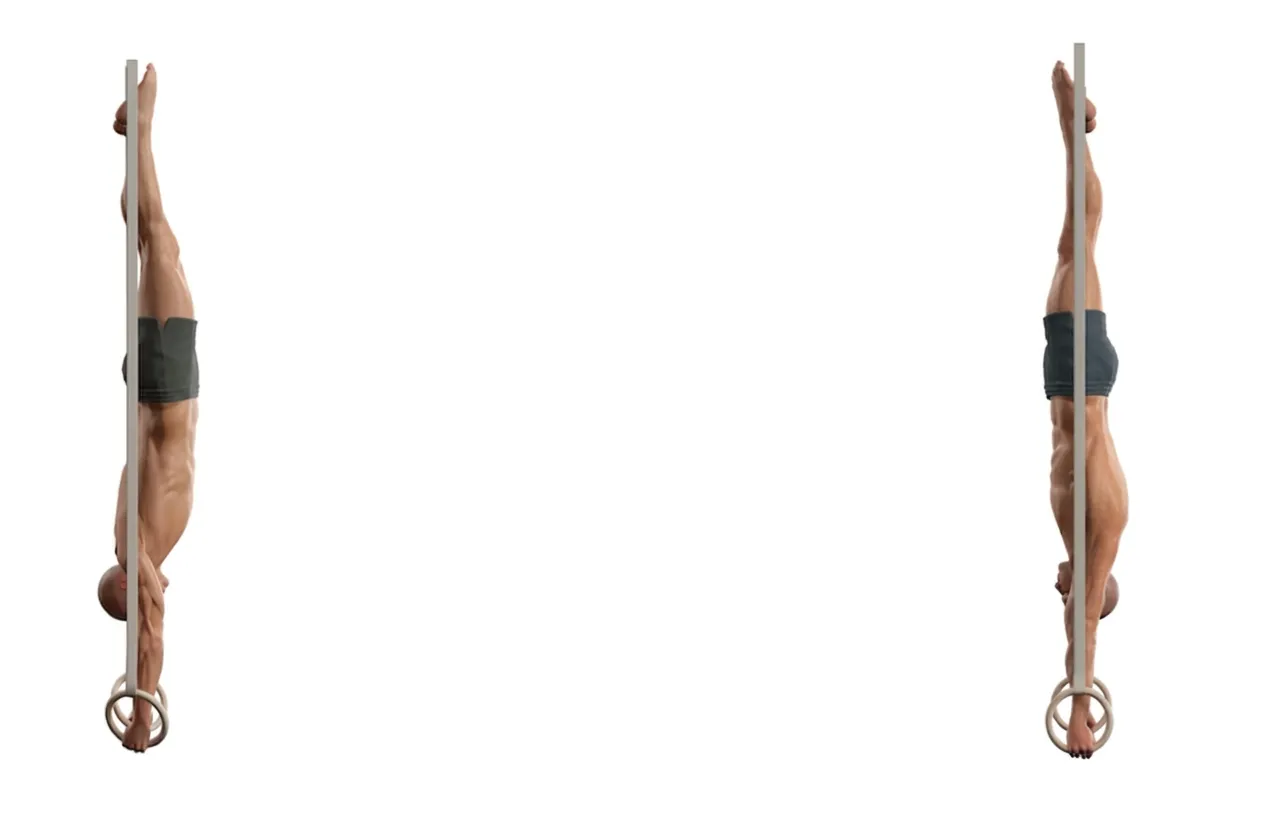
The rings handstand strips away the last piece of assistance in the rings inversion line. No straps, no cables to lean on — just two independent rings, your wrists, and a straight body stacked directly overhead. It is the point where rings handstand training stops being about mimicking a floor handstand and starts being its own discipline.
What Is the Rings Handstand?
The rings handstand (often abbreviated R HS) is a freestanding handstand performed with your hands on gymnastic rings instead of the floor, feet removed from the straps entirely. It sits at Level 7 in the Rings Handstands branch, classified as an isometric hold. Because the rings can rotate and drift independently under each hand, the balance demand is far higher than a floor handstand — every micro-correction has to be made through the wrists and shoulders rather than the fingertips alone.
According to Overcoming Gravity, the rings handstand is "an extension of the rings strap handstand, with two new goals": pressing all the way to the top position rather than inching up from a shoulder stand, and steadily removing your reliance on the straps for assistance as you go.
Prerequisites
Do not approach the rings handstand until two things are solid: a confident rings strap handstand with the rings turned to parallel, and a freestanding floor handstand you can hold for 30 seconds without a wall. The floor handstand builds the proprioception and finger-balance reflexes; the strap handstand builds the specific shoulder elevation and ring-control strength. Skipping either one means you are trying to learn balance and strength deficits at the same time, on the hardest surface available.
The Progression Chain
This is the top of the Rings Handstands branch, built directly on the shoulder stand and strap handstand before it. From here, strength carries forward into the Rings Handstand Pushups branch — Overcoming Gravity calls the rings freestanding handstand pushup "a milestone of strength for most people, and this is the first rated B skill on the chart," and it depends entirely on being able to hold the position you are now training.
Sets, Reps, and Training Frequency
Progression standard: 3 sets of a 30-second hold, matching BodyTree's isometric unlock criteria. Train rings handstand work 2–3 times per week. Because the stabilizer demand on the wrists and forearms is high, pair it earlier in a session — before pressing volume fatigues the same joints — and do not chase hold time at the expense of a turned-in, arched position.
Coaching Cues
- Constant outward pressure on the rings. Actively push the rings apart and out through the whole hold; this is what keeps them from rotating in.
- Micro-adjust with fingers and wrists, not big arm swings — the same fine-correction principle as a floor handstand, just with an unstable base underneath it.
- Keep shoulders fully open and elevated. Overcoming Gravity is explicit here: scapulas should be "elevated maximally and retracted slightly" to lock in the position.
- Aim for a pike or straddle entry on the way up so you control your hips into position, the same way you would kick up to a floor handstand, rather than muscling straight through a bent-arm press.
Common Mistakes
- Regressing to bent arms and lost scapular elevation. The book warns that "even if you can obtain correct scapular positioning with the rings strap handstand you will probably regress a bit" once you drop the strap assistance — expect it, and correct for it deliberately rather than assuming your strap-handstand form will transfer automatically.
- Letting the rings turn in. The rings will drift back toward parallel-in under fatigue; actively re-turn them out and film yourself to check.
- Over-arching the lower back. Rings tempt you to arch far more than a floor handstand does — squeeze the abdominals and glutes to keep the straight-body line the skill actually requires.
- Over-relying on the straps. Tapping the straps with your toes for a moment is fine early on, but the second goal of this skill is explicitly to need them less and less over time.
Prehab and Longevity
Freestanding ring work loads the wrists and forearms through a constantly shifting angle, which is exactly why Overcoming Gravity's tendonitis guidance recommends rings for rehabbing upper-body work in the first place — "a pair of gymnastics rings can be particularly helpful... because the rings allow for free rotation, enabling your wrists, elbows, and shoulders to avoid getting stuck in a particular movement pattern." That same freedom is a double-edged sword: it protects against repetitive strain but only if your wrist extensors and flexors can already handle load through a full range.
Build that capacity with eccentric-concentric wrist curls (anterior wrist/golfer's-elbow pattern) and reverse wrist curls (posterior wrist/tennis-elbow pattern) two to three times per week, done separately from your handstand training days. If you feel anterior or posterior wrist discomfort during holds, back off hold time before it becomes a nagging tendinopathy — this skill rewards patience over grinding through pain.
Related Guides
Frequently Asked Questions
How is a rings handstand different from a floor handstand?
The rings can rotate and shift independently under each hand, so balance corrections come through the wrists and shoulders rather than fingertip pressure alone. It also demands more active shoulder elevation and ring rotation control that a fixed floor surface never requires.
Do I need the rings strap handstand before this?
Yes. The strap handstand builds the specific scapular elevation and ring-turnout strength this skill depends on. Attempting freestanding rings handstands without it means learning balance and strength deficits simultaneously.
Why do my rings keep turning inward?
It happens to everyone as fatigue sets in through the hold. Overcoming Gravity treats this as expected regression, not failure — actively re-press the rings outward and use video to check your rotation over time.
What comes after the rings handstand?
Once you can hold it reliably, the same position feeds directly into rings handstand pushups, which Overcoming Gravity calls one of the first B-level skills on the gymnastics progression chart.
BodyTree tracks your progression through all 251 calisthenics skills — automatically generated programs, video proof, and a community of serious practitioners.
Get BodyTree — Free on iOS & Android