One-Arm Handstand: How to Learn It
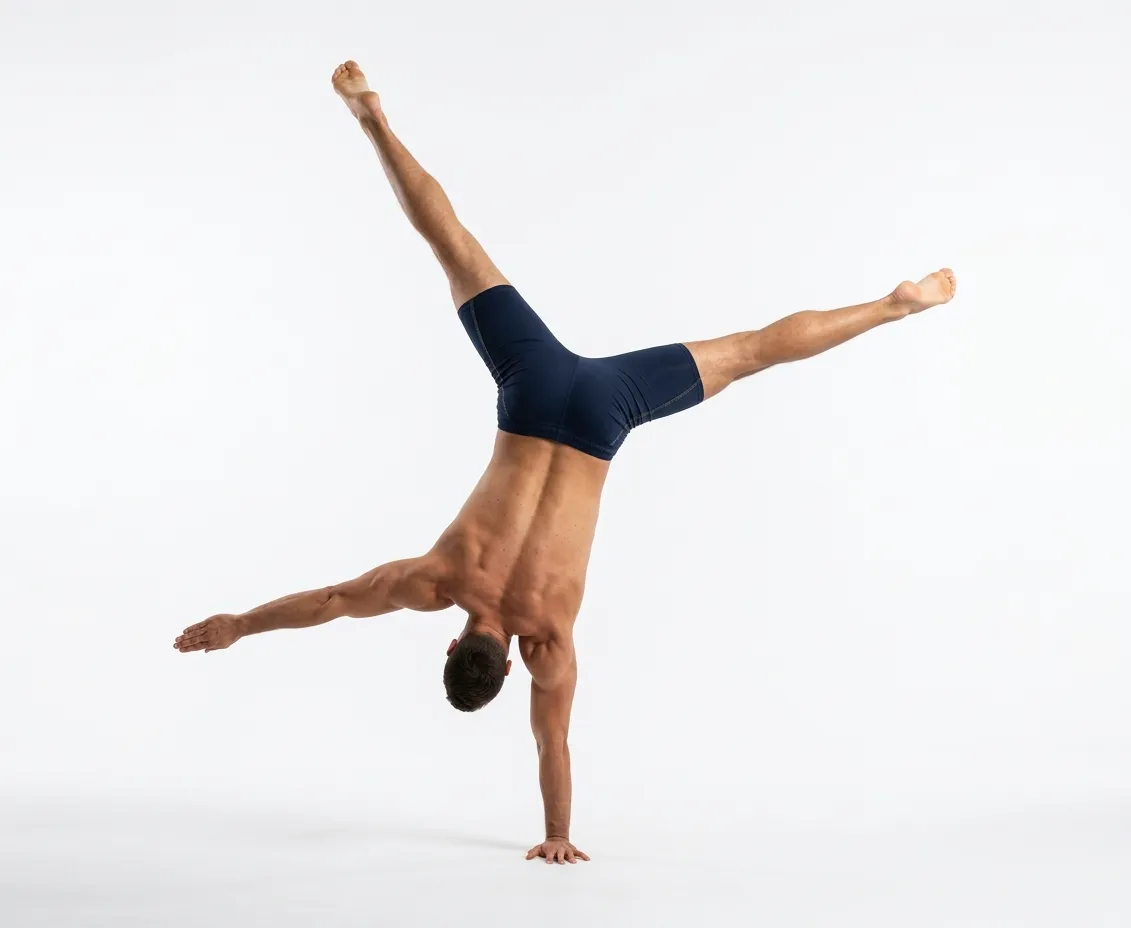
The one-arm handstand is one of the most coveted skills in calisthenics: a balance feat that demands years of practice, total body control, and the kind of patience that separates those who achieve it from those who quit. It is Level 10 in BodyTree's Handstands branch, the final node of a progression that starts with a wall, a hollow body, and the willingness to be upside down every day.
According to Overcoming Gravity, written in part by professional acrobat Yuri Marmerstein, you should realistically expect to train five to six days per week for a couple of years to achieve the balance and precision required. That is not a warning — it is a frame. This skill rewards daily practice more than any other in calisthenics.
What Is the One-Arm Handstand?
The one-arm handstand is a freestanding balance on a single arm with the body held in a controlled vertical line above it. Unlike strength skills such as the planche or front lever, balance is the primary limiting factor, not raw force production. The support arm must remain vertical, the shoulder locked into full active elevation, and every micro-correction made through the fingers of a single hand.
It sits at the end of BodyTree's Handstands branch, which progresses through Wall Handstand, Freestanding Handstand, and Freestanding HS with One-Arm Support before arriving here. Once unlocked, this node has no successor — it is the pinnacle of the branch.
Prerequisites
According to Overcoming Gravity, several prerequisites must be solid before one-arm handstand training begins:
- 60-second freestanding handstand. Not a personal record — consistently achievable, with minimal visible body movement and good alignment so that little corrective effort is required.
- Positional control in handstand. The ability to move head, shoulders, and legs deliberately while maintaining balance. If the handstand breaks whenever you shift attention elsewhere, the one-arm is not ready.
- Multiple leg positions. Proficiency in straight body, tuck, open straddle, and closed-hip straddle. The straddle is the standard entry point for one-arm work because it lowers your center of gravity and widens the base.
- Handstand walking. Walking on the hands forces dynamic weight shifting between hands, which is the core movement pattern of a one-arm hold, just faster and more chaotic.
- Press handstand from seated. This guarantees the shoulder strength and active flexibility needed to save a handstand that is tipping forward, and it builds the shoulder condition required for one-arm loading.
The Progression Chain
The path to the one-arm handstand is the full Handstands branch. Wall support removes balance entirely so you can build strength and alignment. Freestanding practice adds real two-arm balance. The one-arm support stage (removing fingers one at a time from a straddled weight shift) teaches the weight-transferring movement without yet demanding a full single-arm hold. The final step is lifting the free arm cleanly without disturbing the rest of the body.
Sets, Reps, and Training Frequency
The one-arm handstand is skill work, not strength work, and follows different rules. According to Overcoming Gravity, skill work should be approached like a warm-up: it must not leave you fatigued, because fatigue destroys the quality of movement that is being trained.
- Duration: 10 to 20 minutes of total practice per session, never to failure.
- Frequency: Daily or near-daily (5 to 6 sessions per week) produces faster adaptation than 2 to 3 times per week. Balance is a neurological skill that requires consistent, high-quality repetition to ingrain.
- Rep structure: Short attempts of 2 to 5 seconds, many sets, with full rest between each to maintain quality. The goal is not long holds to fatigue but clean, controlled attempts that build the pattern.
- Session quality: Stop on an off day when nothing is working. Grinding through bad sessions trains bad patterns and produces nothing useful.
Coaching Cues
- Straddle first. Learn one-arm balance in a straddle handstand. It lowers the center of gravity and widens the base, making balance corrections more forgiving. Closing the legs is a separate refinement developed later.
- Move the body, not the arm. To shift weight onto the support arm, move your hips and entire body laterally over that arm. Do not reach the arm outward. The support arm stays vertical; everything else shifts around it.
- Lock the shoulder. The supporting shoulder must remain in full active elevation throughout the shift and the hold. Losing shoulder tension during the weight shift is the most common cause of immediate collapse.
- Fingertip control through the ring finger. The center of balance in a one-arm handstand falls near the ring finger joint. Develop sensitivity in the ring and pinky fingers specifically — they do most of the steering.
- Lift the free arm in segments. Rather than swinging the free arm up all at once, lift it in a ballet-style sequence: elbow first, then forearm, then hand. This minimizes the disturbance to the rest of the body.
Common Mistakes
- Using a wall for one-arm practice. Wall one-arm handstands are not effective training for the actual skill. The wall provides support but teaches none of the wrist-level corrections that make freestanding one-arm balance possible. Use the floor with progressive finger reduction instead.
- Shifting the arm instead of the body. Reaching the support arm outward without moving the hips and body over it breaks the vertical force transfer line. The arm stays put; the body shifts.
- Swinging the free arm up. A fast, sudden lift of the free arm sends a shockwave through the body and breaks the balance. Lift slowly, in segments.
- Starting in a straight-body position. While some athletes do learn straight-body first, the straddle entry is far more reliable for most and is the standard recommendation in Overcoming Gravity.
- Training through persistent finger pain. The ring and pinky fingers take significant strain during this progression. Soreness that does not resolve overnight is a signal to rest, not push through.
Prehab and Longevity
The one-arm handstand places concentrated load on the wrist, elbow, and shoulder of the support arm. Overcoming Gravity is explicit: the ring and pinky fingers will become noticeably sore during skill acquisition. This is normal but must be managed carefully.
- Wrist conditioning baseline: The wall handstand and freestanding stages build wrist condition over months. Do not rush into one-arm work without that base. Wrist circles, finger extensions, and progressive handstand volume are the preparation.
- Hard floor or parallettes only: Advanced handstand practice belongs on hard floors or hand-balancing implements. Soft or compliant surfaces remove the tactile feedback that fingertip corrections depend on.
- Grip specificity: General grip work helps, but targeted strengthening of the ring and pinky fingers transfers most directly to one-arm balance. Rice bucket work and towel hangs are practical options.
- Rest when sore: If finger or wrist soreness does not resolve naturally within a day, take one to two sessions off. Returning fresh is always faster than grinding through pain and developing a chronic overuse injury.
Related Guides
Frequently Asked Questions
How long does it take to learn a one-arm handstand?
According to Overcoming Gravity's section by acrobat Yuri Marmerstein, expect to train five to six days per week for a couple of years. The timeline depends heavily on how solid your two-arm freestanding handstand is when you start.
Can you practice a one-arm handstand against a wall?
Not effectively. Wall one-arm handstands do not develop the wrist-level balance corrections that freestanding one-arm work requires. Use progressive finger reduction from a straddle handstand on the floor instead.
Should I learn it in a straddle or straight-body position?
Start in a straddle. It lowers your center of gravity and widens the base, making balance corrections more forgiving. Straight-body one-arm handstands are a refinement to develop once the straddle version is solid.
What comes after the one-arm handstand?
The one-arm handstand is the pinnacle of BodyTree's Handstands branch. Beyond it: one-arm press handstands, controlled movement in one-arm balance, straddle-to-straight transitions, and transferring the skill to parallettes and rings.
BodyTree tracks your progression through all 251 calisthenics skills — automatically generated programs, video proof, and a community of serious practitioners.
Get BodyTree — Free on iOS & Android