Wall Headstand Pushup: How to Learn It
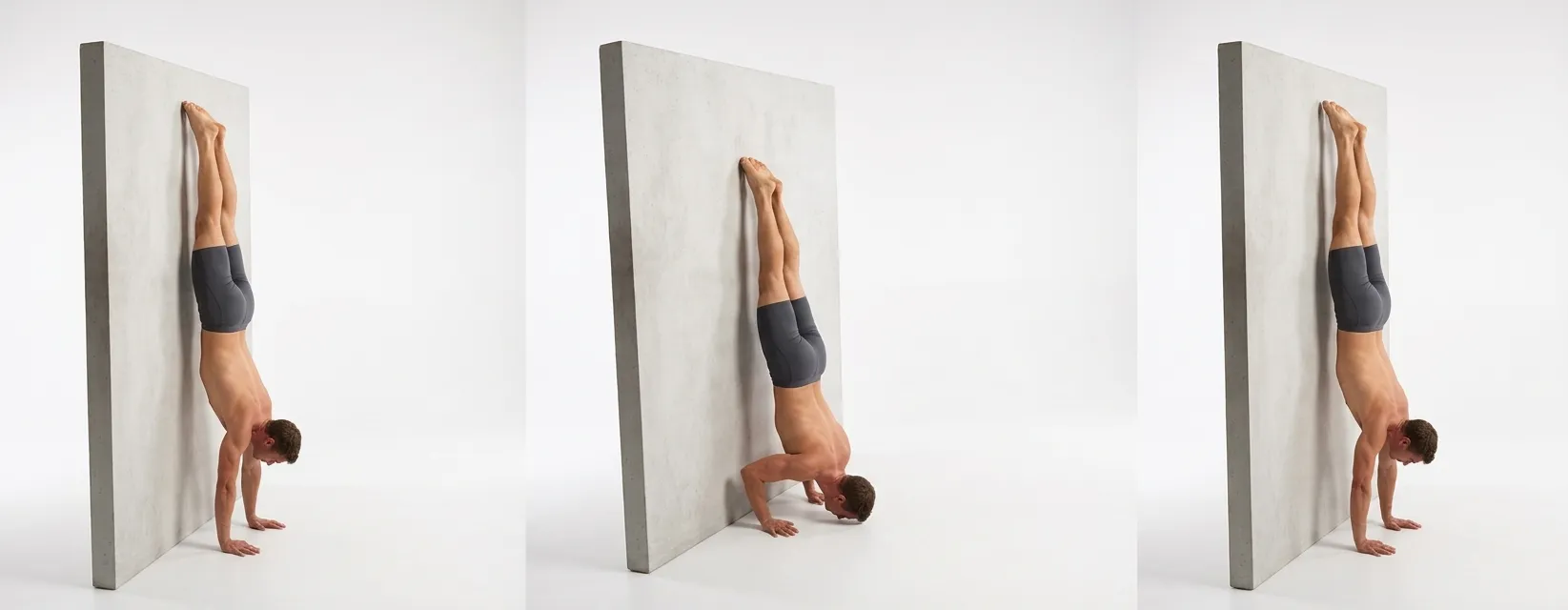
The wall headstand pushup is what most people picture when they hear the words handstand pushup. You lower head-to-floor against a wall and press back to a straight-body lockout. According to Overcoming Gravity it is not a true handstand pushup, because your head touching the floor stops the range early, but it is still a genuine feat of overhead pressing strength and body control. It is Level 4 of the Handstand Pushups branch, and it is the last stop before the range of motion opens up on parallettes.
What Is the Wall Headstand Pushup?
The wall headstand pushup is a full-range headstand pushup performed with your body straight and your heels resting lightly against a wall. You begin in a wall handstand, close the shoulder angle while bending the elbows, and lower in one uniform line until the crown of your head lightly touches the floor. Then you press back to a locked overhead position. The wall is not there to hold your weight; it is there to keep your line honest so your shoulders and triceps do the work instead of your balance.
Prerequisites
Before training the concentric, you should own the level below it: the wall headstand pushup eccentric for 3 sets of 5 controlled lowers. That eccentric base is what makes the first clean press possible. You should also be comfortable holding a wall handstand with a straight body and a hollow line, since a soft, arched hold at the start becomes a worse arch under fatigue.
The Progression Chain
Each step raises the pressing demand: the pike and box variations shift more weight onto the hands, the eccentric teaches the lowering path, and this level joins them into a full concentric rep. The next step, the wall handstand pushup, elevates your hands on parallettes so your head can drop below hand level, adding the range this variation cuts short.
Sets, Reps, and Training Frequency
Progression standard in BodyTree is 3 sets of clean full-range reps. Overcoming Gravity frames overhead pressing work around roughly 5 to 8 quality repetitions per set for most people; bias lower (closer to 5) when strength is the goal. Train vertical pressing 2 to 3 times per week with at least a day between sessions, since 48 to 72 hours is the typical recovery window for this kind of work. Chase clean reps, not a rep count: the book is explicit that your goal is awareness and strength in the primary movers, not the most repetitions you can grind out.
Coaching Cues
- Ride the scapular rhythm. Start with your shoulder blades elevated. As your head descends they naturally depress and travel forward with your elbows; on the way up, finish elevated again, covering your ears like earmuffs at lockout.
- Keep elbows tracking near your sides. Flaring feels stronger because it recruits the traps, but it steals the forward-back stability you will need for freestanding work later.
- Lower in one uniform line. No collapse at the bottom, no fast drop. Let the head touch lightly, then press.
- Only your heels touch the wall. If the back of your head grazes the wall above you, you are arching.
Common Mistakes
- Arching the back. Overcoming Gravity calls this the biggest problem in headstand pushups. When you arch, the trapezius and chest take over as the shoulder angle closes, building strength in the wrong pattern and dulling your sense of where your body is in space.
- Letting fatigue drive form. As you tire it feels almost natural to pull in other muscles to finish a rep. That cements incorrect neural patterns. Stop the set when your line breaks, not when you fail.
- Partial depth. If the head does not reach the floor, you are training partial-range strength that will not carry to the deeper positions ahead.
Related Guides
Frequently Asked Questions
Is a wall headstand pushup a real handstand pushup?
Not quite. Overcoming Gravity notes that because your head touching the floor stops the range early, it is not a true handstand pushup. It is still a serious overhead pressing feat and the standard step before the full-range wall handstand pushup on parallettes.
Why do my elbows want to flare out?
Flaring recruits the traps and feels stronger, which is exactly why it is tempting under fatigue. Keeping elbows near your sides is harder but builds the forward-back stability required for freestanding handstand pushups later, so keep them tucked.
How do I add range once this feels easy?
Move to the wall handstand pushup: raise your hands on parallettes or blocks so your head can drop below hand level. If the full range is too hard at once, use eccentrics or place your head over a slightly elevated surface and lower the height as you get stronger.
BodyTree tracks your progression through all 251 calisthenics skills — automatically generated programs, video proof, and a community of serious practitioners.
Get BodyTree — Free on iOS & Android