
Rings Wide Pushups: Your First Ring Press
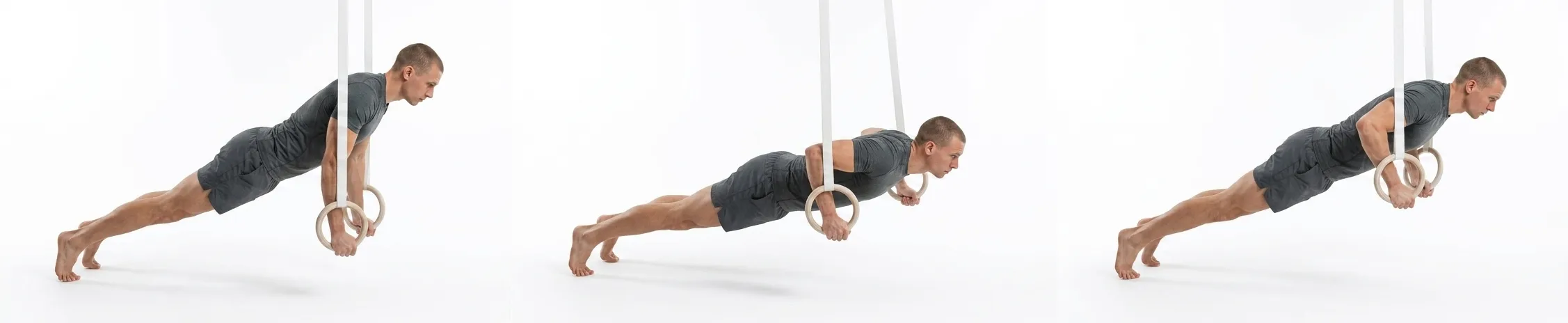
If you have never touched a set of gymnastic rings, this page is still for you. Rings wide pushups look intimidating because the handles move, but the movement underneath is the push-up you already know. Nothing about them requires a gym, a coach, or a background in training. The rings simply refuse to hold still, and learning to make them hold still is what builds the shoulder control that carries every later pressing skill. If you cannot do a floor push-up yet, that is completely fine. Start at wall pushups, work down to the floor over a few weeks, and come back. Nobody skips that part.
What Are Rings Wide Pushups?
A rings wide pushup is a push-up performed with your hands on two gymnastic rings set slightly wider than your shoulders instead of flat on the floor. You lower until your chest drops below the level of the rings, then press back to a straight-arm lockout while keeping the rings from wandering.
Two things change compared to a floor push-up. First, the rings hang freely, so your shoulders and upper back have to actively hold the line of the movement rather than borrowing stability from the ground. Second, hanging handles let your chest travel below your hands, which adds range of motion a floor push-up cannot give you.
The wide hand position is the friendly version. Setting the rings wider than shoulder width shortens the leverage your shoulders have to control, so the rings feel less like they are trying to escape. That is exactly why this step sits before Rings Pushups in the chain and not after: it is the on-ramp, not a harder variation.
In BodyTree this move lives in the Pushups branch at level 5, the first rung of that branch that leaves the floor behind.
Prerequisites
You are ready to start when you own the floor. Concretely, that means:
- Three sets of fifteen standard pushups with your chest touching the floor and full lockout at the top. That is the unlock standard for the step before this one.
- Three sets of fifteen diamond pushups, which is the direct previous link in the chain and the reason your triceps will not be the thing that fails you on rings.
- A pain-free wrist and elbow under load. Rings are actually kinder here than the floor, because your hands are free to rotate rather than locked flat, but any nagging joint is worth calming down before you add instability.
You do not need a hollow-body hold, a dead hang, or any strength number beyond the two above. If you have all of that, the only new skill is balance.
The Progression Chain
The push-up branch starts standing at a wall and ends at some of the hardest pressing skills in calisthenics. Every step keeps the same movement and changes one variable: how much of your bodyweight you are pressing, how long the lever is, or how much the surface helps you.
Rings wide pushups are where the surface stops helping. Behind you, all four steps are floor work you can do in a bedroom. Ahead of you, Rings Pushups narrows the hands to shoulder width, and the levels beyond that turn the rings out and lean the body forward toward pseudo planche work. Each of those is a small, specific change to the same press.
A useful way to hold the whole chain in your head: the floor teaches you the movement, the rings teach you to own it.
How to Make Them Easier on Day One
This is the part most people miss, and it is the difference between a productive first session and a frustrating one. Rings wide pushups have a built-in dial: ring height.
Set the rings at hip height and stand with your feet well back. Your body is on a shallow incline, you are pressing a fraction of your weight, and the rings still wobble, so you still get the whole point of the exercise. Lower the rings and walk your feet back a little further each week. When the rings are just above the floor and your body is horizontal, you are doing the full move.
This is a genuine regression, not a compromise. An incline ring push-up you can control for ten smooth reps builds far more than a horizontal one you survive for three. Chase control first, height second.
Sets, Reps, and Frequency
The unlock standard in BodyTree is three sets of fifteen reps with clean form, which is when the app opens the next step in the branch.
Getting there:
- Start at three sets of five at a ring height you can genuinely control, resting two to three minutes between sets.
- Add a rep or two per set each week rather than adding sets. Slow, boring progress in the same exercise is what actually accumulates.
- When fifteen feels easy, lower the rings and drop back to five reps. That reset is progress, not a step backwards.
- Train pressing two to three times a week with at least a day in between. Rings are a coordination skill as much as a strength one, and skills like frequent, fresh practice.
Keep a rep or two in reserve on most sets. Ring stability collapses before your muscles do, and reps taken past that point are practising a wobble rather than a press.
Pair your pressing with a similar amount of pulling. Pushing far ahead of pulling is one of the most reliable ways to make a shoulder unhappy over months, and the fix is simply keeping the two roughly level. Ring rows on the same set of rings are the obvious partner.
Coaching Cues
- Rings slightly wider than your shoulders. Wider is easier here. Resist the urge to narrow them until the whole rep looks calm.
- Squeeze the rings and press them slightly toward each other the entire set. Actively pulling them inward is what stops the shaking.
- Straight line from head to heels. Squeeze your glutes and brace your midsection so your hips do not sag or pike.
- Elbows about thirty to forty five degrees from your body, not flared straight out to the sides.
- Chest below ring level at the bottom. This depth is the reward rings give you, so use it.
- Full lockout at the top, with the rings still and your shoulder blades set. Finish every rep.
- Move slowly. A two second lowering and a controlled press look unimpressive and build far more than a fast one.
Common Mistakes
- Going horizontal on day one. The rings are new; the incline is your friend. Most people who bounce off this exercise skipped the dial.
- Letting the rings drift apart. If the hands separate under load, the set is over. Press inward and reset.
- Sagging hips. Instability tempts you into a soft midsection. Brace as hard as you would in a plank.
- Cutting depth. Stopping at hand level throws away the only advantage rings offer over the floor.
- Chasing rep numbers with a shaky rep. Quality of stabilization is the actual adaptation here.
- Pressing far more than you pull. Keep a row in the routine for every push.
Prehab and Longevity
Rings are generally friendlier to joints than the floor, because your hands and forearms are free to find their own rotation instead of being pinned flat. That freedom is only an advantage if you build up to the load gradually.
Two habits worth keeping for as long as you train:
- Warm the wrists and elbows before pressing. A couple of minutes of gentle wrist circles, forearm stretches on the floor, and light banded or bodyweight elbow work is enough. Low intensity, higher repetitions.
- Add light rotator cuff and upper back work. The muscles at the back of the shoulder are the ones that quietly hold a pressing shoulder together, and they respond well to easy, high repetition sets rather than heavy ones.
Tendons and connective tissue adapt more slowly than muscle, and what they respond to is consistent, meaningful load over time rather than any single clever exercise. That is the argument for adding one rep a week instead of four, and for treating a month of unglamorous sets as the plan rather than the delay before the plan.
If something sharpens into real pain rather than fatigue, back off the ring height, reduce the volume, and give it time. Nagging pain that does not settle is worth a conversation with a medical professional rather than a harder week.
Related Guides
Frequently Asked Questions
Are rings wide pushups harder than normal pushups?
Yes, but mostly for a different reason. The rings move, so your shoulders and upper back have to stabilize the press instead of leaning on the floor. Set the rings at hip height and stand your feet back and they become easier than a floor push-up, which is exactly how you should start.
Do I need rings at home to train this?
You need a set of gymnastic rings and something overhead to hang them from, such as a pull-up bar, a beam, or a sturdy tree branch. Rings are one of the cheapest pieces of training equipment there is, and the same pair covers rows, dips, and support holds.
Why wide instead of shoulder width?
Wider hands shorten the leverage your shoulders have to control, so the rings feel steadier. It is the on-ramp to ring pressing. Narrowing to shoulder width is the next step in the chain, not a shortcut you should take early.
How long will it take to get three sets of fifteen?
For someone who already owns floor pushups, eight to twelve weeks of pressing twice a week is a realistic window. Progress is faster at the start, when most of what you gain is coordination rather than strength.
BodyTree tracks your progression through all 251 calisthenics skills — automatically generated programs, video proof, and a community of serious practitioners.
Get BodyTree — Free on iOS & Android